

Our Verdict
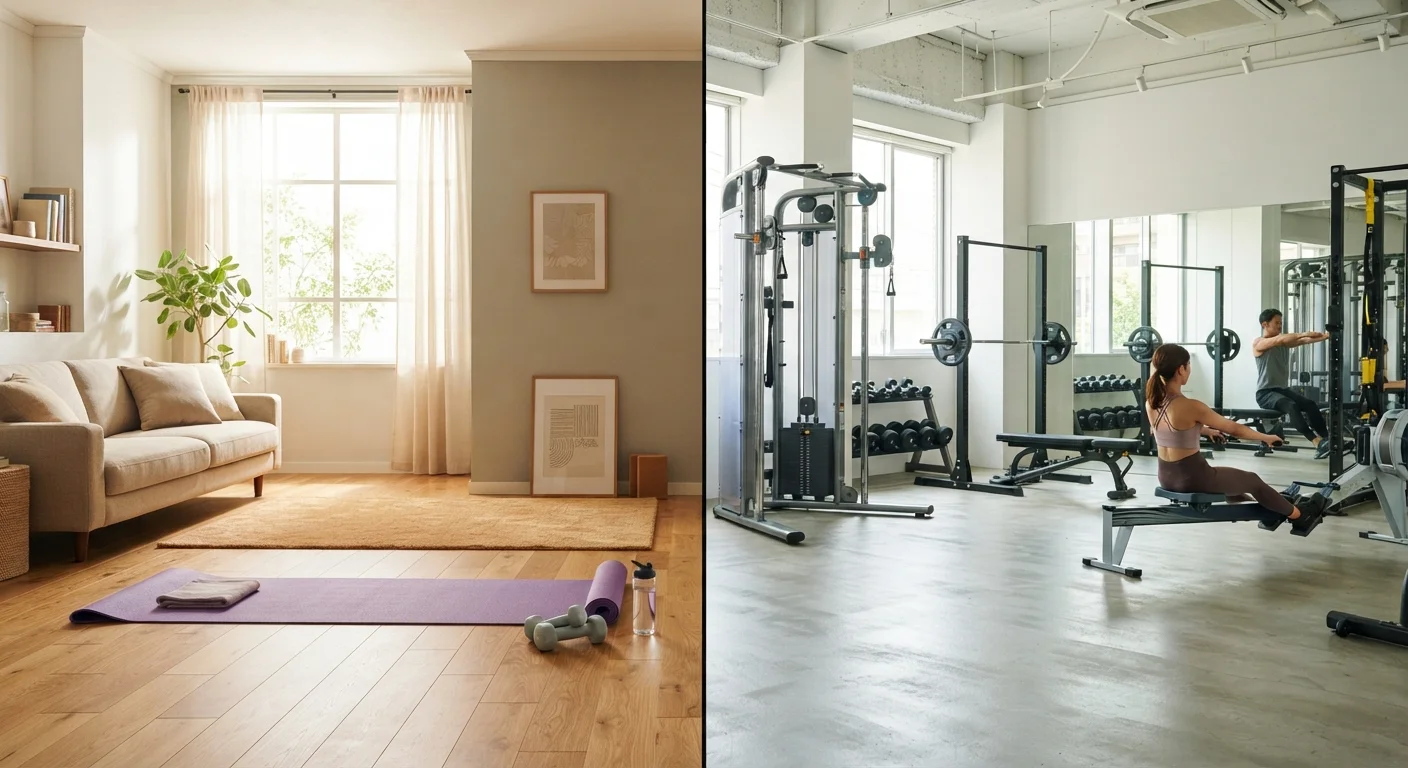
Home workouts and gym training can both produce real, lasting fitness results when done consistently. The best environment is the one you'll actually show up for, week after week. Rather than seeking the objectively 'better' option, focus on which setting removes friction from your routine and keeps you engaged over the long term.
| Best for | Recommended |
|---|---|
| Those working within strict time or cost constraints | Home Workouts |
| Those pursuing structured strength or sport-specific training | Gym Training |
| Those who thrive on social energy and external accountability | Gym Training |
| Those who value flexibility and minimal setup | Home Workouts |
The Core Question: Where Will You Actually Show Up?
When comparing home workouts to gym training, the most important variable isn't equipment or programming - it's adherence. Research consistently shows that the fitness routine people stick with over time produces better outcomes than the theoretically optimal one they abandon after six weeks.
That said, each setting has genuine, practical differences worth understanding before you commit. If you're rebuilding activity from a long break, see our guide to starting exercise after years of inactivity for a low-pressure starting point. For everyone else, here's an honest look at what each environment actually offers.
| Home Workouts | Gym Training | |
|---|---|---|
| Upfront Cost | Low - minimal equipment needed | Moderate - membership fees apply |
| Ongoing Cost | Near zero | Monthly or annual fees |
| Convenience | Very high - no commute required | Depends on proximity and hours |
| Equipment Variety | Limited without investment | Extensive, including specialist machines |
| Social Motivation | Low - self-driven environment | High - community and classes available |
| Scalability for Advanced Goals | Limited at higher levels | Strong - progressive overload supported |
| Flexibility of Schedule | Total - train any time | Constrained by facility hours |
Cost, Access, and Convenience
Home workouts have a clear financial edge. Beyond a modest one-time investment in basics like resistance bands, a mat, or a set of adjustable dumbbells, ongoing costs are essentially zero. Gym memberships, by contrast, typically carry monthly fees, and some facilities add initiation charges or require contracts.
Convenience cuts even deeper than money. A home setup eliminates commute time, locker room logistics, and the need to schedule around facility hours. This can be the deciding factor for people with unpredictable schedules, caregiving responsibilities, or long commutes. On the other hand, gyms offer access to equipment that would be prohibitively expensive to replicate at home - cable machines, barbells with heavy plate stacks, and specialized training apparatus.
Start With What You'll Actually Use
If you're deciding between settings, run a two-week trial rather than making a long-term commitment immediately. Track how often you complete sessions in each environment. Frequency and consistency are more predictive of results than any single factor. Hybrid approaches - gym on certain days, home on others - are a practical middle ground many people find sustainable.
Exercise Variety and Training Effectiveness
A gym's equipment range supports a wider spectrum of training modalities. If your goals include heavy compound lifting, machine-assisted hypertrophy work, or sport-specific conditioning, a well-equipped facility gives you tools that home setups rarely match. For those weighing the distinct benefits of cardio versus resistance work, our breakdown of cardio vs. strength training can help clarify what each approach does for your health.
Home workouts, however, are far more capable than many assume. Bodyweight training, resistance bands, and minimal free weights can address strength, endurance, mobility, and cardiovascular fitness effectively for the majority of people - especially those at beginner and intermediate levels. The limitations become more apparent at advanced training stages where progressive overload requires heavier loads than a home setup can provide.
Don't overlook simpler options either. Walking as a form of exercise carries real, research-supported benefits that require no gym and no equipment at all.
Motivation, Social Dynamics, and Mental Barriers
Environment shapes behavior. Many people find that entering a gym signals a mental shift into workout mode - the social atmosphere, the presence of others exercising, and even the ambient energy can function as natural motivators. Group classes layer in structured accountability that some individuals find essential.
Home training flips this dynamic. Without external social pressure, self-discipline carries more weight. Some people thrive in this autonomous setting; others find it easy to talk themselves out of a session when the couch is three feet away. Understanding your own motivational style honestly is arguably more useful than any equipment comparison.
It's also worth examining assumptions you might hold about what fitness requires. Common exercise myths - like needing a full hour or perfect equipment - keep many people from getting started at all, regardless of where they train.
~50%
Adults who drop exercise within 6 months
Research on exercise behavior consistently finds that roughly half of people who begin a new fitness routine discontinue within six months, highlighting that adherence is the central challenge.
150 min
Weekly moderate activity recommended
Current U.S. physical activity guidelines recommend at least 150 minutes of moderate-intensity aerobic activity per week for adults - achievable in either a home or gym setting.
Tracking Progress in Either Setting
Progress is measurable in both environments, and neither setting has a monopoly on meaningful feedback. Strength gains, improved endurance, better sleep quality, and increased energy are all trackable outcomes that appear whether you train at home or at a gym. If you're unsure how to gauge whether your routine is working, explore ways to measure fitness progress beyond the scale - these markers are often more motivating and more accurate than weight alone.
Many people find the most sustainable long-term approach is a hybrid one: using home workouts for convenience on busy days and the gym for structured sessions when time and energy allow. There is no rule requiring an either-or commitment.
This article is for general informational purposes only and does not constitute medical or fitness advice. Consult a qualified healthcare or fitness professional before beginning any new exercise program, especially if you have existing health conditions.
The content provided on our blog site traverses numerous categories, offering readers valuable and practical information. Readers can use the editorial team’s research and data to gain more insights into their topics of interest. However, they are requested not to treat the articles as conclusive. The website team cannot be held responsible for differences in data or inaccuracies found across other platforms. Please also note that the site might also miss out on various schemes and offers available that the readers may find more beneficial than the ones we cover.