

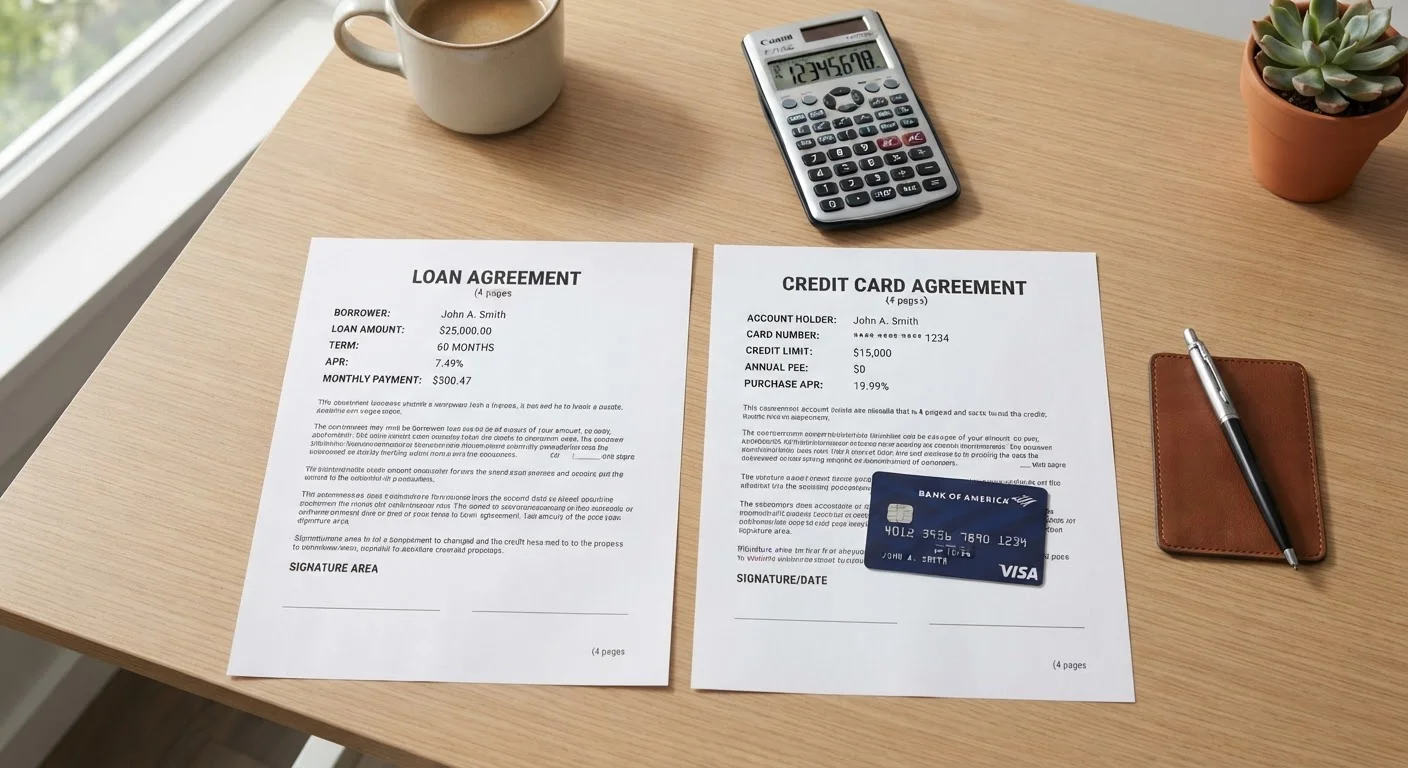
Option A
Balance Transfer Credit Card
The promotional-rate window for disciplined payoff.
Best for: People who can realistically pay off their balance before a promotional 0% APR period ends.
Option B
Personal Loan
The fixed-structure path to a clear payoff date.
Best for: People who want predictable monthly payments and a defined end date, regardless of credit card discipline.
How Each Tool Actually Works
When people talk about using a credit card or a personal loan to pay off debt, they usually mean one of two specific strategies: a balance transfer card (moving existing debt onto a new card with a promotional low or 0% APR) or a personal loan (borrowing a lump sum at a fixed rate to pay off existing balances). Both are forms of debt consolidation - but the mechanics differ significantly.
A balance transfer card extends a temporary promotional rate, often 0%, for a set window - commonly 12 to 21 months. Once that period ends, the remaining balance shifts to the card's standard variable APR, which can be considerably higher. You're essentially racing the clock. A transfer fee of roughly 3-5% of the moved balance applies upfront in most cases.
A personal loan works differently. You borrow a fixed amount, agree to a fixed interest rate, and repay it in equal monthly installments over a set term - typically 2 to 7 years. There's no promotional window to beat and no variable rate lurking. Some lenders charge an origination fee (often 1-8% of the loan amount), which may be deducted from your funds or added to the loan balance. For a broader look at how different debt types are structured, see the full picture of American debt.
| Criterion | Balance Transfer Card | Personal Loan |
|---|---|---|
| Interest rate structure | Promotional 0% APR, then variable | Fixed APR for entire loan term |
| Typical fee | 3-5% transfer fee upfront | 0-8% origination fee (varies by lender) |
| Repayment timeline | Flexible (revolving); promo ends in 12-21 months | Fixed term, typically 2-7 years |
| Monthly payment | Variable minimum; you set the pace | Fixed installment every month |
| Risk of rate increase | High - rate spikes after promo ends | None - rate locked at origination |
| Credit score impact | Affects utilization ratio; hard inquiry | Adds installment account; hard inquiry |
| Discipline required | High - must avoid new charges and beat deadline | Moderate - fixed schedule does the structure for you |
Interest, Fees, and the Real Cost Comparison
The promotional 0% APR on a balance transfer card sounds hard to beat - and mathematically, it can be, if you pay off the full balance before the window closes. But several factors complicate that picture.
First, the transfer fee is immediate. Moving $5,000 at a 3% fee costs $150 on day one. Second, if any balance remains when the promotional period ends, the remaining debt accrues interest at the card's standard APR - which for many cards is well above 20%. Missing a payment can also void the promotional rate in some cases. Finally, if you continue using the card for new purchases, those charges may not carry the same promo rate and can muddy your payoff timeline.
Personal loans don't have a promotional trap, but they aren't free either. The interest rate you receive depends heavily on your credit profile. Borrowers with higher credit scores generally access lower rates; those with limited or damaged credit histories may find loan APRs that aren't meaningfully better than their current card rates. Origination fees also reduce the effective amount you receive, so it's worth calculating the APR - not just the stated interest rate - when comparing offers. If you're unclear on these terms, our debt and credit glossary defines APR and related concepts plainly.
20%+
Typical credit card APR after promo ends
The Federal Reserve tracks average credit card interest rates, which have remained above 20% for general-purpose cards in recent years.
3-5%
Standard balance transfer fee range
Most balance transfer cards charge a percentage of the transferred amount as a one-time upfront fee, according to broadly available card terms.
12-21 months
Common promotional APR window length
Promotional 0% APR periods vary by card issuer; longer windows typically require stronger credit qualifications.
Eligibility, Credit Impact, and What to Watch For
Both products require a credit check, and both can affect your credit score. Applying for either typically triggers a hard inquiry, which may cause a small, temporary dip in your score. Beyond that, the effects diverge.
A balance transfer card adds a new revolving account. If the card has a high credit limit and you transfer a relatively small balance, your overall credit utilization ratio - a key scoring factor - may improve. But if the new card's limit is low and the balance is large, utilization could spike and hurt your score in the short term. Opening a new account also lowers your average account age, which can affect scoring models.
A personal loan adds an installment account to your credit mix, which can be a positive signal for some scoring models. Making consistent on-time payments over the loan's life builds a positive payment history. However, paying off the loan closes the account, which can slightly reduce your score at payoff - a counterintuitive but real effect.
Qualification thresholds vary by lender. Generally, stronger credit opens access to lower rates on personal loans and higher-limit balance transfer cards with better promotional terms. If your credit is in fair or poor territory, the terms on either product may be less favorable. Consider pairing whichever tool you choose with durable repayment habits - our guide to keeping debt manageable over time covers practical approaches that hold up long-term.
This article is for general informational purposes only and does not constitute personalized financial, tax, or legal advice. Consult a qualified financial professional before making decisions about your specific situation.
Neither Tool Fixes the Root Cause
Balance transfer cards and personal loans restructure existing debt - they don't eliminate the behaviors or circumstances that created it. If spending habits or income gaps aren't addressed alongside the strategy, new debt can accumulate on top of the consolidated balance. Pairing either tool with a concrete payoff plan - such as the approaches outlined in our debt avalanche vs. debt snowball comparison - improves the odds of lasting results.
The content provided on our blog site traverses numerous categories, offering readers valuable and practical information. Readers can use the editorial team’s research and data to gain more insights into their topics of interest. However, they are requested not to treat the articles as conclusive. The website team cannot be held responsible for differences in data or inaccuracies found across other platforms. Please also note that the site might also miss out on various schemes and offers available that the readers may find more beneficial than the ones we cover.