

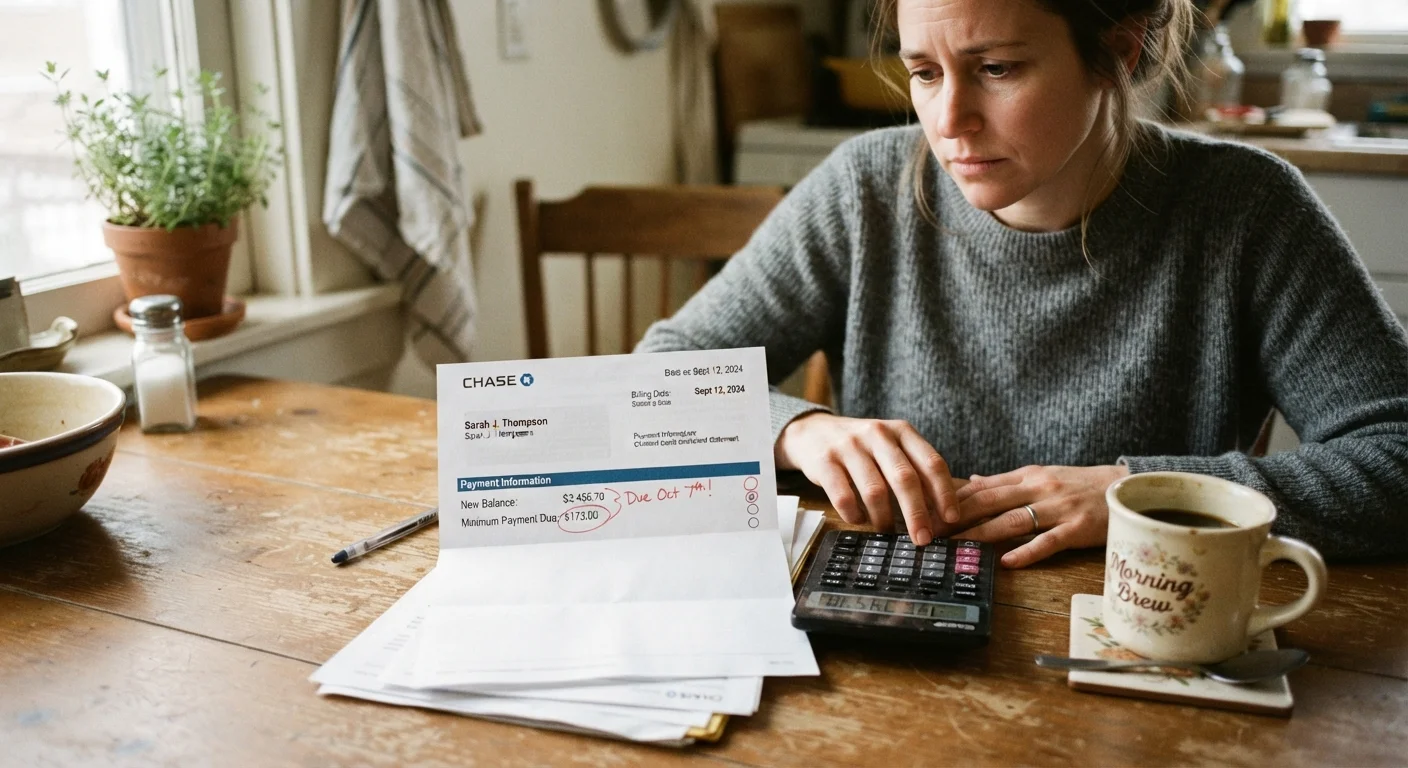
How the Minimum Payment Trap Works
Credit card minimum payments are engineered to be manageable - sometimes deceptively so. A $3,000 balance might carry a minimum payment of $60 or $75. That number feels reasonable until you understand that at a typical annual percentage rate (APR) above 20%, most of that payment is immediately absorbed by interest charges. The portion actually reducing your principal balance can be as little as $10-$20.
Federal law requires card issuers to print a minimum payment warning on every statement. This disclosure tells you exactly how many years it will take to clear your balance paying only the minimum, and the total interest you'll pay. Most people skip past it. That single number - sometimes 10, 15, or even 20 years for a moderate balance - is worth reading carefully.
Minimum Payments Are Not a Payoff Plan
Credit card issuers set minimum payments low - often 1-3% of your balance - because it maximizes the interest you pay over time. Treating the minimum as your target payment is one of the costliest financial habits a household can have. The minimum keeps your account in good standing, but it does almost nothing to shrink what you owe.
For readers trying to build better overall spending habits, revisiting your budgeting basics is a useful starting point before tackling debt repayment.
Common Mistakes That Keep Balances Growing
Most people aren't making one catastrophic error - they're making several small ones simultaneously. Each mistake on its own seems minor, but together they can keep a household in revolving debt for years.
Treating the minimum payment as the monthly goal rather than the absolute floor.
Why it happens: The minimum is the most visible number on the statement and feels like the 'required' amount, so many people default to it without considering what it actually costs them long-term.
Ignoring how daily compounding makes balances grow faster than expected.
Why it happens: Most people think of interest as a monthly charge, but most card issuers calculate it daily using your average daily balance. The distinction is easy to miss because the charge only appears on your monthly statement.
Adding new charges to a card while trying to pay down an existing balance.
Why it happens: People often view credit cards as a convenience tool and don't mentally separate 'paying off old debt' from 'using the card today,' especially when cash flow is tight.
Having no structured payoff strategy across multiple cards.
Why it happens: When multiple balances compete for limited funds, it's tempting to spread payments evenly or pay minimums everywhere - which prolongs every debt simultaneously.
Overlooking how subscription charges and small recurring costs inflate card balances.
Why it happens: Automated charges feel invisible until the statement arrives, and by then the damage - in the form of a higher balance accruing interest - is already done.
New Purchases Restart the Interest Clock
If you carry a balance and keep using the card, each new charge begins accruing interest almost immediately. This means you can be making monthly payments and still watch your balance grow. Pausing new charges on a card you're actively trying to pay down is one of the most practical steps you can take.
If you're managing several cards at once and not sure where to focus, debt consolidation is one option worth understanding - though it carries its own trade-offs. And once you've made progress, building habits that keep debt manageable over time will help you avoid sliding back.
What Actually Moves the Needle
The math behind credit card debt strongly favors the borrower who pays more than the minimum, even modestly. Adding an extra $50 per month to a $3,000 balance at a 22% APR can cut years off repayment and save several hundred dollars in interest - without requiring a dramatic budget overhaul.
20%+
Average credit card APR in the US
The Federal Reserve has tracked average credit card interest rates exceeding 20% in recent years, making carried balances extremely expensive over time.
2-3%
Typical minimum payment as a share of balance
Most issuers set minimums at 1-3% of the outstanding balance or a flat dollar floor, whichever is greater - a formula that maximizes repayment duration.
~$1,000
Potential interest on a $3,000 balance paid at minimum
General consumer finance calculations show that carrying a $3,000 balance at a high APR and paying only the minimum can result in hundreds to over a thousand dollars in interest charges before the debt is cleared.
The practical steps are straightforward: identify your highest-interest balance, commit to a fixed payment above the minimum each month, and stop adding new charges to that card while paying it down. None of this requires perfection. It requires a decision and a consistent follow-through. Thinking of your payment as a fixed expense - like rent or utilities - rather than a flexible line item makes it easier to protect.
Debt has a way of feeling abstract until you run the actual numbers. When you do, the case for paying more than the minimum is impossible to ignore. This article is for general informational purposes only and is not personalized financial advice. Consider speaking with a licensed financial counselor or adviser about your specific situation.
The content provided on our blog site traverses numerous categories, offering readers valuable and practical information. Readers can use the editorial team’s research and data to gain more insights into their topics of interest. However, they are requested not to treat the articles as conclusive. The website team cannot be held responsible for differences in data or inaccuracies found across other platforms. Please also note that the site might also miss out on various schemes and offers available that the readers may find more beneficial than the ones we cover.