

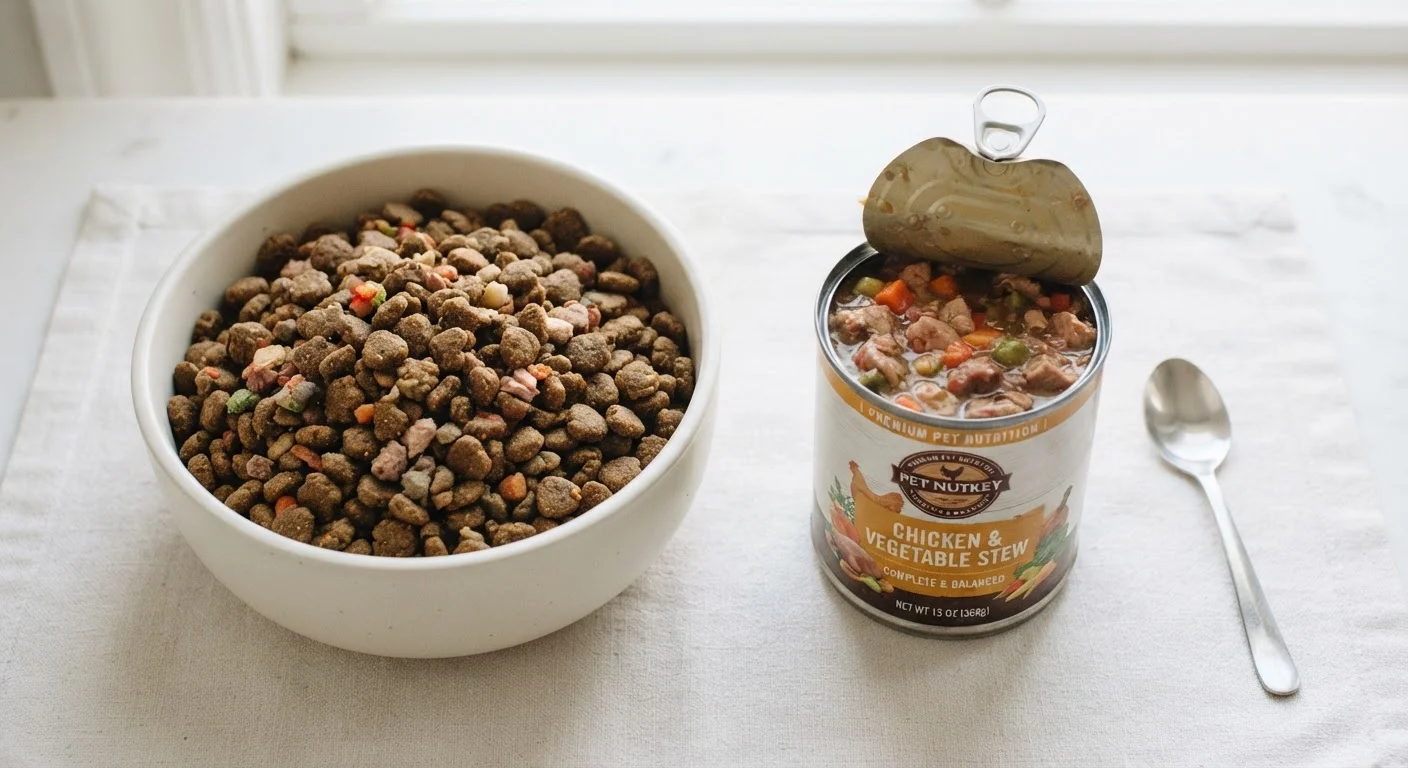
Option A
Dry Kibble
The convenient, shelf-stable staple of pet feeding.
Best for: Pet owners seeking an affordable, easy-to-store option with potential dental benefits.
Option B
Wet / Canned Food
The moisture-rich, palatable alternative to dry feeding.
Best for: Pets with hydration concerns, urinary issues, dental problems, or picky eating habits.
What's Actually Inside Each Format
At the manufacturing level, dry kibble and wet canned food start from similar raw ingredients - meats, grains or legumes, fats, vitamins, and minerals - but their processing diverges sharply. Kibble is cooked at high heat and pressure through a process called extrusion, then dried to a moisture content of roughly 6-10%. Canned food is cooked inside a sealed container at lower temperatures and retains most of its natural moisture, typically landing between 70-82% water by weight.
That moisture difference has a cascading effect on everything else. On a dry matter basis - meaning nutrients compared after removing water - many wet and dry foods are nutritionally comparable in protein, fat, and carbohydrate ratios. Where they genuinely differ is in caloric density per gram and how much a pet needs to eat to meet its daily energy requirements. A single cup of dry kibble delivers far more calories than the same volume of wet food, which is mostly water.
For a deeper look at how species biology shapes these needs differently, see our breakdown of cat versus dog nutrition.
| Criterion | Dry Kibble | Wet / Canned Food |
|---|---|---|
| Moisture content | ~6-10% | ~70-82% |
| Caloric density | High (more calories per gram) | Lower (mostly water by weight) |
| Shelf life (unopened) | 12-18 months, easy to store | 2-5 years canned; refrigerate after opening |
| Cost per serving | Generally lower | Generally higher |
| Palatability | Moderate; varies by formula | High; stronger aroma appeals to picky eaters |
| Dental benefit | Minimal unless prescription dental formula | No mechanical dental benefit |
| Hydration support | Low; pets must drink separately | High; supports daily fluid intake |
| Best suited for | Healthy pets, active dogs, multi-pet households | Cats, senior pets, urinary/kidney concerns |
Hydration, Dental Health, and Digestibility
Hydration is where the gap between formats matters most - particularly for cats. Cats evolved in arid environments and have a blunted thirst response; they tend to drink less water than they need when fed exclusively dry food. Research suggests cats on wet diets consume roughly twice as much total water as cats on dry-only diets. For cats prone to lower urinary tract issues or early-stage kidney disease, increasing moisture intake through food is often one of the first recommendations veterinarians make.
Dogs are less vulnerable to hydration shortfalls since they drink more readily, but wet food can still support dogs with kidney disease or those in hot climates.
The dental health picture is more nuanced. Dry kibble is commonly promoted as better for teeth, and while some prescription dental diets have demonstrated plaque-reducing benefits, standard kibble's effect on oral health is modest at best. Most kibble shatters on contact and doesn't provide meaningful mechanical scrubbing. Veterinary dental associations generally consider dedicated dental chews and brushing more effective than food format alone.
Digestibility is roughly similar between formats for most healthy pets, though some animals with sensitive gastrointestinal tracts tolerate one over the other. If a pet shows signs of digestive upset - loose stools, vomiting, or gas - after a food change, consult a veterinarian before attributing it to format alone.
~2×
More total water intake in cats on wet diets
Studies comparing cats fed wet versus dry food consistently show approximately double the total water consumption on wet diets, including water drunk from bowls.
70-82%
Moisture content in typical wet pet food
Compared to just 6-10% in dry kibble, this difference in water content drives most of the practical distinctions between the two formats.
AAFCO
The nutritional standard to look for on any label
The Association of American Feed Control Officials sets minimum nutrient profiles; a "complete and balanced" AAFCO statement is the clearest signal of a nutritionally adequate pet food.
Reading Labels: What to Look For Regardless of Format
The single most important marker on any pet food - wet or dry - is the AAFCO nutritional adequacy statement. The Association of American Feed Control Officials sets minimum nutrient profiles for dogs and cats at different life stages. A label that says "complete and balanced for all life stages" or specifies a life stage (e.g., adult maintenance, growth) tells you the food meets those minimums. A label that says "for supplemental or intermittent feeding only" means it does not, and should not be used as a sole diet.
Beyond that, consider: Is a named protein source (e.g., "chicken," not just "poultry by-product") listed first or among the first few ingredients? Are there named fats rather than vague "animal fat"? Is a specific manufacturer's feeding trial cited, or is the adequacy claim based on formulation alone?
Mixing Formats Is a Legitimate Option
Combining dry and wet food - sometimes called a "mixed feeding" approach - is widely practiced and generally safe when both foods carry AAFCO complete-and-balanced statements. It allows owners to balance cost and convenience with improved palatability and hydration. If you feed both, reduce portions of each proportionally to avoid overfeeding. Your veterinarian can help you calculate appropriate amounts based on your pet's weight and activity level.
As you become a more confident label reader, our guide on evaluating a pet food before you commit to it provides a practical checklist to apply to any format. And if your pet's needs are likely to change over time, feeding your pet at every life stage explains how to adapt their diet as they age.
The content provided on our blog site traverses numerous categories, offering readers valuable and practical information. Readers can use the editorial team’s research and data to gain more insights into their topics of interest. However, they are requested not to treat the articles as conclusive. The website team cannot be held responsible for differences in data or inaccuracies found across other platforms. Please also note that the site might also miss out on various schemes and offers available that the readers may find more beneficial than the ones we cover.