

What All Those Letters and Numbers Actually Mean
Before you step foot in any terminal, it helps to decode the shorthand printed on your boarding pass. Every commercial airport has a three-letter IATA code - for example, LAX for Los Angeles International or ORD for Chicago O'Hare. These codes are standardized worldwide and appear consistently across your itinerary, luggage tags, and airport departure boards. When two nearby airports serve the same city (think JFK, LGA, and EWR all serving New York), the code is the clearest signal of exactly where you're headed.
Below the airport code on your boarding pass, you'll find a terminal designation and a gate number. At smaller airports, there may be only one terminal; at large hubs, there can be several, each serving different airlines or flight types. The gate number typically follows a letter-number format - B22, for instance, means Concourse B, Gate 22. Concourses are the long hallways of gates that branch off from a central terminal building. Not every airport uses both terms interchangeably, but understanding this distinction keeps you moving in the right direction.
Bookmark the Airport's Official Site Before You Go
Each major U.S. airport maintains an official website with up-to-date terminal maps, shuttle schedules, and amenity guides. Bookmarking it before your travel day means you're not searching from scratch in a noisy terminal. Look for the airport by its IATA code - searching 'ORD airport map' pulls up O'Hare's official resources quickly.
Reading a Terminal Map Without Getting Lost
Most airports post large printed maps near baggage claim, security checkpoints, and central corridors - and virtually every major U.S. airport also offers a digital map through its official website or app. When you pick up a map, orient yourself by locating the security checkpoint you've already passed through. From there, identify the concourse letter or color zone that matches your gate.
Pay attention to a few key landmarks: airline club lounges (useful as orientation anchors), connector walkways or trains between terminals, and airside vs. landside areas. Landside is before security; airside is everything beyond the checkpoint. If your connecting flight requires switching terminals, confirm whether you need to exit security and re-enter - this has major implications for how much time you need. Some airports, like Dallas/Fort Worth and Denver, use inter-terminal trains that run airside, so you stay past security. Others require a complete security re-screening.
For international travelers, look for signage distinguishing domestic departures from international departures, and note that customs and immigration occupy their own dedicated zone, usually on arrival. See our first international trip guide for a fuller breakdown of arrival procedures.
Inter-Terminal Transfers Take More Time Than You Think
If your connection requires moving between terminals at a large hub, budget at least 45-60 minutes beyond what feels comfortable. Security re-screening, shuttle wait times, and long concourse walks all compound. Airports such as Houston Bush Intercontinental and New York JFK are particularly known for tight connections that catch travelers off guard.
Tracking Your Gate Assignment in Real Time
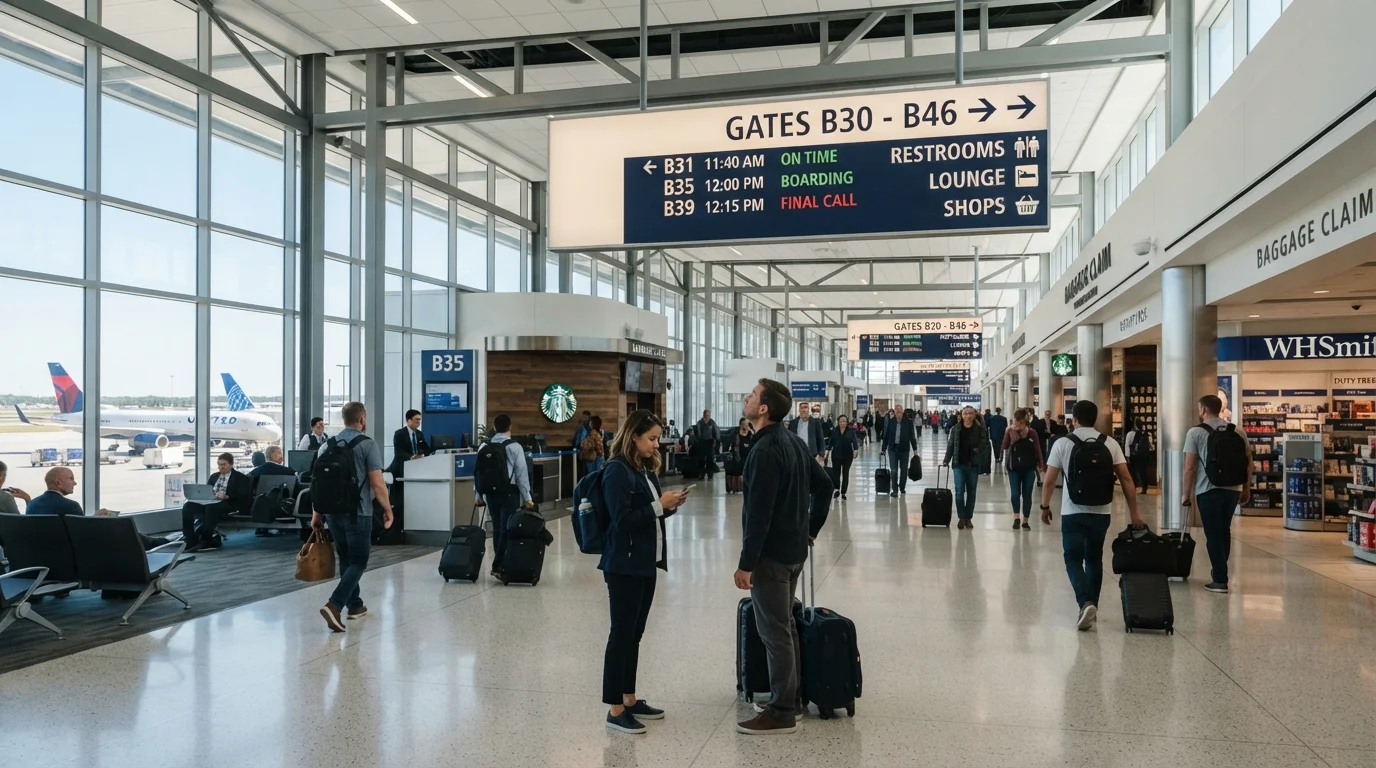
Your boarding pass shows the gate assignment as it existed when you checked in - but gates change. Airlines shift flights between gates for operational reasons, including aircraft swaps and runway positioning. The most reliable source of current gate information is the airport's live departure board, not your boarding pass and not a notification you received hours earlier.
Large departure boards are typically located at terminal entrances, near security exits, and at the start of each concourse. Find your flight by airline and flight number, then confirm the gate and status column. Status labels to know: On Time, Delayed, Boarding, Gate Change, and Departed. If your flight shows a gate change, walk to the new gate before settling in anywhere.
Most airline apps also push gate-change notifications, which is a useful backup - but treat them as a prompt to verify on the physical board rather than the definitive answer. If you're ever unsure, any airline gate agent (not just yours) can look up your flight. Understanding how flight timing works across time zones can also help you interpret scheduled vs. local departure times correctly when reading the board.
Following Overhead Signs Confidently
U.S. airport overhead signage follows a consistent color and icon system. Yellow signs typically indicate airside directions - gates, concourses, airline clubs. Blue or green signs often point toward ground transportation, baggage claim, and exits. Red typically signals restricted areas or emergency routes. These conventions vary slightly by airport, but the logic is consistent enough that a minute spent reading the legend at the first sign cluster pays off for the rest of your walk.
Directional arrows on signs point toward clusters of gates, not individual ones - follow the arrow for your gate range (e.g., Gates B1-B20 →) and then look for numbered markers on the floor or wall as you approach. If you reach the end of a concourse and haven't found your gate, you've likely passed a branch corridor. Backtrack and look for a secondary hallway rather than assuming you're in the wrong terminal.
Once you've landed and cleared your gate area, the next challenge is getting where you're going on the ground. Our ground transportation comparison walks through the options waiting outside baggage claim.
What you will need
The content provided on our blog site traverses numerous categories, offering readers valuable and practical information. Readers can use the editorial team’s research and data to gain more insights into their topics of interest. However, they are requested not to treat the articles as conclusive. The website team cannot be held responsible for differences in data or inaccuracies found across other platforms. Please also note that the site might also miss out on various schemes and offers available that the readers may find more beneficial than the ones we cover.