

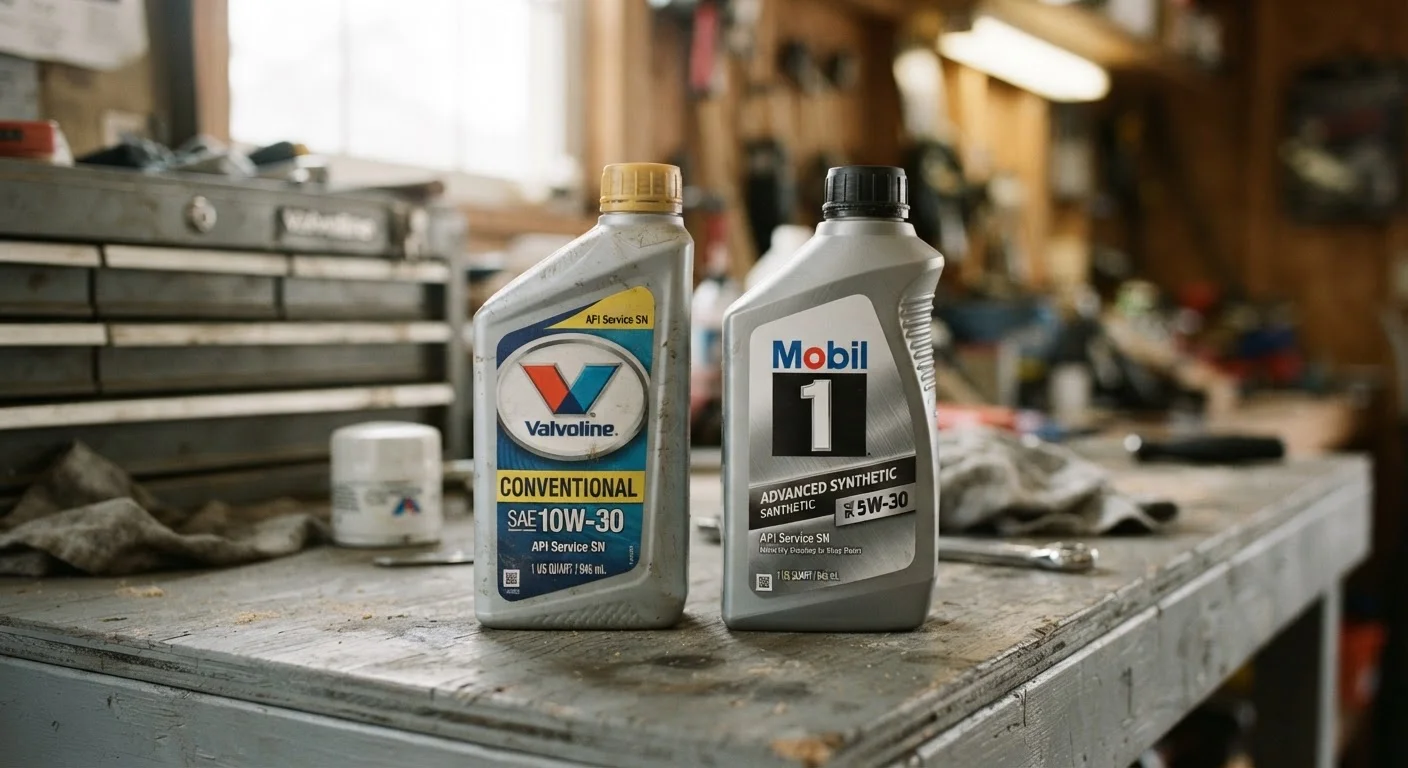
Option A
Conventional Motor Oil
The time-tested, widely available standard.
Best for: Older vehicles with simpler engines running under normal, low-stress driving conditions.
Option B
Synthetic Motor Oil
The engineered alternative built for modern demands.
Best for: Newer engines, turbocharged vehicles, extreme climates, and drivers extending oil-change intervals.
Where Each Oil Comes From
Conventional motor oil starts as crude petroleum pumped from the ground. It is refined to remove the worst impurities, then blended with additives for protection against heat, oxidation, and wear. However, because it originates from a natural source, it retains molecular inconsistencies - a mix of hydrocarbon chain lengths that perform differently under varying temperature and pressure conditions.
Synthetic motor oil is manufactured through a controlled chemical process, typically starting from a base stock such as polyalphaolefin (PAO) or other engineered compounds. The resulting molecules are more uniform in size and structure, which translates directly to more predictable behavior inside an engine. This is not just marketing language - the molecular consistency is measurable and has practical consequences for how the oil performs under stress.
For a broader look at how fluid decisions connect to real engine outcomes, see what actually changes under the hood when you switch between oil types.
How Performance Differs in Real Driving Conditions
The performance gap between conventional and synthetic oil becomes most visible at temperature extremes. At cold startup - when most engine wear occurs - synthetic oil flows faster through oil passages, reaching bearings and valve trains more quickly. Conventional oil thickens more in winter temperatures, creating a momentary but real window of reduced lubrication.
At the high end of the temperature range, synthetic oil resists viscosity breakdown better. This matters most in turbocharged engines, where oil circulating through the turbo housing can reach temperatures above 400°F. Conventional oil is more prone to oxidizing and forming sludge under these conditions, which can restrict flow and reduce protection over time.
| Criterion | Conventional Motor Oil | Synthetic Motor Oil |
|---|---|---|
| Base source | Refined crude petroleum | Engineered chemical compounds |
| Molecular consistency | Variable chain lengths | Uniform, controlled structure |
| Cold-weather flow | Slower at startup | Faster, more reliable flow |
| Heat resistance | More prone to breakdown | Holds viscosity better |
| Typical change interval | 3,000-5,000 miles | 7,500-15,000 miles |
| Cost per quart | Lower upfront cost | Higher upfront cost |
| Turbo engine suitability | Generally not recommended | Well-suited |
| Most common use case | Older, simpler engines | Modern and high-stress engines |
Under typical highway driving with a naturally aspirated engine in a moderate climate, the practical performance difference between the two narrows considerably. Both will protect your engine adequately if changed on schedule. The difference is that synthetic oil maintains that protection across a wider range of conditions and over a longer interval.
Cost, Change Intervals, and the Long-Term Math
Synthetic motor oil costs more per quart than conventional - often two to four times as much at retail. For many drivers, that sticker difference drives the decision. But the cost comparison is not straightforward, because synthetic oil generally lasts longer between changes.
7,500-15,000 mi
Typical synthetic oil change interval
Many automakers publish extended drain intervals for full synthetic oil in their owner's manuals, though exact figures vary by vehicle and driving conditions.
~$10-$15
Typical conventional oil cost per quart
Retail pricing varies by region and brand; synthetic oil typically costs $20-$30 or more per quart, making the per-quart difference significant but not always the deciding factor over time.
Manufacturer-approved change intervals for synthetic oil commonly range from 7,500 to 15,000 miles, depending on the vehicle and oil type. Conventional oil change intervals are typically 3,000 to 5,000 miles under normal driving conditions, though the outdated 3,000-mile rule has been debunked for most modern vehicles - as explored in common car maintenance myths that still cost drivers money.
When you account for fewer changes per year, the real-world cost difference often shrinks. That said, the correct interval is always the one specified in your owner's manual for your specific vehicle, oil type, and driving conditions - not a generic estimate.
Your Owner's Manual Overrides General Rules
Oil type recommendations in this article reflect general patterns across the vehicle market. Your specific engine may have different requirements based on its design, age, and tolerances. Always defer to the oil type and viscosity listed in your owner's manual. If your manual is unavailable, a qualified mechanic or the vehicle manufacturer's support line can confirm the correct specification.
Skipping oil changes entirely is a separate risk category. What actually happens if you skip an oil change goes well beyond a dirty filter - and the mechanical consequences are the same regardless of which oil type you use.
How to Know Which Your Vehicle Actually Needs
The most reliable source is your vehicle's owner's manual. Manufacturers specify not just oil type but viscosity grade (such as 5W-30 or 0W-20), and many modern engines are designed around full synthetic from the factory. Using conventional oil in an engine specified for synthetic is not just a performance compromise - in some cases it can affect warranty coverage.
Turbocharged engines, direct-injection engines, and vehicles with variable valve timing systems are particularly dependent on clean, stable oil. These systems have tighter tolerances and more aggressive operating conditions than older naturally aspirated designs. For these vehicles, synthetic is not a premium upgrade - it is the minimum viable specification.
If your vehicle is older and the manual specifies conventional oil, switching to synthetic is generally not harmful, but it is also unlikely to produce dramatic benefits unless you are experiencing specific issues like sludge buildup or operating in climate extremes. Understanding the systems your car actually uses - from engine to drivetrain - is part of broader vehicle literacy. Resources like Understanding Your Car can help you build that foundation across multiple systems.
The content provided on our blog site traverses numerous categories, offering readers valuable and practical information. Readers can use the editorial team’s research and data to gain more insights into their topics of interest. However, they are requested not to treat the articles as conclusive. The website team cannot be held responsible for differences in data or inaccuracies found across other platforms. Please also note that the site might also miss out on various schemes and offers available that the readers may find more beneficial than the ones we cover.