

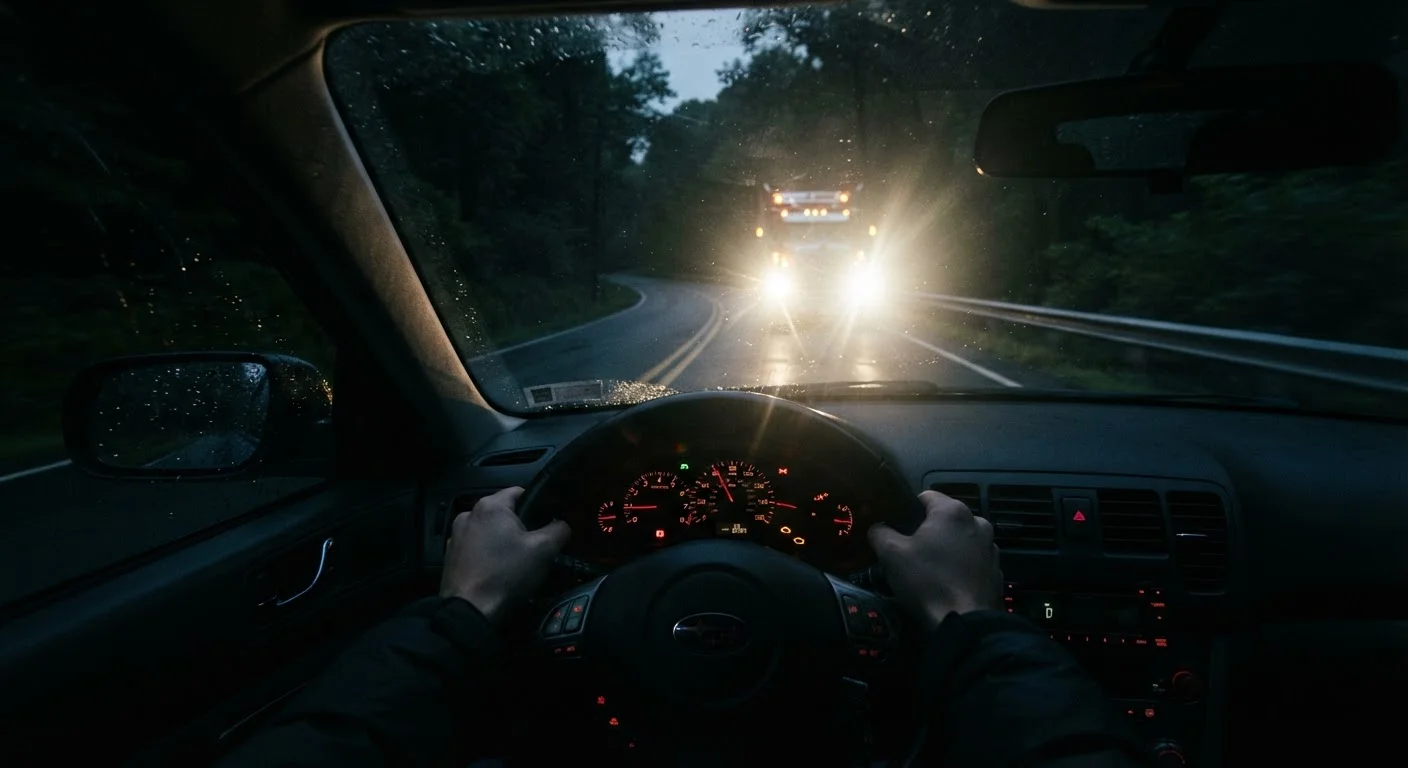
Why Night Driving Is Genuinely More Dangerous
Roughly 50% of traffic fatalities in the US occur at night, despite nighttime accounting for a much smaller share of total driving miles, according to the National Safety Council. The reasons are compounding: human eyes take 7-10 seconds to begin adjusting when exposed to a bright light source, depth perception degrades significantly in low light, and peripheral vision - the early-warning system drivers depend on - narrows considerably after dark.
Most drivers underestimate these limitations because they feel familiar on well-traveled routes. But familiarity can breed exactly the kind of complacency that leads to close calls. As our guide on overconfidence behind the wheel explains, experienced drivers are not immune to the risks of reduced attention - especially on roads they think they know.
“The single biggest contributor to nighttime crash risk is the mismatch between how fast drivers are going and how far ahead they can actually see. Most drivers don't slow down at night - they just squint harder.”
— Road Safety Research Consensus, Summary of findings across multiple US traffic safety studies
Six Practices That Experienced Night Drivers Follow
Safe night driving isn't about driving less - it's about driving differently. The following practices address the specific hazards that darkness introduces.
Clean your windshield and headlights before night trips
Dirt, film, and grime on glass scatter light and dramatically worsen glare from oncoming headlights. Headlights coated with oxidized plastic can lose more than half their output over time. Both are fixable with minimal effort and have an immediate impact on visibility.
Reduce speed to match your actual stopping distance within headlight range
Standard low-beam headlights illuminate roughly 160-200 feet ahead. At 60 mph, a typical vehicle needs over 200 feet to stop. This creates an 'overdriving your headlights' condition where you cannot stop in time for objects at the edge of your visibility. Slowing down closes this gap.
Increase your following distance to at least 4 seconds after dark
Reaction time doesn't change much at night, but the consequences of late detection are worse because hazards appear with less warning. Brake lights ahead can mask what triggered them - extra space buys processing time. Our article on why tailgating is dangerous breaks down the physics in detail.
Look toward the right edge of the road when facing oncoming glare
Staring at oncoming headlights triggers temporary flash blindness and takes time to recover from. Shifting your gaze to the right lane marking allows you to maintain your lane position while protecting your night vision from being overwhelmed.
Dim your instrument cluster and disable interior lights
Bright cabin lighting - including a phone screen on the dash - forces your eyes to adapt between two very different brightness levels, degrading your ability to see the dark road ahead. Keeping the interior as dark as your needs allow preserves night vision.
Actively scan for pedestrians and cyclists well beyond the lit path
Pedestrians and cyclists are dramatically harder to see at night and are disproportionately represented in nighttime fatality statistics. They may not be wearing reflective gear. Scanning deliberately at intersections, crosswalks, and roadway shoulders - not just the lane ahead - is essential.
Managing Fatigue Before It Manages You
Fatigue is night driving's most treacherous co-pilot. The body's circadian rhythm naturally suppresses alertness after midnight and again in the mid-afternoon, meaning nighttime drivers are fighting biology, not just darkness. Drowsy driving impairs reaction time in ways that parallel alcohol impairment - and drivers are notoriously poor at self-assessing how tired they actually are.
Plan Caffeine and Rest Before Long Night Drives
Caffeine can provide a temporary alertness boost of 30-60 minutes, but it is not a substitute for adequate sleep. If you know a night trip is coming, prioritizing 7-8 hours of sleep the night before and avoiding alcohol earlier in the day are the most reliable defenses against fatigue-related impairment. Schedule your most demanding driving for daylight hours whenever possible.
If you notice lane drifting, difficulty keeping your eyes open, or repeated yawning, those are serious warning signs - not mild inconveniences. Our companion article on fatigue at the wheel covers the early warning signs in detail and outlines what to do before fatigue becomes dangerous.
Quick Habits You Can Apply Tonight
Improving your night driving doesn't require a major overhaul - small, deliberate changes compound into meaningfully safer habits. Start with the ones most directly matched to your current gaps.
~50%
Of US traffic fatalities occur at night
The National Safety Council estimates roughly half of all traffic deaths happen after dark, despite lower overall nighttime traffic volume.
3x
Higher fatality rate per mile driven at night
Mile for mile, nighttime driving carries approximately three times the fatal crash risk compared to daytime driving, according to traffic safety research.
Night driving also intersects with other challenging conditions. If rain or fog is added to the mix, the risks escalate sharply - see our guide on driving in rain, fog, and ice for how to layer those adjustments. And if your night routes include highway stretches, the highway vs. city driving habits article explains how to calibrate your approach depending on road type.
The content provided on our blog site traverses numerous categories, offering readers valuable and practical information. Readers can use the editorial team’s research and data to gain more insights into their topics of interest. However, they are requested not to treat the articles as conclusive. The website team cannot be held responsible for differences in data or inaccuracies found across other platforms. Please also note that the site might also miss out on various schemes and offers available that the readers may find more beneficial than the ones we cover.