

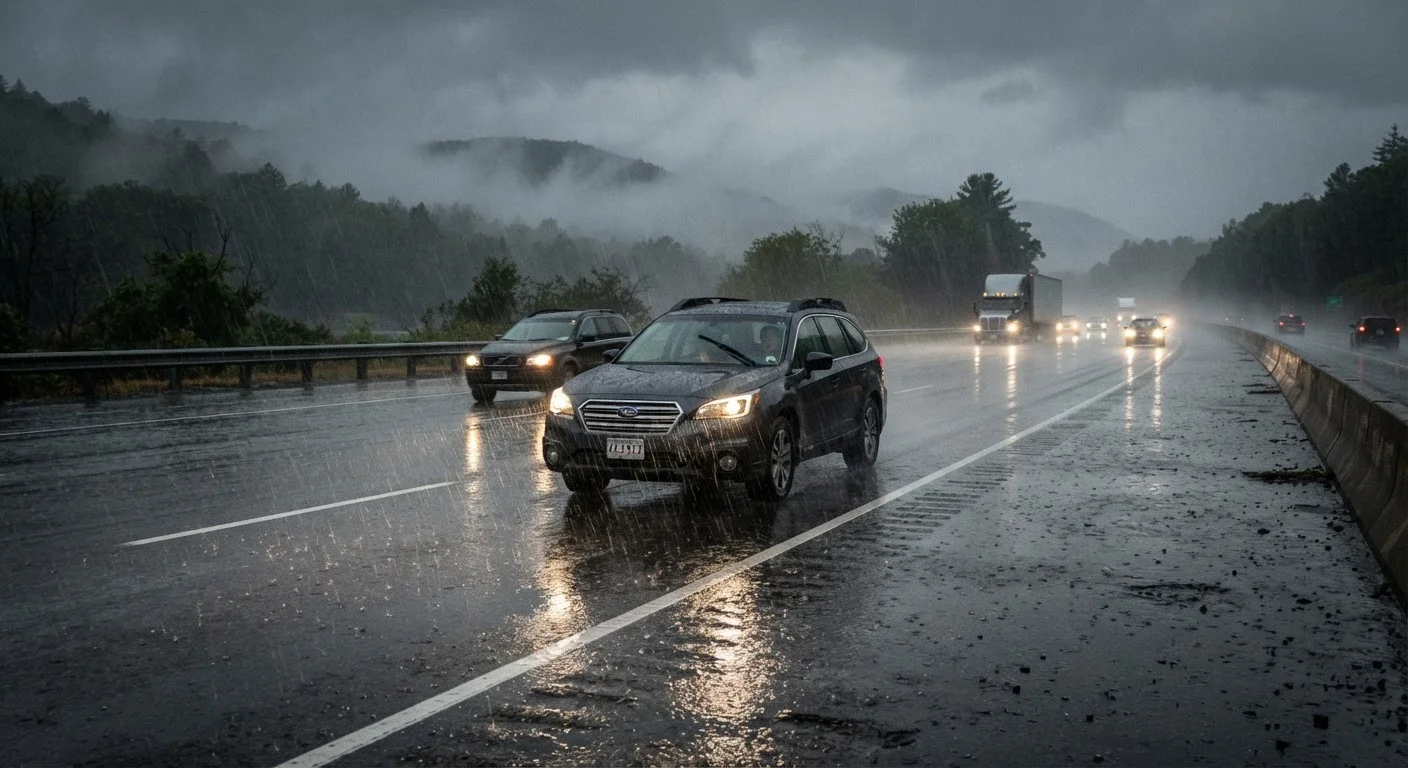
Why Adverse Weather Demands a Fundamentally Different Approach
Most traffic fatalities involving adverse weather do not happen because drivers ignore rain or ice - they happen because drivers underestimate how dramatically those conditions change vehicle physics. Wet pavement disrupts the friction your tires depend on. Fog compresses your reaction window to whatever you can see in front of you. Ice removes the predictability of braking and steering almost entirely.
The principles of defensive driving form the foundation of any adverse-weather strategy: scan far ahead, give yourself room to react, and never rely on your vehicle's capabilities to compensate for excessive speed or proximity to other vehicles. Weather adds urgency to those habits - it does not replace them.
It also helps to recognize that your vehicle behaves differently in each type of adverse condition. Rain primarily affects traction and braking distance. Fog primarily affects visibility and reaction time. Ice affects steering, braking, and acceleration simultaneously. Treating them as one category leads to under-preparation for each specific hazard.
What you will need
Before walking through the step-by-step adjustments, confirm your vehicle is ready. The tools and checks below are not optional extras - they are baseline requirements for safe adverse-weather driving.
Front and rear windshield defrosters
Clear ice and condensation from glass before and during driving to maintain full visibility.
Windshield washer fluid rated for freezing temperatures
Prevents the washer fluid from freezing in the reservoir and on the windshield during cold-weather driving.
Ice scraper and snow brush
Remove ice and snow from all windows, mirrors, lights, and the hood before driving in winter conditions.
Tire pressure gauge
Verify correct inflation - cold temperatures can cause pressure to drop, affecting traction and handling.
Emergency kit (blanket, flashlight, jumper cables, sand or kitty litter)
Provides essentials if you become stranded in winter weather.
Step-by-Step: Adapting to Rain, Fog, and Ice
The following steps cover the full range of actions - from pre-departure preparation through active driving adjustments - that reduce your risk in each condition type. Some steps apply across all three; others are specific to one hazard. Work through them in sequence before and during any adverse-weather drive.
Prepare your vehicle before you leave
Adverse-weather driving begins before you turn the key. Clear all snow and ice from every window, mirror, and exterior light - not just the windshield. Snow left on the roof can slide forward onto your windshield or blow onto vehicles behind you, and in many US states this is a fineable offense. Confirm that wipers are functional, headlights are working, and the defroster clears glass quickly. Check tire pressure; cold air causes pressure to drop roughly 1 PSI for every 10°F decrease in temperature.
Turn on headlights in rain and fog - correctly
In most US states, law requires headlights whenever wipers are in use. But beyond legality, headlights make you visible to other drivers - not just the road visible to you. In fog, switch to low beams, not high beams. High beams reflect off fog particles and create glare that reduces your own visibility while blinding oncoming drivers. If your vehicle has dedicated fog lights, use them as designed. In heavy rain, low beams are equally appropriate and required.
Reduce speed meaningfully - not just slightly
Posted speed limits reflect dry, clear road conditions. In rain, fog, or ice, those limits can represent an unsafe speed even if they are the legal maximum. Wet asphalt can extend stopping distances by 50% or more compared to dry pavement; ice can multiply stopping distance by six times or greater, depending on temperature and tire condition. Slow down in proportion to the hazard: moderate rain warrants 5-10 mph under the limit; dense fog or ice may require half the posted speed or less. As noted in our guide to what speed limits legally mean, driving too fast for conditions is a violation even when you are under the posted limit.
Increase your following distance significantly
The standard three-second following rule applies to dry conditions. In rain, extend this to at least six seconds. On ice or snow, eight to ten seconds is a reasonable minimum. Larger following distance gives you more time to react, more room to brake gradually, and a buffer if the vehicle ahead loses control. This principle is a cornerstone of defensive driving - and in adverse weather, it becomes non-negotiable.
Brake early, smooth, and progressively
Hard, sudden braking is dangerous on any slick surface. On wet roads, brake firmly but progressively - apply steady pressure rather than jamming the pedal. On ice, brake even more gently and far earlier than feels necessary. If your vehicle has ABS, apply firm continuous pressure and allow the system to pulse automatically - do not pump the pedal. If you do not have ABS and begin to skid, release the brakes momentarily, then reapply gently. In a skid, steer in the direction you want the front of the car to go.
Navigate fog using the right-edge line as a guide
In dense fog, the painted right-edge line of your lane - the white line near the shoulder - is a reliable reference point that keeps you properly positioned without forcing your eyes into oncoming headlights. Avoid overdriving your visibility: you should be able to stop within the distance you can see clearly. If visibility drops below a few car lengths, find a safe place to pull completely off the road and activate your hazard lights. Pulling onto the shoulder and leaving your brake lights on is dangerous because approaching drivers may steer toward your lights, mistaking them for traffic.
Know where ice forms first and plan accordingly
Bridges and overpasses freeze before road surfaces because cold air circulates above and below the deck. Shaded areas under trees or buildings hold ice longer into the morning. Intersections where vehicles brake repeatedly can develop polished ice patches. In freezing conditions, anticipate these zones and reduce speed well before reaching them. Also be alert when temperatures hover near 32°F - this is when ice can form and melt repeatedly throughout a single commute, making conditions unpredictable. Your tire tread depth becomes especially important here, as it is your primary grip on these surfaces.
Never Use Cruise Control in Wet or Icy Conditions
Cruise control is designed for stable, consistent road surfaces. In rain, fog, or ice, road grip can change in an instant, and you need immediate manual control of your throttle. If your vehicle hydroplanes while cruise control is active, the system may try to maintain speed, making the loss of traction harder to correct.
Black Ice Offers No Warning
Black ice forms when moisture freezes in a thin, transparent layer that looks like wet pavement. It commonly appears on bridges, overpasses, and shaded stretches of road - often before other surfaces ice over. If your steering suddenly feels light or your car begins to drift without input, ease off the gas gently and do not brake sharply. Abrupt braking on black ice is one of the leading causes of spin-outs.
Check Your Tires Before Every Winter Trip
Tread depth and tire pressure directly affect how your vehicle handles on wet or icy roads. Worn tires dramatically increase stopping distance and reduce hydroplaning resistance. See our tire pressure and tread depth field guide for exactly what to check and when to be concerned.
Once you have internalized these adjustments, consider how they interact with the type of road you are on. The habits that differ between highway and city driving shift further in adverse weather - high-speed highways demand even greater following distances, while city intersections concentrate ice and reduced-visibility risk in tighter spaces.
For drivers who also navigate reduced visibility at night, our guide to night driving covers the compounding effects when darkness and weather overlap.
The content provided on our blog site traverses numerous categories, offering readers valuable and practical information. Readers can use the editorial team’s research and data to gain more insights into their topics of interest. However, they are requested not to treat the articles as conclusive. The website team cannot be held responsible for differences in data or inaccuracies found across other platforms. Please also note that the site might also miss out on various schemes and offers available that the readers may find more beneficial than the ones we cover.