

Start here
The Big Picture: What an Engine Actually Does
Next
The Four-Stroke Cycle Explained Simply
Then
Key Parts and What They Do
Apply it
Why This Knowledge Makes You a Smarter Driver
The Big Picture: What an Engine Actually Does
At its core, a car engine is an energy converter. It takes the chemical energy stored in gasoline and transforms it into mechanical motion - the rotating force that ultimately spins your wheels and moves the car forward.
That conversion happens through controlled combustion: small, rapid explosions inside sealed chambers called cylinders. Each explosion pushes a piston downward, and that motion is harnessed and redirected to drive the vehicle. It sounds dramatic, but this process happens smoothly and continuously - typically hundreds of times per minute in each cylinder.
Most passenger cars on American roads use a four-stroke internal combustion engine running on gasoline. Diesel engines follow similar principles but ignite fuel differently. Hybrid and electric vehicles add complexity, but understanding the gasoline engine is the foundation for making sense of almost everything else under the hood.
Cylinder
A sealed chamber inside the engine where the air-fuel mixture is burned. Most cars have four, six, or eight cylinders working together.
Piston
A tight-fitting plug inside each cylinder that moves up and down in response to combustion, transferring force to the crankshaft.
Crankshaft
A rotating shaft connected to the pistons that converts their up-and-down motion into the rotational force needed to drive the wheels.
Combustion
The rapid burning of an air-fuel mixture inside a cylinder, triggered by a spark plug, that releases the energy powering the engine.
Torque
The rotational force produced by the engine. Higher torque means stronger pulling and acceleration, especially from a standstill.
Timing Belt
A belt (or chain) that keeps the crankshaft and camshaft turning in perfect coordination so valves open and close at the right moments.
The Four-Stroke Cycle Explained Simply
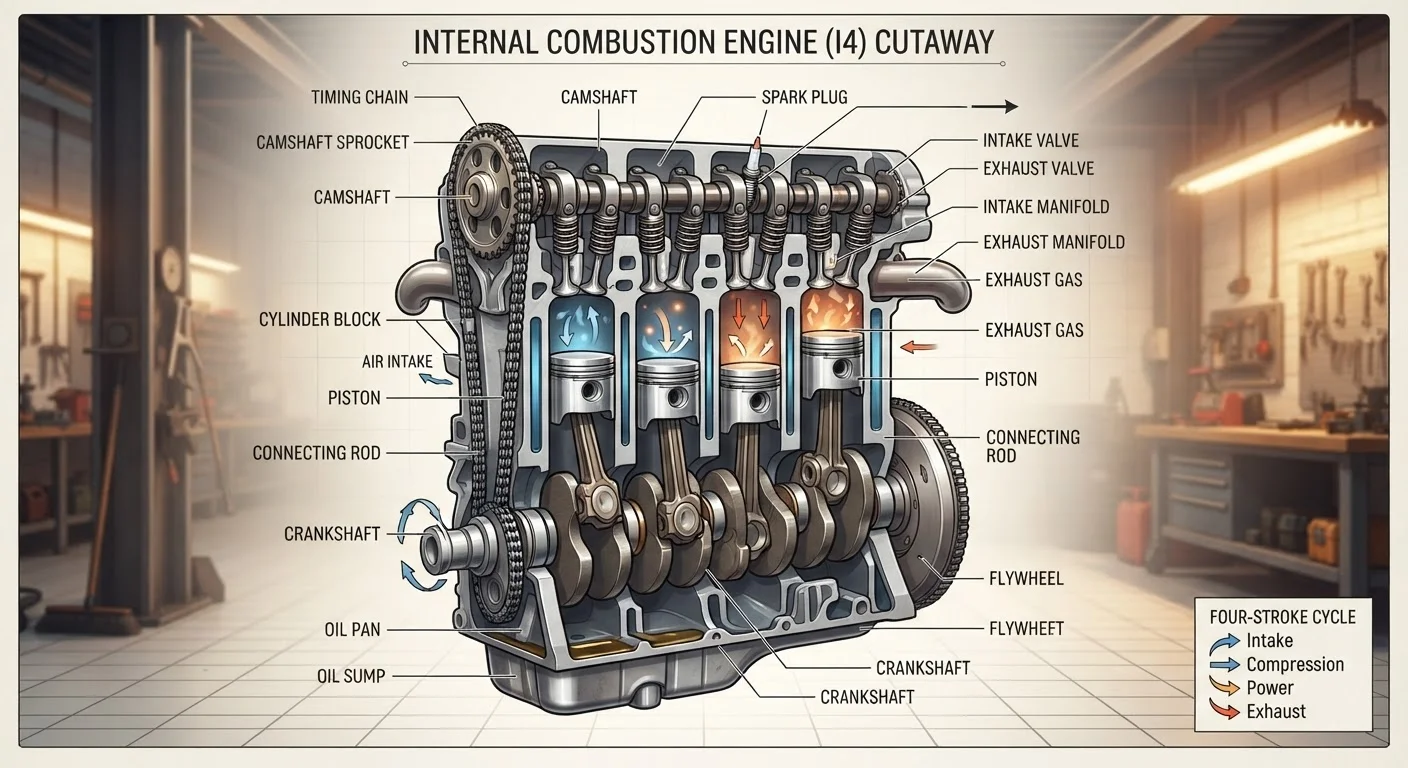
Every cylinder in your engine repeats the same four-step sequence over and over. Here's what actually happens during each stroke:
- Intake: The piston moves down, creating a vacuum that draws a precisely measured mixture of air and gasoline into the cylinder through intake valves.
- Compression: The piston moves back up with the valves closed, squeezing the air-fuel mixture into a much smaller space. Compression makes combustion far more powerful and efficient.
- Combustion (Power Stroke): At the peak of compression, the spark plug fires. The ignited mixture explodes rapidly, forcing the piston downward with significant force. This is the only stroke that actually produces power.
- Exhaust: The piston rises again, pushing the burnt gases out through exhaust valves. Those gases travel through the exhaust system and exit through the tailpipe.
Then the cycle starts again - immediately, automatically, without interruption. In a four-cylinder engine cruising at highway speed, this sequence happens roughly 2,000 times per minute in each of the four cylinders.
A Helpful Mental Image
Picture a bicycle pump being pushed down rapidly and then automatically reloading. Now imagine that downward push triggering a small explosion that makes the pump push itself - and that energy being captured to spin a wheel. That's essentially what happens inside each cylinder, repeated continuously while the engine runs.
Key Parts and What They Do
Several components work together to make the four-stroke cycle possible. Knowing their names helps you follow any conversation at the repair shop - and understand what's actually wrong when something fails.
- Pistons: Metal cylinders that move up and down inside the engine block. They're the primary recipients of combustion force.
- Crankshaft: Connected to the pistons via connecting rods, the crankshaft converts their up-and-down motion into rotation - much like bicycle pedals convert leg movement into wheel spin.
- Camshaft: Controls the precise timing of when intake and exhaust valves open and close, synchronizing with the crankshaft.
- Spark Plugs: Deliver a precisely timed electrical spark to ignite the air-fuel mixture in each cylinder.
- Timing Belt or Chain: Keeps the crankshaft and camshaft synchronized. A snapped timing belt can cause severe engine damage - this is why replacement intervals matter.
- Oil Pan and Pump: Store and circulate engine oil to lubricate moving parts and reduce friction-generated heat.
- Cooling System: Coolant flows through passages in the engine block, absorbing heat and carrying it to the radiator to be dispersed.
For plain-language definitions of these and dozens of other terms you'll encounter, see our complete glossary of car terms.
Don't Ignore Timing Belt Intervals
Timing belts on many engines have a manufacturer-specified replacement interval - often between 60,000 and 100,000 miles, depending on the vehicle. If a timing belt snaps while the engine is running, it can cause pistons and valves to collide, resulting in catastrophic and expensive damage. Check your owner's manual or ask a qualified mechanic for the interval specific to your vehicle.
Why This Knowledge Makes You a Smarter Driver
You don't need to rebuild an engine to benefit from understanding one. When you know that a misfiring cylinder disrupts the combustion cycle, a rough idle stops feeling mysterious. When you understand that the timing belt keeps two critical shafts synchronized, a mechanic's replacement recommendation makes sense rather than sounding like an upsell.
This foundation also helps you know when a problem is urgent. Engine oil at critically low levels, coolant leaking from a hose, or a check engine light tied to the combustion system - these are scenarios where understanding the basics lets you respond appropriately rather than guessing.
Ready to take the next step? Our guide on keeping a car roadworthy over the long term walks through every major system your vehicle depends on. And if you've ever wondered which maintenance tasks you can safely handle yourself, see our breakdown of DIY car maintenance vs. taking it to a mechanic.
The more you understand what's happening under the hood, the harder it becomes to be misled - and the better decisions you'll make for your vehicle's long-term health.
Frequently Asked Questions
Torque is the rotational force an engine produces - it's what gets the car moving from a stop. Horsepower is a measure of how quickly that force can be sustained over time, which matters most at higher speeds. You'll feel torque when accelerating from a traffic light and horsepower when merging onto a highway.
Engine oil lubricates hundreds of fast-moving metal parts so they don't grind against each other. Without it, friction generates extreme heat and the engine can seize within minutes. Oil also helps carry heat away from critical components and keeps internal passages clean.
These terms describe how many cylinders an engine has and how they're arranged. A four-cylinder engine has four pistons firing in a straight line. A V8 has eight cylinders arranged in a V shape. More cylinders generally means more power, but also more fuel consumption.
Not a traditional gasoline engine. Spark plugs ignite the air-fuel mixture inside each cylinder to trigger combustion. A faulty or missing spark plug causes misfires, rough idling, and poor fuel economy. Diesel engines work differently - they ignite fuel through compression heat alone, without spark plugs.
Overheating usually results from low coolant levels, a failing water pump, a clogged radiator, or a blown head gasket that allows coolant to escape. If your temperature gauge climbs into the red, pull over safely and let the engine cool before checking anything under the hood.
Aggressive revving when the engine is cold can stress components before oil has fully circulated and reached operating temperature. Most modern engines warm up quickly during normal, gentle driving. Hard acceleration is best saved for after the engine has reached its normal operating temperature.
The content provided on our blog site traverses numerous categories, offering readers valuable and practical information. Readers can use the editorial team’s research and data to gain more insights into their topics of interest. However, they are requested not to treat the articles as conclusive. The website team cannot be held responsible for differences in data or inaccuracies found across other platforms. Please also note that the site might also miss out on various schemes and offers available that the readers may find more beneficial than the ones we cover.