

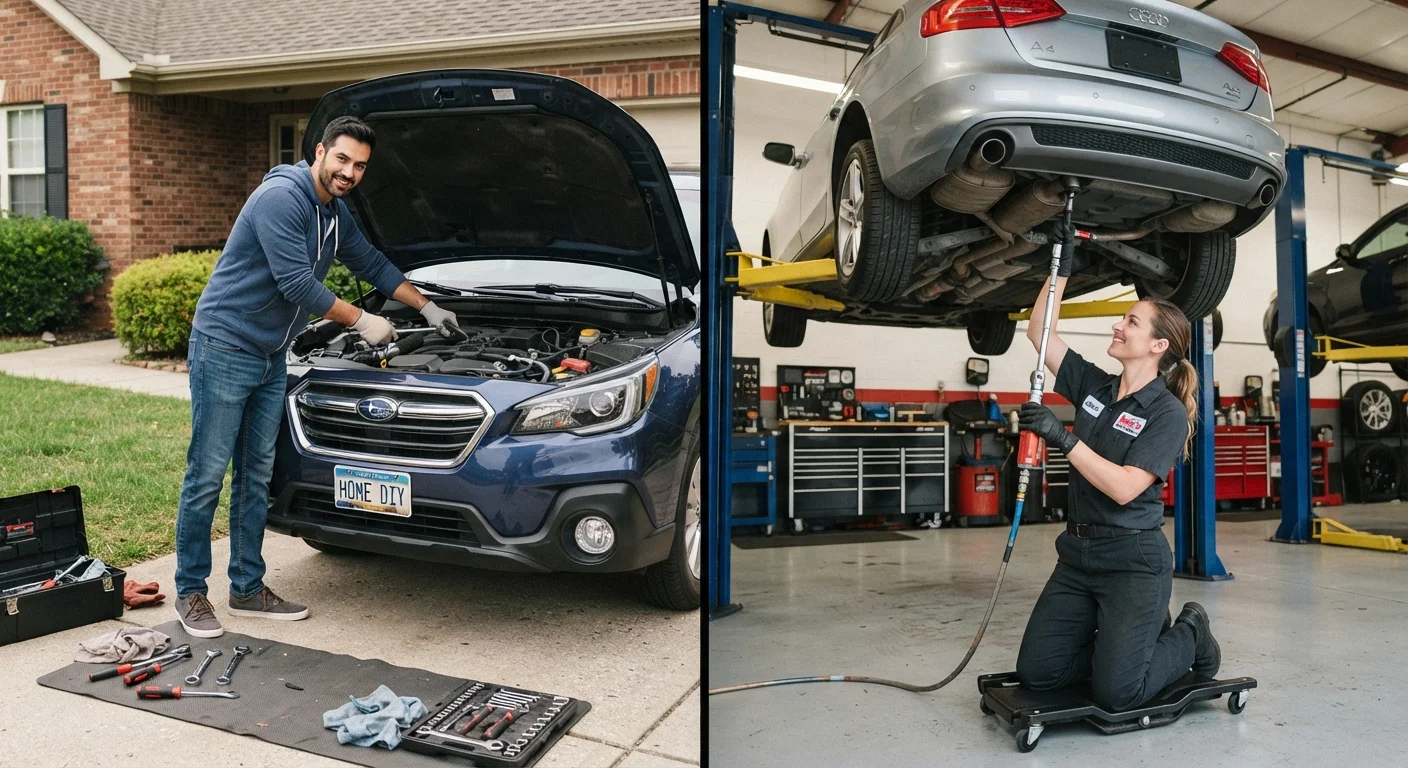
Our Verdict
DIY maintenance and professional service aren't mutually exclusive - the smartest drivers use both strategically. Handle the straightforward, low-risk tasks yourself to save money and build familiarity with your vehicle. For anything involving safety systems, specialized tools, or diagnostic complexity, a qualified mechanic is the right call every time.
| Best for | Recommended |
|---|---|
| Drivers who want to reduce routine maintenance costs | DIY maintenance |
| Complex repairs involving brakes, suspension, or electronics | Professional mechanic |
| Vehicles still under manufacturer warranty | Professional mechanic |
| Drivers building mechanical knowledge incrementally | DIY for simple tasks, mechanic for the rest |
The Core Question: Risk vs. Reward
Every maintenance decision comes down to a straightforward calculation: what's the upside of doing it yourself, and what happens if something goes wrong? For tasks with low consequences of error and minimal required tools, DIY often makes sense. For work where a mistake could compromise your safety or trigger an expensive cascade of repairs, professional service earns its cost.
This isn't about mechanical aptitude alone. It's about having the right information, the right tools, and an honest read of your comfort level. As part of what it takes to keep a car roadworthy long-term, understanding where DIY fits - and where it doesn't - is itself a core maintenance skill.
| DIY Maintenance | Professional Mechanic | |
|---|---|---|
| Typical cost | Parts cost only | Parts plus labor |
| Time investment | Varies; often longer for beginners | Usually faster with experience and tools |
| Tool requirements | Basic hand tools for simple jobs | Specialized equipment available on-site |
| Safety risk | Low for routine tasks; high for complex systems | Minimized by training and liability accountability |
| Warranty implications | Potential impact if done incorrectly | None when using authorized service |
| Best suited for | Filters, fluids, wipers, tire pressure | Brakes, suspension, electronics, diagnostics |
What You Can Realistically Do at Home
Several maintenance tasks are genuinely accessible to drivers with no formal mechanical training. These jobs involve low safety risk, widely available parts, and clear instructions in your owner's manual.
- Engine air filter replacement: Typically involves unclipping a housing, swapping the filter, and reattaching. No special tools required.
- Windshield wiper blades: Most attach with a simple clip mechanism. The process takes under five minutes per blade.
- Cabin air filter: Usually located behind the glove box or under the dashboard. Straightforward swap on most vehicles.
- Tire pressure checks and inflation: A quality tire gauge and an air compressor (or a gas station pump) are all you need. Correct pressure is printed on the door jamb sticker - not the tire sidewall.
- Checking and topping off fluids: Coolant, washer fluid, and power steering fluid reservoirs are clearly labeled under the hood. Always follow manufacturer specifications for fluid type.
- Battery terminal cleaning: Corrosion buildup on terminals can cause starting issues. A mixture of baking soda and water, applied carefully with a brush, clears it effectively.
New drivers building maintenance habits should start with this tier of tasks - the learning curve is low and the payoff in confidence is real.
Always Cross-Check With Your Owner's Manual
Before attempting any DIY task, verify the procedure and specifications in your vehicle's owner's manual. Fluid types, filter part numbers, and torque specs vary significantly between makes and models. A step that works perfectly on one vehicle may not apply to yours, and using the wrong specification can cause damage that costs far more to fix than the original service would have.
Where DIY Carries Real Risk
Some jobs look approachable but involve enough complexity - or enough consequence if done wrong - that professional service is the prudent choice for most drivers.
- Brake work: Pad replacement may seem simple, but improper installation, incorrect torque on caliper bolts, or a failure to properly bed new pads can lead to brake fade or failure. Understanding what brake pads, rotors, and calipers actually do is valuable - but knowledge and execution are different things.
- Suspension and steering components: These systems affect vehicle handling at speed. Improper installation of tie rods, ball joints, or control arms can create unpredictable steering behavior.
- Timing belt or chain service: Requires precise alignment. A mistake can cause engine damage costing thousands to repair.
- Airbag system components: Any work near the supplemental restraint system (SRS) carries a risk of accidental deployment, which can cause serious injury. This is strictly professional territory.
- Advanced electronics and ADAS calibration: Modern vehicles rely on sensors for features like lane-keeping assist and automatic emergency braking. These require specialized calibration equipment after any repair.
Don't Let Confidence Outpace Your Experience
Watching a tutorial video makes many repairs look deceptively simple. In practice, seized bolts, unexpected corrosion, and vehicle-specific variations can turn a "30-minute job" into a multi-hour problem - sometimes with a car that can't be driven to a shop afterward. If you're unsure at any point during a repair, stopping and calling a mechanic is always the right decision. Partial disassembly done incorrectly can be more dangerous than the original issue.
If your vehicle is still under a manufacturer warranty, unauthorized repairs - even well-executed ones - may affect coverage. Always review your warranty documentation before attempting any beyond-the-basics work.
Understanding What a Mechanic's Estimate Actually Means
One of the most valuable things a driver can do is learn to read a repair estimate clearly. Labor hours, diagnostic fees, and the distinction between OEM (original equipment manufacturer) and aftermarket parts all affect the final number in ways that aren't always obvious. Reading a mechanic's estimate without feeling lost helps you ask the right questions and recognize when something doesn't add up.
It's also worth separating legitimate maintenance needs from upsells. Not every service a shop recommends at a given interval is necessary for your specific vehicle and driving conditions. Your owner's manual - not the shop's service menu - is the authoritative source for your car's actual maintenance schedule. Common car maintenance myths like mandatory 3,000-mile oil changes persist in part because shops have a financial interest in promoting them.
~35%
Share of repair cost that is typically labor
Labor commonly accounts for a significant portion of total repair bills at independent shops and dealerships, making DIY labor savings meaningful for eligible tasks.
68%
Drivers who perform at least one DIY task annually
According to automotive consumer research, a majority of American drivers report handling at least one maintenance item themselves, most commonly wiper blades or air filters.
Making the Call: A Practical Framework
When you're deciding whether to DIY or book an appointment, run through these questions:
- Do I have the right tools? Some jobs require torque wrenches, OBD-II scanners, or specialty sockets. Improvising with the wrong tool introduces risk.
- What's the consequence of an error? A poorly installed cabin filter is an inconvenience. A poorly installed brake caliper is a safety hazard.
- Is this documented clearly? Your owner's manual, a vehicle-specific forum, or a reputable video walkthrough for your exact make and model all help. Generic advice applied to the wrong vehicle can mislead.
- Will this affect my warranty or insurance? Modifications or repairs done outside authorized channels may have coverage implications worth checking.
For a broader look at how understanding your vehicle's systems informs smarter decisions - from oil type to tire wear patterns - that foundational knowledge pays dividends every time you open the hood or review a quote.
The content provided on our blog site traverses numerous categories, offering readers valuable and practical information. Readers can use the editorial team’s research and data to gain more insights into their topics of interest. However, they are requested not to treat the articles as conclusive. The website team cannot be held responsible for differences in data or inaccuracies found across other platforms. Please also note that the site might also miss out on various schemes and offers available that the readers may find more beneficial than the ones we cover.