

What Coolant Actually Does - Beyond Preventing Freezing
Most drivers associate coolant with cold weather, but its job is far broader than keeping fluid from turning solid overnight. A properly maintained cooling system manages engine temperature in all conditions - on a scorching August highway just as much as a January morning commute.
Here's what coolant does on every drive:
- Heat transfer: Combustion generates intense heat. Coolant absorbs that heat from the engine block and cylinder head, carries it to the radiator, and releases it into the air.
- Freeze protection: The glycol base dramatically lowers the freezing point of the water in the system, preventing ice expansion that would crack engine components.
- Boil-over prevention: Coolant raises the boiling point of the fluid mixture, buying a buffer against overheating on hot days or under heavy loads.
- Corrosion inhibition: Metal components inside your engine - aluminum, steel, copper - are vulnerable to electrochemical corrosion. Inhibitor additives in coolant form a protective layer on those surfaces.
That last function is the one most drivers overlook, and it's why coolant doesn't last forever. See our guide to car fluids and what happens when each one runs low for a broader look at how each fluid protects your vehicle.
Coolant Types Are Not Interchangeable
Coolant formulas differ by color and chemistry - Inorganic Additive Technology (IAT, typically green), Organic Acid Technology (OAT, often orange or red), and Hybrid OAT (HOAT, frequently yellow or pink). Mixing incompatible types can neutralize corrosion inhibitors and accelerate system damage. Always confirm the correct specification in your vehicle's owner's manual before adding or replacing fluid.
How Coolant Degrades - and Why Level Alone Doesn't Tell the Full Story
Oil gets changed on a schedule because everyone understands it breaks down. Coolant deserves the same logic, but it rarely gets it. The fluid in your reservoir can look perfectly full while its protective chemistry has quietly failed.
As coolant circulates through the engine, heat and electrochemical reactions gradually consume the corrosion inhibitors. Without those inhibitors, the coolant becomes mildly acidic. Acidic coolant begins attacking the very metal surfaces it was supposed to protect - aluminum heads, water pump internals, and radiator fins are all at risk.
Visible signs that coolant may need attention include:
- A color that has shifted from the original bright green, orange, or pink to a brownish or rusty hue
- Visible particles or sediment in the reservoir
- A slimy or oily texture, which can indicate oil contamination from a failing head gasket
- A consistently low level without any obvious external leak
None of these symptoms are subtle once you know what to look for - which is why a quick visual check during every oil change is a reasonable habit. Long-term vehicle reliability depends on catching these slow-developing issues before they become expensive failures.
~$1,500-$3,000+
Typical cost range for head gasket repair
Head gasket failure - often caused by engine overheating - is one of the most expensive cooling-system-related repairs a driver can face, according to automotive repair cost estimates.
30,000-50,000 mi
Common coolant flush interval
Most manufacturer maintenance schedules recommend a coolant flush within this range, though extended-life formulas may allow longer intervals - always check your owner's manual.
50/50
Recommended antifreeze-to-water ratio
A 50/50 mix of antifreeze concentrate and distilled water is the standard recommendation for most US climates, balancing freeze protection, boil-over resistance, and corrosion inhibitor effectiveness.
Warning Signs You Shouldn't Ignore While Driving
Dashboard warnings and unusual sensations are your car's way of signaling that the cooling system is struggling. Recognizing them early can be the difference between a flush and a rebuilt engine.
Pay attention to these signals:
- Rising temperature gauge: If the needle climbs toward the red zone, reduce load immediately - turn off the A/C, pull over safely if the gauge keeps rising, and let the engine cool before checking fluid. Never open a hot radiator cap.
- Sweet smell inside the cabin: Ethylene glycol has a distinctive sweet odor. Smelling it through the vents often indicates a heater core leak - coolant entering the HVAC system.
- White exhaust smoke: Thick white smoke from the tailpipe, especially when the engine is warm, can indicate coolant burning inside the combustion chamber - a sign of a failing head gasket.
- Puddles under the parked car: Coolant leaks are often brightly colored and may have a faint sweet smell. Don't confuse normal A/C condensation (clear water) with a genuine coolant drip.
Any of these symptoms warrant a visit to a qualified mechanic rather than a wait-and-see approach. Skipping that step is exactly the kind of ownership habit that leads to expensive repairs.
Check Coolant When the Engine Is Cold
Never open the radiator cap or coolant reservoir cap on a warm or hot engine - pressurized coolant can spray and cause serious burns. A coolant level check takes seconds and should always be done before starting the car, not after a drive. Make it part of your monthly walk-around alongside tire pressure.
Keeping Your Cooling System in Good Shape
Cooling system maintenance doesn't require advanced mechanical skill, but some tasks genuinely belong in a shop. Here's a practical breakdown:
What you can do yourself (with caution):
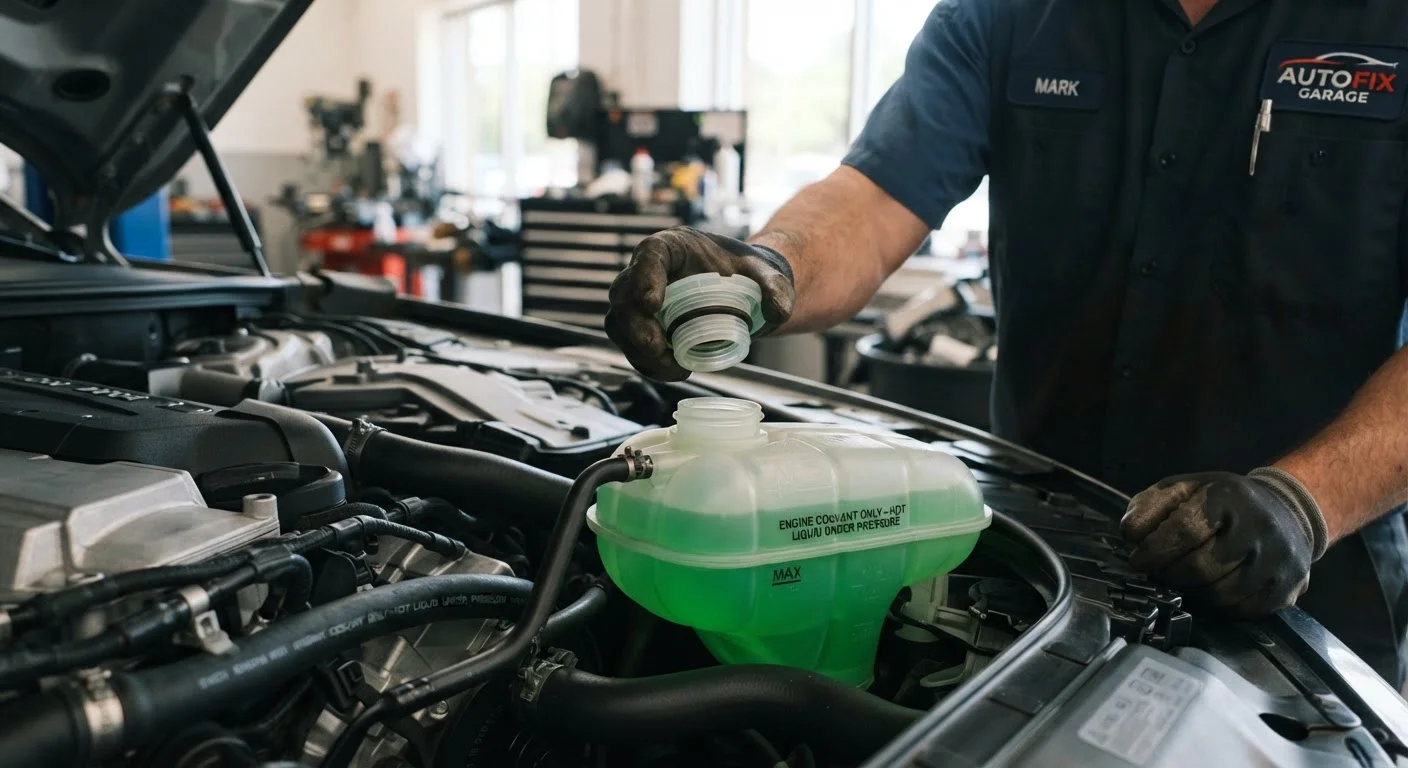
- Check the coolant reservoir level when the engine is cold - the markings on the translucent reservoir make this straightforward.
- Inspect for obvious external leaks around hose connections or beneath the vehicle.
- Note any color changes in the visible fluid.
What a mechanic should handle:
- A full coolant flush and refill - this involves pressurizing and draining the system properly.
- Pressure testing for leaks that aren't visible externally.
- Thermostat or water pump replacement - both involve cooling system disassembly.
As part of your overall car maintenance routine, ask your shop to inspect cooling system hoses and the radiator cap during scheduled services. Hoses become brittle or soft with age, and a failed radiator cap - which controls system pressure - can trigger overheating even when fluid levels are correct.
Coolant is one of the few fluids where the right type matters as much as the right amount. Using the wrong formulation can cause inhibitor chemistry to conflict, accelerating corrosion rather than preventing it. Your owner's manual specifies the correct coolant type - that's the only source worth trusting for this detail.
“The cooling system is one of the most underappreciated systems in a vehicle. Drivers monitor their oil religiously but often don't think about coolant until the temperature light comes on - which is already too late for cheap repairs.”
— Cars & Driving Editorial Team, Automotive Maintenance Analysts
Frequently Asked Questions
Most manufacturers recommend a coolant flush every 30,000 to 50,000 miles, though some extended-life formulas can last longer. Your owner's manual is the most reliable guide for your specific vehicle. Age matters too - coolant that's several years old may have degraded inhibitors even if mileage is low.
Topping off can restore the proper fluid level if coolant has simply evaporated slightly, but it doesn't restore depleted corrosion inhibitors. If the fluid is discolored, rusty, or overdue for service, a full flush is the correct step. Always use the coolant type specified in your owner's manual - mixing incompatible formulas can accelerate corrosion.
Driving with insufficient or chemically depleted coolant risks engine overheating, which can cause warped cylinder heads, a blown head gasket, or complete engine failure. These repairs are among the most expensive in automotive maintenance. Catching the problem early through routine checks prevents the bulk of that cost.
The terms are often used interchangeably, but there is a technical difference. Antifreeze is the concentrated glycol-based product. Coolant typically refers to the diluted mixture of antifreeze and water that actually goes into your vehicle's system - usually a 50/50 ratio for most climates.
You can visually inspect the coolant reservoir when the engine is cold - look for the correct level and note the color. An inexpensive test strip available at auto parts stores can check pH and freeze protection. However, a qualified mechanic can perform a more thorough evaluation of inhibitor strength and system integrity.
The content provided on our blog site traverses numerous categories, offering readers valuable and practical information. Readers can use the editorial team’s research and data to gain more insights into their topics of interest. However, they are requested not to treat the articles as conclusive. The website team cannot be held responsible for differences in data or inaccuracies found across other platforms. Please also note that the site might also miss out on various schemes and offers available that the readers may find more beneficial than the ones we cover.