

Why Fat Type Matters More Than Fat Amount
For decades, dietary fat was treated as a single villain. Nutrition guidance has since grown considerably more nuanced: the type of fat you eat matters far more than the total number of fat grams on your plate. Understanding the three main categories - saturated, unsaturated, and trans fat - gives you a practical lens for reading food labels and making everyday choices without overhauling your entire diet.
If you regularly consult the Nutrition Facts panel on packaged foods, see our guide to what the nutrition label is actually telling you for context on how these fat values fit into the bigger picture.
| Saturated fat state at room temp | Solid |
| Unsaturated fat state at room temp | Liquid |
| Primary source of artificial trans fat | Partially hydrogenated oils (U.S. Food and Drug Administration) |
| Omega-3s classified as | Essential polyunsaturated fats |
| Trans fat FDA status | No longer generally recognized as safe (artificial) (FDA ruling, phased in by 2020) |
| "0g trans fat" label threshold | Less than 0.5g per serving (FDA labeling regulations) |
Saturated Fat: What It Is and Where It Comes From
Saturated fat gets its name from chemistry: its carbon chains are fully "saturated" with hydrogen atoms, making it solid at room temperature. Common sources include beef, pork, full-fat dairy products like butter and cheese, coconut oil, and palm oil.
Most major health organizations - including the American Heart Association - recommend limiting saturated fat intake because higher consumption is associated with elevated LDL (low-density lipoprotein) cholesterol in the blood, which is a recognized risk factor for cardiovascular disease. However, nutrition research is ongoing, and the relationship between saturated fat and heart health is more complex than once thought. The overall dietary pattern matters, not any single food in isolation.
Saturated Fat
A type of dietary fat whose carbon chains carry the maximum number of hydrogen atoms, making it solid at room temperature. Found primarily in animal products and some tropical plant oils.
Unsaturated Fat
A dietary fat containing one or more double bonds in its carbon chain, making it liquid at room temperature. Includes both monounsaturated and polyunsaturated subtypes, broadly associated with cardiovascular benefits when they replace saturated fats.
Trans Fat
A type of fat formed when liquid oils are partially hydrogenated to become solid. Artificial trans fat has been largely removed from the U.S. food supply due to its association with increased cardiovascular risk.
LDL Cholesterol
Low-density lipoprotein cholesterol, often called 'bad' cholesterol. Elevated LDL levels in the blood are associated with a higher risk of cardiovascular disease.
HDL Cholesterol
High-density lipoprotein cholesterol, often called 'good' cholesterol. Higher HDL levels are generally associated with a lower risk of heart disease.
Omega-3 Fatty Acids
A type of polyunsaturated fat the body cannot synthesize on its own, requiring dietary intake. Found in fatty fish, walnuts, and flaxseed, and studied for roles in heart and brain health.
Partial Hydrogenation
An industrial process that adds hydrogen to liquid vegetable oil, converting it to a semi-solid or solid fat. This process creates artificial trans fats and has largely been phased out of the U.S. food supply.
Unsaturated Fat: The Broadly Helpful Category
Unsaturated fats have one or more double bonds in their carbon chains, making them liquid at room temperature. They divide into two subtypes:
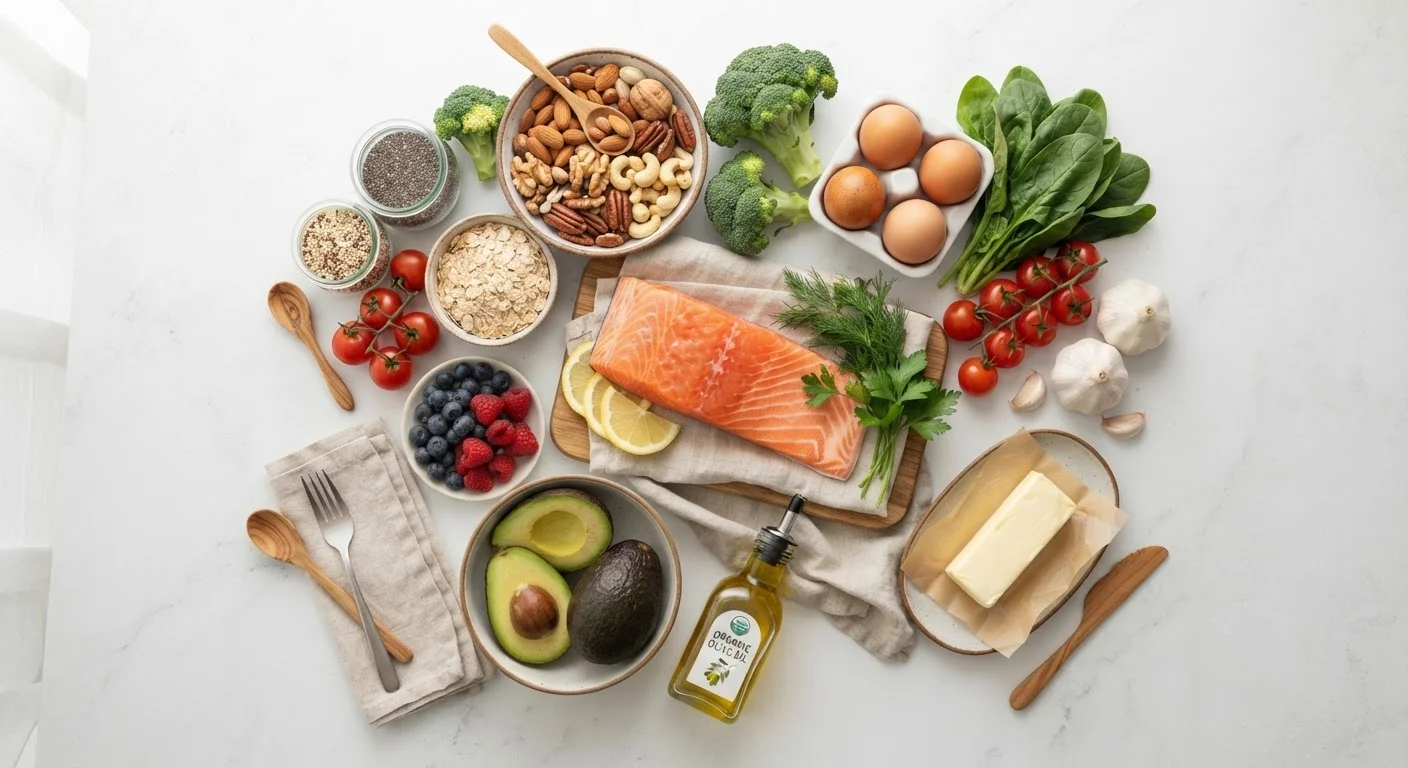
- Monounsaturated fats - found in olive oil, avocados, and many nuts. Associated in research with supporting healthy cholesterol levels when they replace saturated fat in the diet.
- Polyunsaturated fats - found in fatty fish, walnuts, flaxseed, sunflower oil, and soybean oil. This category includes omega-3 and omega-6 fatty acids, which the body cannot produce on its own and must obtain from food.
Omega-3 fatty acids in particular have been studied for their role in supporting heart and brain health. Fatty fish such as salmon, mackerel, and sardines are among the most concentrated sources. Replacing saturated fat with unsaturated fat - rather than simply removing fat - is a pattern consistently supported by nutritional research.
~90%
Of Americans don't meet omega-3 intake recommendations
Estimates from dietary intake surveys suggest most U.S. adults consume less omega-3 than public health guidelines suggest is beneficial.
2x
LDL impact of trans fat vs. saturated fat
Research indicates that gram for gram, artificial trans fat has a more adverse effect on cholesterol ratios than saturated fat, per Harvard T.H. Chan School of Public Health summaries.
Trans Fat: The Category Worth Avoiding
Trans fats come in two forms. Small amounts occur naturally in some animal products, but the primary concern has been artificial trans fat - created through a process called partial hydrogenation, which turns liquid vegetable oil into a solid. This manufactured fat was widely used in processed snacks, stick margarines, and fried fast foods because it extended shelf life and improved texture.
Artificial trans fat raises LDL cholesterol while simultaneously lowering HDL (high-density lipoprotein, the "good" cholesterol), a combination associated with increased cardiovascular risk. Recognizing this, the U.S. Food and Drug Administration ruled that partially hydrogenated oils are no longer generally recognized as safe, effectively phasing them out of the U.S. food supply. However, products can still be labeled "0g trans fat" if they contain less than 0.5 grams per serving - so checking the ingredient list for "partially hydrogenated oil" remains worthwhile.
Putting It Into Practice
No single food has to be categorized as off-limits. A practical approach focuses on patterns rather than perfection:
- Use oils higher in unsaturated fat (olive, avocado, canola) as your everyday cooking fats.
- Include fatty fish, nuts, and seeds regularly as protein and fat sources.
- Enjoy higher-saturated-fat foods - red meat, full-fat dairy - in reasonable portions rather than as the foundation of every meal.
- Check ingredient labels on processed snack foods for partially hydrogenated oils.
This is general nutrition information intended to support everyday food literacy - not medical or dietary advice tailored to any individual. If you have a specific health condition such as high cholesterol, heart disease, or a metabolic disorder, a registered dietitian or your healthcare provider can offer guidance suited to your situation.
"Zero Trans Fat" Doesn't Always Mean Zero
FDA rules allow a food to be labeled "0g trans fat" if it contains less than 0.5 grams per serving. If you eat multiple servings, small amounts can add up. The safest check is to scan the ingredient list for the words "partially hydrogenated" - if that phrase appears, the product contains artificial trans fat regardless of what the front label says.
This article is for general informational purposes only and does not constitute medical or dietary advice. Consult a qualified healthcare professional before making significant changes to your diet, especially if you have an existing health condition.
The content provided on our blog site traverses numerous categories, offering readers valuable and practical information. Readers can use the editorial team’s research and data to gain more insights into their topics of interest. However, they are requested not to treat the articles as conclusive. The website team cannot be held responsible for differences in data or inaccuracies found across other platforms. Please also note that the site might also miss out on various schemes and offers available that the readers may find more beneficial than the ones we cover.