

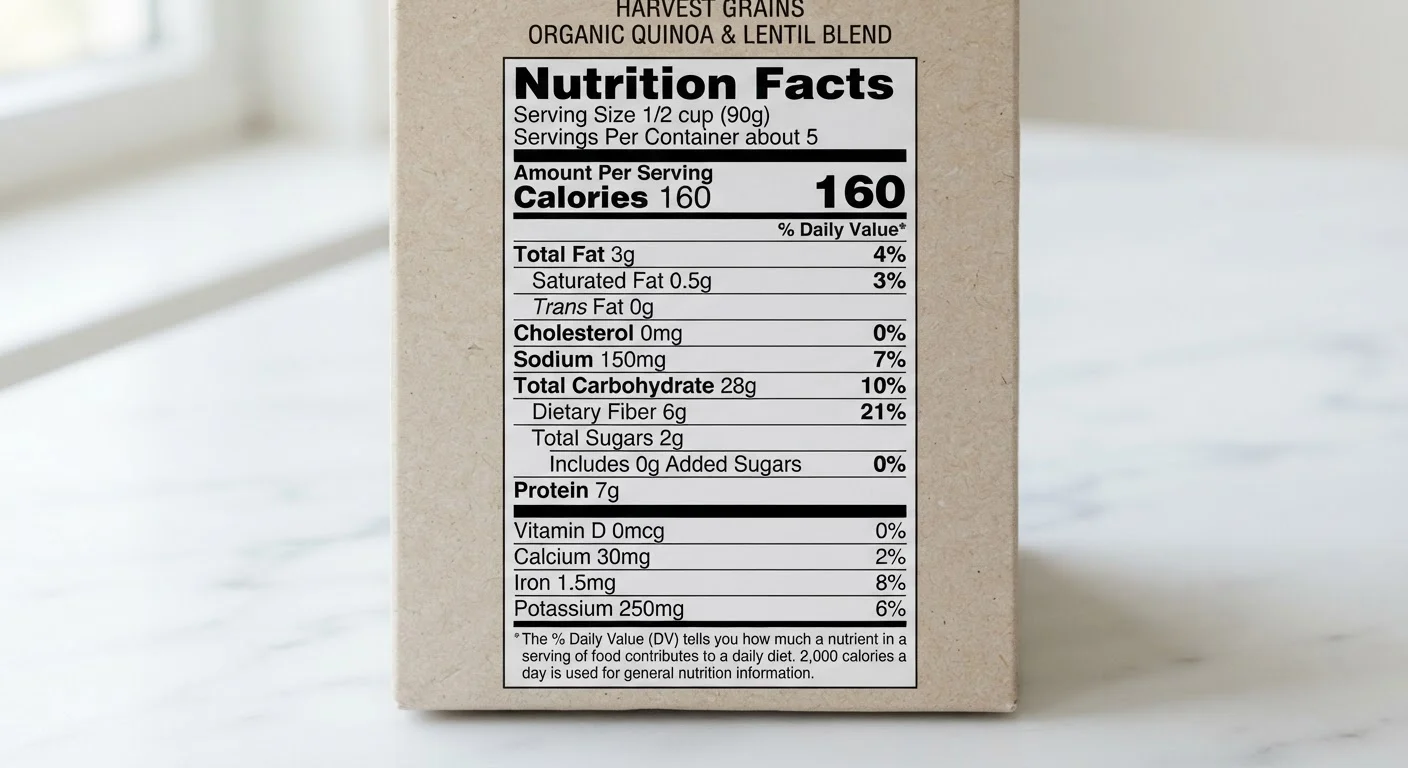
Start With Serving Size - Everything Flows From There
The very first thing to check on any Nutrition Facts panel is the serving size - not the calories. This single number anchors every other figure on the label. If a frozen meal lists one serving as half the package, but you eat the whole thing, every nutrient value doubles.
The FDA updated serving sizes in the 2016 label overhaul to reflect amounts people actually eat, not aspirational portions from decades ago. A serving of ice cream, for example, changed from half a cup to two-thirds of a cup to better match real consumption. So current serving sizes are more realistic - but they still may not match your personal portion.
Always check servings per container alongside serving size. A small bag of crackers might look modest until you notice it contains 2.5 servings - meaning the calorie and sodium numbers multiply accordingly.
Quick Check Before You Buy
Before putting any packaged item in your cart, spend 15 seconds checking three things: the serving size, the calories per serving, and the % DV for sodium and added sugars. That quick scan covers the most commonly misread parts of the label and takes no nutritional expertise to act on.
Calories: Useful, But Not the Whole Story
Calories measure the energy a food provides. The label displays them prominently - and the FDA intentionally made the font larger in the updated format so calories are harder to miss. But a calorie count alone tells you almost nothing about the nutritional value of a food.
Two foods with identical calorie counts can have very different effects on hunger, energy, and long-term health depending on their protein, fiber, fat, and sugar content. A 200-calorie handful of nuts and a 200-calorie cookie both show the same number, but deliver very different nutrients.
Use calories as one data point alongside the rest of the panel, not as a standalone verdict on whether a food is worth eating.
70%+
Of U.S. adults who have used nutrition labels
According to FDA consumer research, most American adults report using the Nutrition Facts label at least occasionally when shopping for food.
3,400mg
Average daily sodium intake for Americans
The CDC estimates average American sodium consumption at around 3,400mg per day - well above the 2,300mg limit recommended in federal dietary guidelines.
17 tsp
Average daily added sugar consumed by Americans
The American Heart Association notes that Americans consume roughly 17 teaspoons of added sugar daily on average, far exceeding recommended limits.
Understanding % Daily Value
The right-hand column of the Nutrition Facts label shows the % Daily Value (% DV) for most listed nutrients. This figure represents how much one serving contributes to the recommended daily intake for a person eating roughly 2,000 calories per day.
The FDA provides a practical rule of thumb: 5% DV or less is considered low for a nutrient; 20% DV or more is considered high. This makes it easy to scan labels quickly without doing math.
- For nutrients you want to limit - saturated fat, sodium, added sugars - look for lower % DVs.
- For nutrients you want to get enough of - fiber, vitamin D, calcium, iron, potassium - look for higher % DVs.
Keep in mind the 2,000-calorie baseline is a standardized reference, not a personal prescription. Your actual needs vary by age, sex, size, and activity level. The % DV is most helpful as a comparative tool - useful for choosing between two similar products rather than as an absolute daily target. For a deeper look at one nutrient that trips up many shoppers, see our guide on where sodium hides in the American diet.
The Nutrients Worth Watching Most Closely
Not every line on the label demands equal attention. Here's what matters most for typical American eating patterns:
Nutrients to Limit
- Saturated fat: Linked to cardiovascular risk when consumed in excess. Appears below total fat. For more context on fat types, our explainer on saturated, unsaturated, and trans fats covers the key differences.
- Sodium: Most Americans consume well above the recommended limit, largely from packaged and restaurant foods - not the salt shaker.
- Added sugars: Listed separately from total sugars since the 2016 update. Added sugars are the ones introduced during processing - syrups, sweeteners, and refined sugar - distinct from naturally occurring sugars in fruit or dairy.
- Trans fat: Largely eliminated from the U.S. food supply, but worth checking - any amount listed warrants attention.
Nutrients to Seek Out
- Dietary fiber: Most Americans fall well short of recommended intake. Foods with 5g or more per serving are considered a good source.
- Vitamin D, calcium, iron, potassium: These are listed precisely because many Americans are under-consuming them.
Labels Don't Cover Every Food
Fresh produce, plain meat and poultry, and foods prepared in restaurants are generally not required to carry a Nutrition Facts panel. This doesn't mean those foods are nutritionally invisible - it simply means you're relying on general nutritional knowledge rather than a label. Many retailers voluntarily provide nutrition information for fresh and bulk items.
Don't Let the Front of the Package Fool You
Packaged food marketing is designed to influence buying decisions before you ever flip the package over. Terms like "multigrain," "natural," "lightly sweetened," and "made with real fruit" appear on the front - and most are loosely defined or outright unregulated. Our companion article on reading food marketing claims explains what these terms actually mean under FDA rules.
The Nutrition Facts panel on the back or side of the package is the regulated, standardized source of truth. A cereal that shouts "whole grain" on the front might still list added sugars as the second ingredient. A yogurt labeled "light" may be lower in fat but higher in added sugar to compensate for flavor.
Building the habit of checking the facts panel - even for 20 seconds - gives you the unfiltered picture that front-of-package design can obscure. You don't need to calculate every gram. Scanning serving size, calories, a few key % DVs, and added sugars takes less time than reading the health claim on the front.
This article is for general informational and educational purposes only. It is not a substitute for personalized dietary or medical advice. Consult a qualified healthcare professional or registered dietitian for guidance specific to your health needs.
Frequently Asked Questions
% Daily Value tells you how much of a nutrient one serving provides relative to the recommended daily amount for a 2,000-calorie diet. A 15% DV for sodium means one serving delivers 15% of the daily upper limit. Use it as a quick benchmark: 5% or less is low, 20% or more is high.
Every number on the label - calories, fat, sodium, sugar - applies to one serving, not the whole package. If a bag of chips lists one serving as 15 chips but you eat 30, you need to double every number. Misjudging serving size is the most common reason people undercount calories and nutrients.
Total sugars includes both naturally occurring sugars (like those in fruit or dairy) and sugars that were added during processing. Added sugars are the ones to watch - they include table sugar, syrups, and sweeteners added by manufacturers. Health guidelines generally recommend limiting added sugars, not total sugars from whole foods.
Not necessarily. Daily Values are reference targets, not strict requirements for every individual. Your needs vary based on age, sex, activity level, and health status. The % DV is most useful as a relative comparison tool when choosing between products, not as a personal prescription.
No. The updated FDA label format removed the 'Calories from Fat' line because research shows the type of fat matters more than total fat calories. The label still lists total fat, saturated fat, and trans fat so you can evaluate fat quality, not just quantity.
Most health guidance suggests keeping an eye on saturated fat, sodium, and added sugars - nutrients many Americans consume in excess. Fiber, vitamin D, calcium, iron, and potassium are listed because many Americans fall short of recommended amounts. Focus on the context of your whole diet, not just one food.
The content provided on our blog site traverses numerous categories, offering readers valuable and practical information. Readers can use the editorial team’s research and data to gain more insights into their topics of interest. However, they are requested not to treat the articles as conclusive. The website team cannot be held responsible for differences in data or inaccuracies found across other platforms. Please also note that the site might also miss out on various schemes and offers available that the readers may find more beneficial than the ones we cover.