

Option A
Engineered Hardwood
The moisture-tolerant, versatile hardwood option.
Best for: Homeowners installing flooring in basements, kitchens, or over radiant heat where moisture and temperature fluctuations are a concern.
Option B
Solid Hardwood
The traditional, long-lasting hardwood classic.
Best for: Above-grade living spaces with stable humidity levels where maximum refinishing potential and long-term durability are priorities.
How Each Floor Is Built
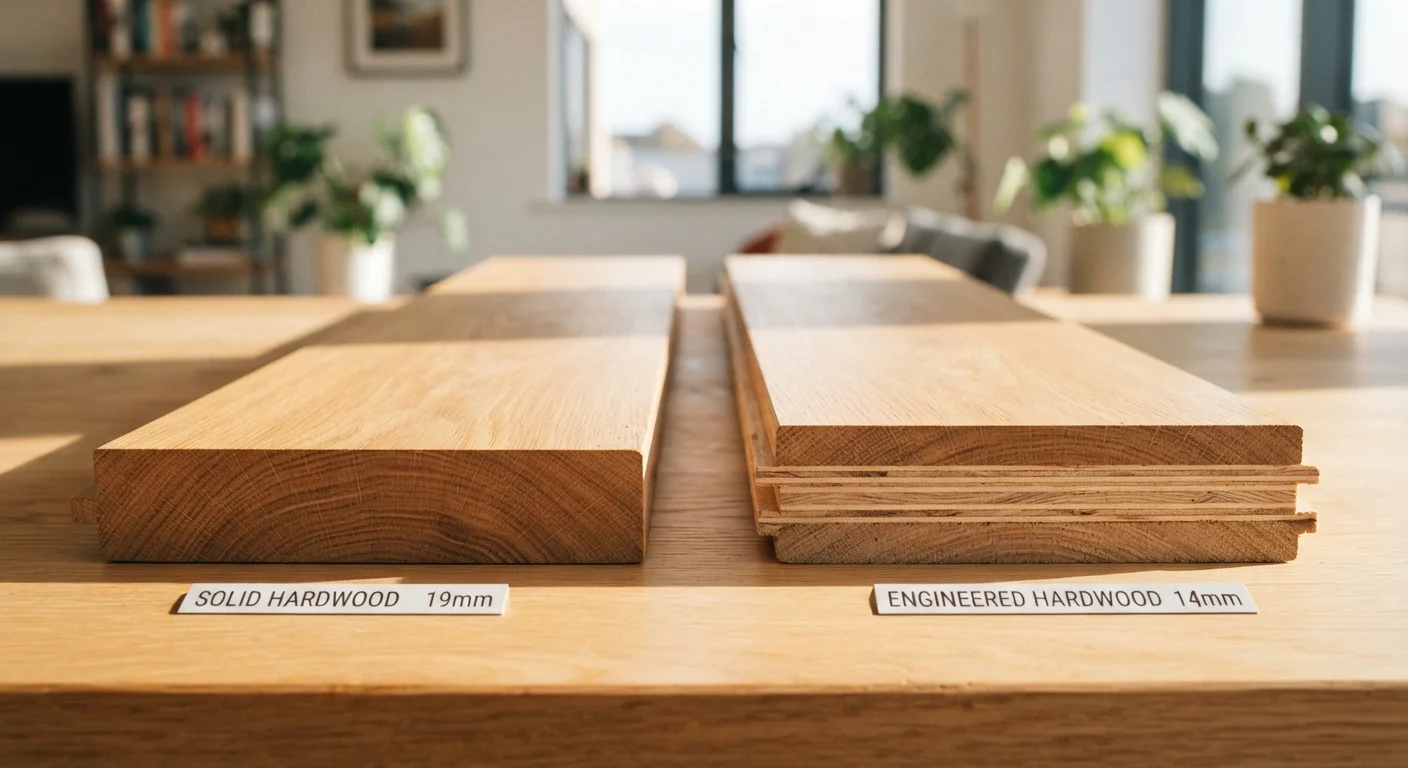
The most important difference between these two flooring types starts beneath the surface. Solid hardwood is exactly what it sounds like: a single, uniform piece of milled wood, typically 3/4 inch thick. Every millimeter of that plank is real wood, which is what gives it exceptional refinishing depth over time.
Engineered hardwood takes a different approach. It's constructed from multiple layers - a genuine hardwood veneer on top, bonded over a core of cross-layered plywood or high-density fiberboard (HDF). The veneer thickness varies by product, typically ranging from about 1/12 inch to 1/6 inch. Thicker veneers generally allow more refinishing passes before the surface layer is exhausted.
Understanding what's inside a plank matters beyond specs. Examining a product's physical construction - including how layers are bonded and how the veneer is attached - can reveal quality differences that spec sheets alone won't show.
| Criterion | Engineered Hardwood | Solid Hardwood |
|---|---|---|
| Construction | Veneer over plywood or HDF core | Single solid wood plank |
| Moisture tolerance | Higher - suitable for below-grade | Lower - above-grade only |
| Refinishing potential | 1-4 times (veneer-dependent) | 5+ times over lifespan |
| Installation methods | Float, glue, or nail | Nail or staple only |
| Radiant heat compatibility | Generally compatible | Limited - risk of warping |
| Typical plank thickness | 3/8 to 9/16 inch | 3/4 inch standard |
| Concrete subfloor installation | Yes, with moisture barrier | Generally not recommended |
Moisture, Stability, and Where Each Can Be Installed
Wood naturally expands and contracts as humidity levels rise and fall. Solid hardwood does this as one thick piece, which means it's sensitive to moisture swings and can cup, gap, or warp if conditions aren't stable. That's why solid hardwood is generally recommended only for above-grade installations - main floors and upper levels with controlled indoor humidity.
Engineered hardwood's cross-ply core counteracts this movement. Because the layers run in alternating grain directions, they pull against each other and resist warping. This makes engineered hardwood appropriate for below-grade spaces like basements, on-grade slabs, and rooms with radiant heat systems. It's not waterproof, but it handles the humidity variation those environments produce far better than solid wood.
3/4"
Standard solid hardwood plank thickness
This consistent thickness throughout the plank is what enables repeated sanding and refinishing over a floor's lifetime.
1/12"-1/6"
Typical engineered hardwood veneer range
Veneer thickness directly determines how many times an engineered floor can be refinished before the surface layer is depleted.
3/16"
Common subfloor flatness tolerance
Most hardwood flooring manufacturers specify the subfloor must be flat within 3/16 inch over a 10-foot span to prevent flex and joint failure.
Neither type should be used in areas with standing water risk or extremely high sustained humidity without additional moisture barriers and proper subfloor preparation.
Refinishing Potential and Long-Term Value
One of solid hardwood's most compelling advantages is its refinishing depth. Because the entire plank is wood, floors can be sanded down and refinished multiple times - often five or more times over the life of the floor. This means scratches, stains, and worn finish can be corrected, and the floor can even be re-stained to a different color. Well-maintained solid hardwood floors in historic homes can remain in service for a century or more.
Engineered hardwood's refinishing potential depends directly on veneer thickness. Thinner veneers may only withstand one or two light sandings before the veneer is compromised. Thicker-veneer engineered products can support two to four refinishes. If refinishing longevity matters to you, check veneer thickness carefully before purchasing.
Veneer Thickness Varies Widely by Product
Not all engineered hardwood is equal. Some lower-cost products use veneers as thin as 1/12 inch, which may not survive even a single professional sanding. Higher-quality engineered products with 1/6-inch or thicker veneers behave more like solid wood for refinishing purposes. Always ask specifically about veneer thickness - not just overall plank thickness - when evaluating engineered options.
In practical terms, many homeowners refinish floors far less frequently than the maximum allows - so even an engineered floor with limited refinishing passes may serve a household for 30-40 years before the question becomes relevant.
Installation Methods and Subfloor Considerations
Solid hardwood is traditionally nail-down or staple-down installed over a wood subfloor. It cannot be floated, and gluing to concrete is generally not recommended due to moisture risk. It also requires the subfloor to be flat, structurally sound, and above a certain moisture threshold - your installer should take moisture readings before proceeding.
Engineered hardwood offers more flexibility. Depending on the product, it can be nailed, glued, or floated using a click-lock system. Floating installation is particularly forgiving and is often chosen for DIY projects since it doesn't require adhesive or fasteners. Engineered flooring can be installed directly over concrete slabs with a proper moisture barrier.
For either type, subfloor flatness is critical. Most manufacturers specify tolerances around 3/16 inch over 10 feet - high or low spots beyond that threshold can cause planks to flex, squeak, or fail at the joints. Always review the manufacturer's installation guidelines, as requirements vary by product.
The content provided on our blog site traverses numerous categories, offering readers valuable and practical information. Readers can use the editorial team’s research and data to gain more insights into their topics of interest. However, they are requested not to treat the articles as conclusive. The website team cannot be held responsible for differences in data or inaccuracies found across other platforms. Please also note that the site might also miss out on various schemes and offers available that the readers may find more beneficial than the ones we cover.