

Where the Rule Comes From
The 50/30/20 framework was popularized by U.S. Senator Elizabeth Warren and her daughter Amelia Warren Tyagi in their 2005 book All Your Worth. Their argument was straightforward: most budgeting advice was too complicated for everyday families to stick with. A three-bucket system, they reasoned, was simple enough to use consistently without spreadsheets or financial expertise.
The rule doesn't replace professional financial guidance, and it doesn't account for every life circumstance. But as a mental model for organizing spending, it has held up well precisely because of its simplicity. It's part of a broader set of approaches covered in our savings strategies overview.
Breaking Down the Three Buckets
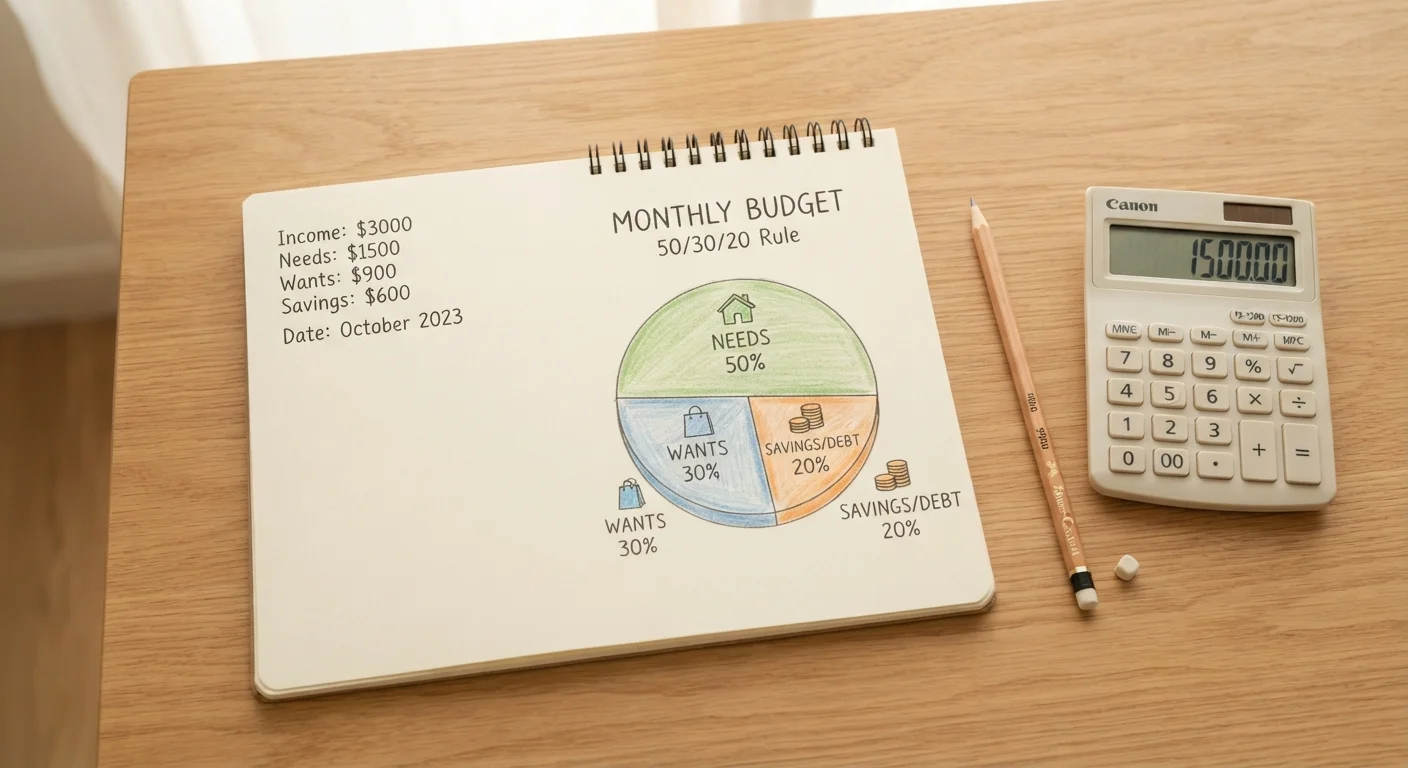
50% - Needs: This half of your take-home pay covers the essentials you can't reasonably cut without serious consequences. Think rent or mortgage, groceries, electricity, water, health insurance premiums, and the minimum payments on any outstanding debts. Transportation to work - whether a car payment and gas or a monthly transit pass - generally falls here too.
The tricky part is that needs are often misidentified. A streaming service might feel essential, but it's a want. A gym membership at $80 a month is probably a want unless a doctor has specifically prescribed exercise as treatment. Drawing a clear line between needs and wants is a skill worth developing before you build your budget.
Start With Your Needs Number First
Before worrying about wants or savings, add up everything you'd need to pay even during a financial emergency: rent, utilities, insurance, groceries, and minimum debt payments. If that number is already close to or above 50% of your take-home pay, you have useful information - your budget flexibility is limited, and trimming wants rather than savings is the smarter move.
30% - Wants: This bucket covers discretionary spending - the choices that improve your quality of life but aren't strictly required. Dining out, concert tickets, clothing beyond basic necessity, vacation funds, and hobby expenses live here. So do upgrades: choosing a nicer apartment than you strictly need, or a newer car when a used one would do.
20% - Savings and Debt Repayment: This portion is your financial future. It includes contributions to a retirement account (like a 401(k) or IRA), building an emergency fund, and any extra payments toward debt beyond the minimums. The goal is to direct at least a fifth of your income toward strengthening your financial position over time.
57%
Americans living paycheck to paycheck
According to a 2023 LendingClub report, roughly 57% of U.S. consumers reported living paycheck to paycheck, highlighting how common it is to struggle with the savings portion of the 50/30/20 split.
20%
Recommended savings and debt payoff share
The 50/30/20 rule designates one-fifth of take-home pay for savings, retirement contributions, and debt repayment beyond minimums - a target many households fall short of in practice.
$1 in $3
Typical share of income spent on housing
The U.S. Department of Housing and Urban Development considers housing 'affordable' when it costs no more than 30% of gross income - closely aligned with the needs-focused half of the 50/30/20 framework.
When the Rule Works - and When It Doesn't
The 50/30/20 guideline works best for middle-income earners with relatively stable expenses and predictable paychecks. It's also a strong starting point for anyone who has never budgeted before and finds detailed systems overwhelming.
It tends to struggle in a few common situations. If you live in a high-cost city, your rent alone might consume 40-50% of take-home pay - leaving almost nothing for other needs before you've touched wants or savings. Conversely, if you earn a very high income, 30% on wants might be far more than you'd ever spend, and shifting more toward savings could be a smarter move.
“The 50/30/20 budget isn't about perfection - it's about giving yourself permission to spend on what matters while making sure your future self isn't left behind.”
— Amelia Warren Tyagi, Co-author of 'All Your Worth' and personal finance researcher
The rule is also less useful when you carry significant high-interest debt. In that case, directing well above 20% toward debt payoff often makes more financial sense than maintaining the standard split. For a more structured, dollar-by-dollar alternative, a zero-based budgeting comparison may be worth exploring.
Putting It Into Practice
Start by calculating your actual monthly take-home pay - the amount deposited after all deductions. Then multiply that figure by 0.50, 0.30, and 0.20 to find your target dollar amounts for each bucket.
Next, list your current monthly spending in each category and compare. Most people find their needs are in reasonable shape, their wants are over budget, and their savings are underfunded. That gap between the 20% target and what's actually being saved is the most actionable insight the exercise produces.
Once you know where you stand, a financial checkup can help you assess your overall savings health and identify specific next steps. The 50/30/20 rule won't solve every financial challenge, but it gives you an honest, low-friction starting point - and that's often the hardest part.
This article is for general informational and educational purposes only and does not constitute personalized financial advice. For guidance specific to your financial situation, consult a qualified financial professional.
Frequently Asked Questions
It's based on net income - the amount you actually take home after federal and state taxes, Social Security, and any other payroll deductions. Using gross income would inflate your budget buckets and lead to overspending, since that money never lands in your bank account.
Needs are expenses required to maintain your basic standard of living: rent or mortgage, groceries, utilities, health insurance, transportation to work, and minimum loan payments. If skipping it would put your housing, health, or job at risk, it's likely a need. The line can get blurry - a <a href="/smart-shopping/smarter-spending/needs-wants-and-the-fuzzy-line-between-them">closer look at needs versus wants</a> can help clarify gray areas.
That's a common reality, especially in high cost-of-living cities or on modest incomes. In that case, treat the framework as directional rather than fixed. Focus on keeping wants lean and protecting any savings - even a small percentage - rather than forcing the numbers to match the rule exactly.
Yes. Beyond minimum payments (which fall under 'needs'), extra debt payments - such as aggressively paying down a credit card or student loan - count toward the 20% bucket alongside retirement savings and emergency fund contributions.
The 50/30/20 rule is broader and lower-effort - it groups spending into three buckets rather than assigning every dollar a specific job. Zero-based budgeting is more granular and hands-on. See a full <a href="/money-matters/budgeting-basics/zero-based-budgeting-vs-the-503020-method">comparison of the two methods</a> to find which fits your style.
It can still provide useful structure, but the percentages may need significant adjustment. When needs consume most of your income, the priority is covering essentials first, then building even a modest savings habit - even 5% saved consistently creates forward progress.
The content provided on our blog site traverses numerous categories, offering readers valuable and practical information. Readers can use the editorial team’s research and data to gain more insights into their topics of interest. However, they are requested not to treat the articles as conclusive. The website team cannot be held responsible for differences in data or inaccuracies found across other platforms. Please also note that the site might also miss out on various schemes and offers available that the readers may find more beneficial than the ones we cover.