

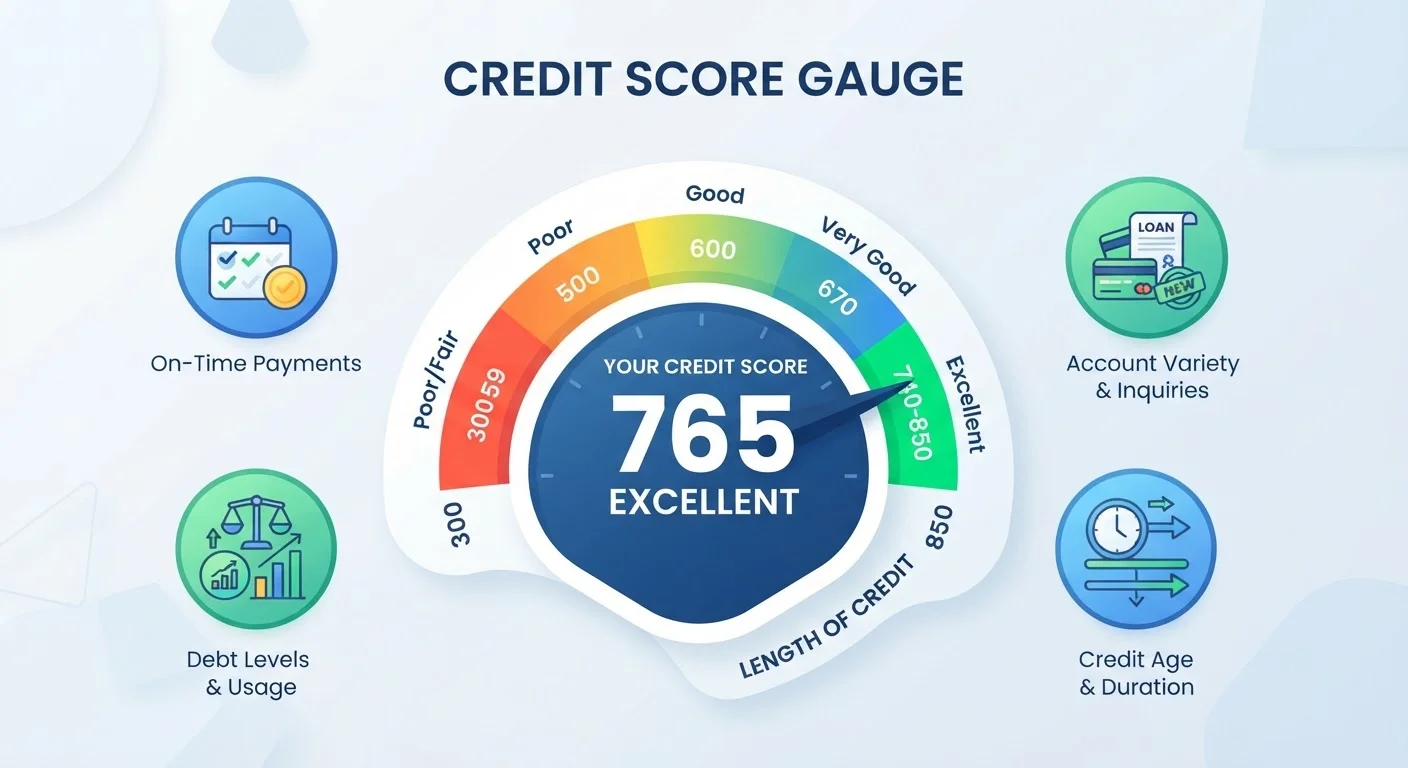
What a Credit Score Is Really Measuring
A credit score isn't a judgment of your character or your financial worth - it's a statistical prediction. Specifically, it estimates the probability that you'll miss a payment by 90 days or more within the next 24 months. That's it. Lenders want a quick, consistent way to compare borrowers, and a score gives them that.
The number is generated by running your credit report data through a mathematical model. The model has been calibrated against millions of real borrowers to identify which behaviors are most predictive of repayment trouble. That's why factors like on-time payments matter so much - they're historically strong predictors, not arbitrary choices.
It's also worth noting what a credit score does not include: your income, your savings account balance, your job title, your age, or your race. Under the Equal Credit Opportunity Act, scoring models are prohibited from using certain personal characteristics. The score is built entirely from your credit report data.
The Five Factors and How Much Each Weighs
Under the FICO model - the most commonly used scoring system - five categories of information determine your score. Understanding each one helps you see exactly where points are gained or lost.
35%
Weight of payment history in FICO scoring
Payment history is the single largest factor in the standard FICO Score model, according to Fair Isaac Corporation's published scoring breakdown.
~200M
Americans with a scoreable credit file
The Consumer Financial Protection Bureau (CFPB) has estimated that the vast majority of U.S. adults have enough credit history to generate a score.
716
Average FICO Score in the United States
FICO has reported the average U.S. FICO Score at approximately 716, placing the typical American in the 'good' credit range.
- Payment history (≈35%): Whether you've paid on time across all accounts. A single 30-day late payment can cause a meaningful drop, especially on an otherwise clean file.
- Amounts owed (≈30%): This is largely your credit utilization rate - how much of your revolving credit limit you're currently using. Keeping this ratio low is one of the fastest-acting levers you have. For a deeper look, see how credit utilization works.
- Length of credit history (≈15%): The age of your oldest account, your newest account, and the average age of all accounts. Longer histories tend to help.
- Credit mix (≈10%): Having a variety of account types - credit cards, auto loans, mortgages - can slightly benefit your score, though this factor carries less weight than the others.
- New credit (≈10%): Recent applications and newly opened accounts. Opening several accounts in a short time can signal risk to lenders.
These weights are approximate and can shift slightly depending on the specific FICO version or scoring model a lender uses.
Common Misunderstandings Worth Clearing Up
Credit scores are surrounded by persistent myths that lead people to make counterproductive decisions. For example, many people believe carrying a small balance on a credit card helps build credit - it doesn't. Paying in full each month is better for your score than carrying a balance forward. Common credit misconceptions like these are worth examining carefully.
Your Score May Vary by Lender
There are dozens of FICO Score versions in use across different lending categories - mortgage lenders, auto lenders, and credit card issuers may each pull a different version. The score you see on a free monitoring app may not be the exact score a specific lender uses. That said, the same underlying factors drive all FICO models, so improving your general credit habits benefits you across the board.
Another common mistake: closing old credit cards to 'clean up' your profile. Closing an account reduces your total available credit and can shorten your average account age - both of which can push your score down. Leaving an old account open, even unused, is often the better move.
If you want to understand the raw data behind your score, your credit report is the source document. Reading your credit report section by section can reveal exactly what's influencing your number and flag any errors worth disputing.
Why Lenders Use It and What It Means for You
From a lender's perspective, a credit score reduces a complex decision to a standardized data point that can be applied consistently across thousands of applicants. It helps determine not just whether you're approved, but at what interest rate. Borrowers with higher scores typically qualify for lower rates, which can translate into meaningful savings over the life of a loan.
Focus on the Two Biggest Factors First
Payment history and credit utilization together make up roughly 65% of a standard FICO Score. If you're working to improve your score, setting up autopay for at least the minimum payment and reducing revolving balances will generally have the greatest impact. Small steps in these two areas tend to produce more noticeable results than changes to lower-weighted factors.
For consumers, understanding the score means you can take targeted actions rather than guessing. If your score is being dragged down by high utilization, paying down balances can produce relatively quick results. If the issue is a thin credit history, time and responsible account management are the primary tools - there's no shortcut.
Credit scores are general financial education tools, not the final word on your financial health. For decisions about loans, debt management, or building credit specific to your situation, consulting with a licensed financial professional is always a sound step.
Frequently Asked Questions
Under the FICO model, scores of 670-739 are generally considered 'good,' 740-799 are 'very good,' and 800 or above is 'exceptional.' Scores below 580 are typically viewed as poor by most lenders. These ranges can vary slightly depending on the lender and the specific scoring version they use.
Credit scores are recalculated each time a lender or credit bureau generates one, which can happen frequently. Your underlying credit report data is typically updated when creditors report new information, usually once per month. So your score can shift from month to month based on changes in balances, payments, or new accounts.
No. When you check your own score, it's recorded as a 'soft inquiry,' which has no effect on your score. Only 'hard inquiries' - triggered when a lender reviews your credit to make a lending decision - can cause a small, temporary dip, usually just a few points.
Yes. Because lenders don't always report to all three credit bureaus, your credit reports can differ slightly between Equifax, Experian, and TransUnion. Since each score is calculated from that bureau's report, small differences in scores across bureaus are normal and expected.
Most negative items - like late payments, collections, or charge-offs - remain on your credit report for seven years from the date of the original delinquency. Chapter 7 bankruptcy can stay on your report for up to ten years. The impact of negative items generally fades over time as positive history accumulates.
The content provided on our blog site traverses numerous categories, offering readers valuable and practical information. Readers can use the editorial team’s research and data to gain more insights into their topics of interest. However, they are requested not to treat the articles as conclusive. The website team cannot be held responsible for differences in data or inaccuracies found across other platforms. Please also note that the site might also miss out on various schemes and offers available that the readers may find more beneficial than the ones we cover.