

Why Body Language Literacy Matters
Dogs communicate almost entirely through posture, movement, and expression. Unlike humans, they cannot explain discomfort or excitement in words - yet they are constantly broadcasting both. Owners who learn to read these signals accurately can prevent conflicts, respond to stress before it escalates, and build a stronger bond with their pets.
Body language should always be read as a whole picture, not a single cue in isolation. A wagging tail paired with a stiff torso means something entirely different from a wagging tail paired with a loose, wiggly body. Context - environment, recent events, familiar vs. unfamiliar people - shapes every signal.
This reference covers the most consistent and clinically recognized signals across the canine communication spectrum. For a deeper look at how stress and fear can manifest over time, see how separation anxiety develops and why it's misread.
| Primary communication mode | Body posture, facial expression, and movement |
| Number of recognized calming signals | 30+ documented behaviors (Turid Rugaas, On Talking Terms with Dogs) |
| Tail wag direction | Right-biased wag = positive; left-biased = cautious (Research published in Current Biology, 2013) |
| Blink rate as a signal | Slow blinking indicates relaxation; hard staring signals tension |
| Most misread signal | Tail wagging - context determines meaning, not movement alone |
Key Signals: A Visual Reference Guide
The signals below are grouped by the emotional state they most reliably indicate. Remember that individual dogs vary, and a signal's meaning can shift based on the full behavioral picture.
Relaxed and Content
- Soft eyes, relaxed brow: No tension around the eye muscles; the gaze is gentle rather than fixed.
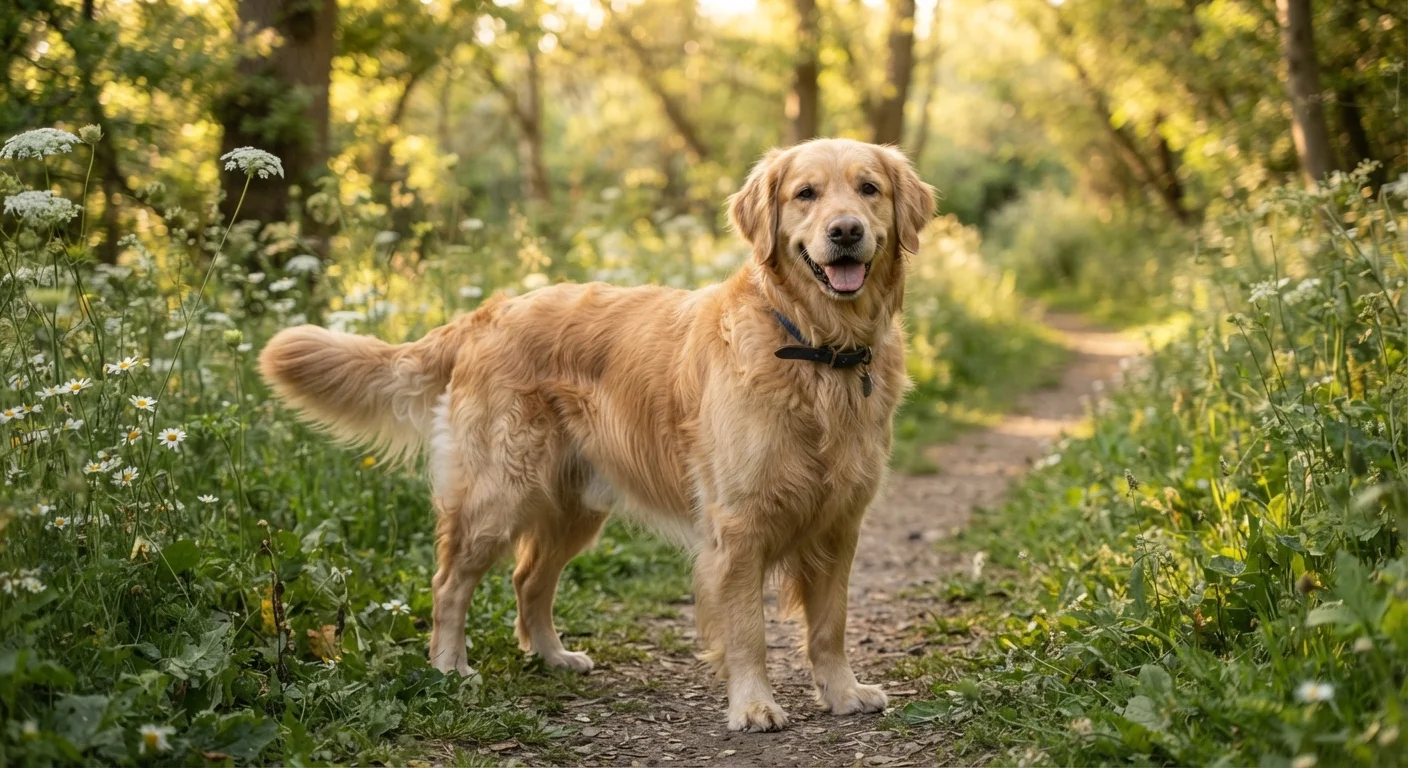
- Mouth slightly open, tongue loosely hanging: Often called a "soft mouth" - a sign of ease.
- Weight evenly distributed: The dog stands or sits without leaning forward or backward aggressively.
- Tail held at or below back level, moving loosely: Broad, relaxed sweeps rather than stiff or rapid flicks.
Playful and Aroused (Positive)
- Play bow: Front end lowered, rear elevated - a clear and universal invitation to engage.
- Bouncy, exaggerated movement: Movements look intentionally clumsy; the dog may dart away and return.
- Ears up and forward: Alert but not rigid; forward-facing in anticipation.
Anxious or Stressed
- Yawning out of context: Unprompted yawning is a recognized calming signal, not tiredness.
- Lip licking when no food is present: Repetitive tongue flicks directed toward another person or animal signal discomfort.
- Whale eye: The whites of the eye (sclera) are visible; the dog turns its head but keeps its gaze fixed.
- Tucked tail: Held tightly between the hindquarters, indicating fear or submission.
- Low body posture, crouching: The dog makes itself small to appear less threatening or to retreat socially.
Warning and Threat Signals
- Hard stare: Unblinking, fixed gaze with tension around the eyes - a precursor to escalation.
- Hackles raised (piloerection): Hair along the spine stands up, indicating high arousal; may accompany positive excitement or threat.
- Stiff, forward-leaning posture: Weight shifted onto the front legs, head held high or low and forward.
- Snarl or lip curl: An explicit warning that the dog is at threshold - do not dismiss it.
Calming signals
A set of behaviors - including yawning, lip licking, and turning away - that dogs use to de-escalate tension, communicate non-threat, or soothe themselves. The concept was significantly described by Norwegian dog trainer Turid Rugaas.
Piloerection (hackles)
Involuntary raising of the hair along a dog's back and neck, controlled by the autonomic nervous system. It indicates heightened arousal but is not exclusively aggressive - it can accompany excitement or fear.
Whale eye
When the whites (sclera) of a dog's eyes are visibly exposed, typically because the dog has turned its head away while keeping its gaze fixed. A reliable indicator of discomfort or threat perception.
Play bow
A posture in which a dog lowers its front end to the ground while keeping its rear raised. It serves as a clear social invitation to play and signals that whatever follows is intended as non-serious interaction.
Threshold
The point at which a dog's stress or arousal level exceeds its ability to respond calmly. A dog 'over threshold' is no longer able to learn or self-regulate and may escalate to snapping or biting.
Appeasement gesture
Any behavior a dog uses to signal social deference or harmlessness - such as crouching, rolling over, or avoiding direct eye contact. These gestures are intended to reduce conflict, not to express guilt.
Pain can mimic or amplify many of the stress signals above. If your dog's body language changes suddenly without a clear situational trigger, consult a veterinarian. Our related reference on signs your pet may be in pain explains why animals often mask discomfort instinctively.
Putting It All Together
Recognizing individual signals is only the first step. What separates reactive owners from genuinely attuned ones is the ability to notice sequences - the lip lick that precedes a snarl, the yawn that follows an uncomfortable greeting, the way a dog's body softens the moment a stressor leaves the room.
Consistent observation over time also reveals your individual dog's baseline. A naturally exuberant breed may carry its tail high even at rest; a more reserved dog may hold its ears back slightly without being afraid. Knowing your dog's neutral state makes deviations far easier to catch.
Species Differences in Stress Signaling
Dogs and cats express stress through very different behavioral channels. What reads as a warning in a dog - a hard stare, stiff posture - has no direct equivalent in feline communication. If you share your home with both species, see why cats and dogs show stress so differently for a side-by-side breakdown.
Owners who pair body language awareness with consistent communication and routine tend to see fewer behavioral problems overall. For a broader look at what that consistency looks like in practice, see the habits behind consistently well-behaved pets.
This article is for general educational purposes only and does not constitute veterinary or behavioral advice. If your dog displays sudden or severe behavioral changes, consult a licensed veterinarian or certified applied animal behaviorist.
The content provided on our blog site traverses numerous categories, offering readers valuable and practical information. Readers can use the editorial team’s research and data to gain more insights into their topics of interest. However, they are requested not to treat the articles as conclusive. The website team cannot be held responsible for differences in data or inaccuracies found across other platforms. Please also note that the site might also miss out on various schemes and offers available that the readers may find more beneficial than the ones we cover.