

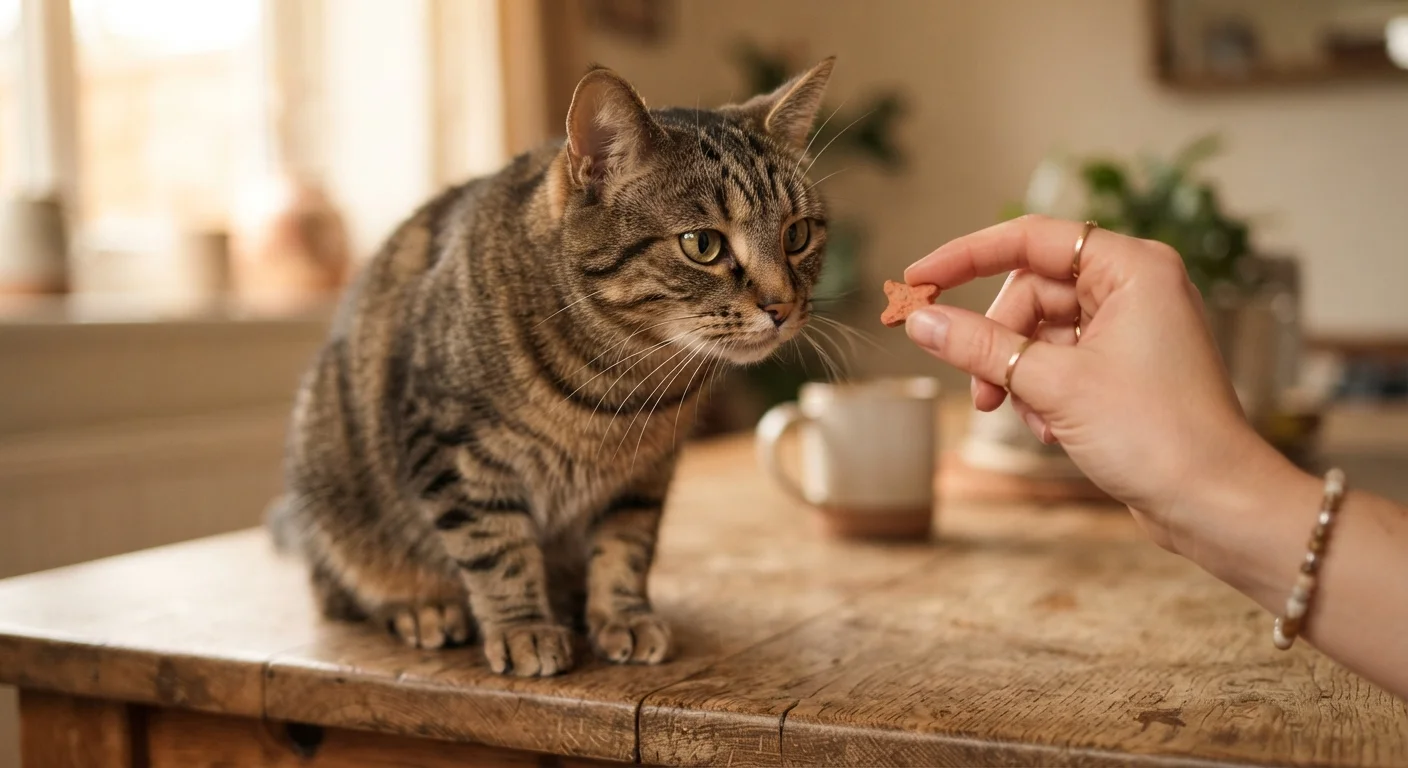
Why Cat Training Myths Persist
Cats have a reputation that dogs never earned: aloof, independent, fundamentally untrainable. That reputation has less to do with feline biology and more to do with how most people have tried - and abandoned - training attempts. When a method fails, owners rarely question the method. They question the cat.
The science tells a different story. Behavioral research consistently shows that cats respond to operant conditioning - particularly positive reinforcement - in ways that parallel dogs and other trainable animals. The myths that keep owners stuck aren't harmless misunderstandings. They actively prevent cats and people from building the kind of relationship both benefit from. Understanding what's actually true is the first step toward changing that.
For a broader look at how subtle training errors compound over time, see our piece on why pet training stalls.
Myth
Cats simply can't be trained - they're too independent to follow instructions.
Fact
Cats are fully capable of learning behaviors on cue; they just respond poorly to the methods commonly used for dogs.
Independence is a personality trait, not an inability to learn. Cats are highly motivated by self-interest - which is exactly what positive reinforcement training capitalizes on. When a behavior reliably produces something the cat values (food, play, affection), they repeat it. Studies in applied animal behavior confirm cats can learn complex tasks including name recognition, touch targeting, and even puzzle-solving behaviors. The real issue is that most owners give up before finding the right motivator or technique.
Myth
Punishing a cat for bad behavior - like spraying water or yelling - teaches them what not to do.
Fact
Punishment rarely stops unwanted behavior in cats and frequently damages the human-cat bond.
Cats do not connect punishment with the behavior that prompted it the way owners hope. Instead, they associate the negative experience with the owner or the environment - becoming fearful or avoidant rather than better behaved. Behavioral science strongly favors redirecting unwanted behavior and rewarding desired alternatives. Punishment-based approaches are more likely to create a stressed, withdrawn cat than a cooperative one.
Myth
You can't teach an old cat new tricks - training only works with kittens.
Fact
Adult and senior cats can learn new behaviors; the process may require more patience, but age alone is not a barrier.
Neuroplasticity - the brain's ability to form new associations - persists throughout a cat's life. Older cats may take slightly longer to generalize a new behavior or may need higher-value rewards, but they are not incapable of learning. In fact, adult cats often have better focus and impulse control than kittens, which can make training sessions more productive. What matters most is motivation, consistency, and appropriate session length - not the cat's age.
Myth
If a cat ignores a cue, it's being stubborn or spiteful.
Fact
A cat that doesn't respond to a cue is usually signaling a training, motivation, or environmental problem - not defiance.
Cats do not experience spite in the way the word implies. When a trained behavior breaks down, the more productive questions are: Has the cue become inconsistent? Is the reward still motivating? Is the cat stressed, unwell, or distracted? Behavioral non-response is data, not attitude. Revisiting the foundational steps - clear cue, immediate reward, low-distraction environment - resolves most cases of apparent stubbornness more reliably than escalating pressure.
Myth
Cats only respond to food, so training is impossible if your cat isn't food-motivated.
Fact
Cats can be trained using a range of reinforcers including play, affection, and access to preferred locations.
While food-based rewards are the most convenient training tool, they aren't the only option. Some cats are highly motivated by a specific toy, brief interactive play, access to a window perch, or even grooming from a trusted owner. The key is identifying what the individual cat values enough to work for - and that varies considerably between animals. A cat that turns its nose up at kibble might be highly motivated by a feather wand or a few seconds of chin scratching.
Myth
Cats scratch furniture out of spite or to deliberately destroy things.
Fact
Scratching is a normal, instinctive behavior serving multiple functions - it is not intentional destruction.
Scratching allows cats to condition their claws, stretch key muscle groups, and deposit scent from glands in their paws - a form of territorial communication. Cats are not choosing the armchair to annoy anyone. Effective management means providing appropriate scratching surfaces that satisfy these needs (ideally vertical, sisal-covered, and tall enough for a full stretch) and using positive reinforcement to direct the cat toward them. Punishment for scratching ignores the biological drive behind it and rarely produces lasting change.
What Better Cat Training Actually Looks Like
Debunking myths is only useful if it points toward something concrete. Effective cat training shares a few consistent features: sessions are short (two to five minutes), rewards are highly motivating and delivered immediately after the target behavior, and cues are kept simple and consistent. Cats are exquisitely sensitive to timing - a reward delivered three seconds late teaches the wrong lesson entirely.
Never Train a Stressed or Unwell Cat
Attempting to train a cat that is in pain, sick, or highly anxious will not produce results and may worsen their stress. If your cat has become suddenly withdrawn, aggressive, or has stopped engaging with things it previously enjoyed, consult a veterinarian before assuming the issue is behavioral. Medical causes for behavioral changes are common and should always be ruled out first.
Environment matters too. A cat that is overstimulated, anxious, or in pain will not engage with training no matter how skilled the owner. Ruling out underlying health or stress factors before labeling a cat "difficult" is essential. If your cat has recently changed behavior, a veterinary check-in is always a reasonable first step.
Owners who build real behavioral consistency with their cats tend to share a common mindset: patience, realistic expectations, and a willingness to adapt. That approach applies across species. What well-behaved pets' owners do differently is worth exploring once the fundamentals are in place.
This article is for general informational purposes only and is not a substitute for professional veterinary or behavioral advice. If your cat is showing signs of distress, anxiety, or sudden behavioral change, consult a qualified veterinarian or certified animal behaviorist.
The content provided on our blog site traverses numerous categories, offering readers valuable and practical information. Readers can use the editorial team’s research and data to gain more insights into their topics of interest. However, they are requested not to treat the articles as conclusive. The website team cannot be held responsible for differences in data or inaccuracies found across other platforms. Please also note that the site might also miss out on various schemes and offers available that the readers may find more beneficial than the ones we cover.