

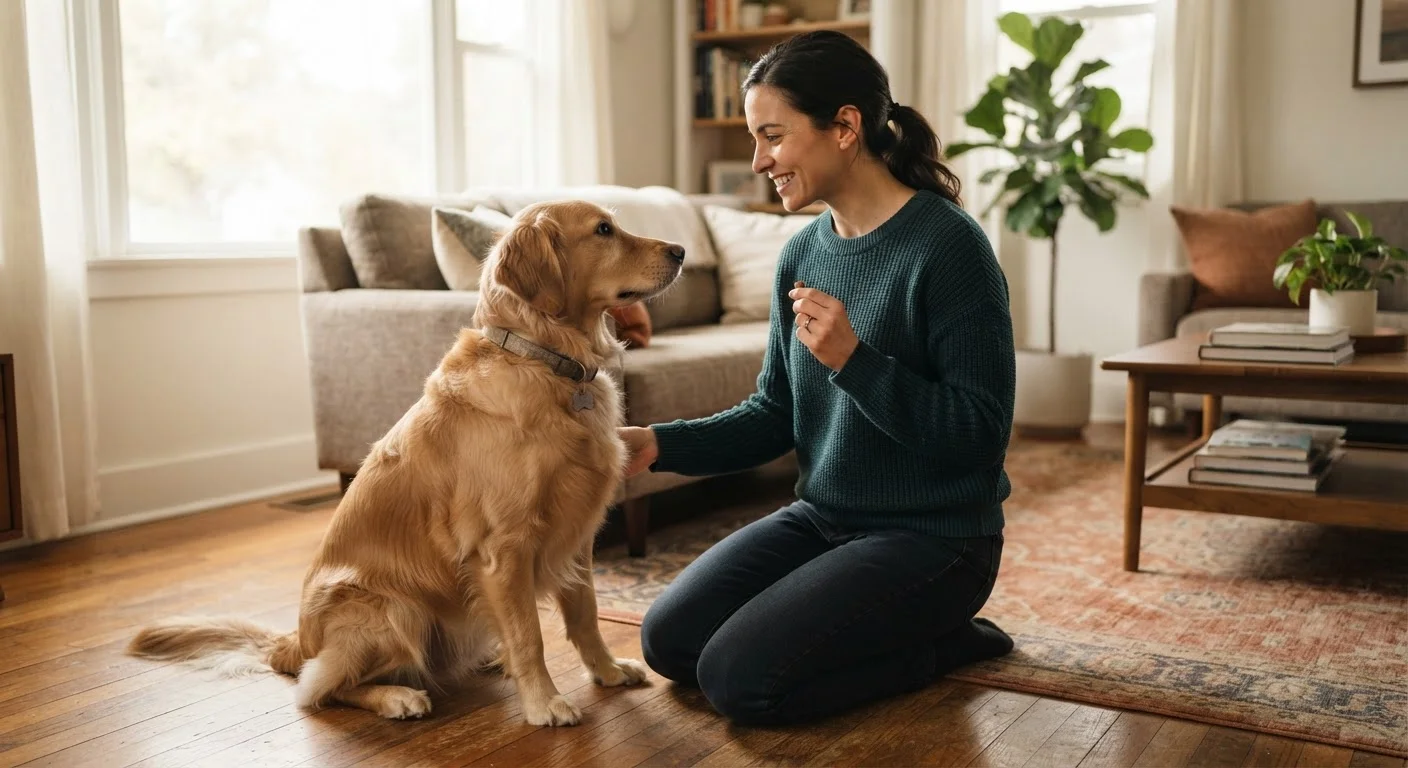
Why Training Stalls Without an Obvious Cause
Most pet owners who hit a training plateau aren't doing anything dramatically wrong. The patterns that derail progress tend to be subtle - slight inconsistencies, small timing errors, habits that made sense early on but don't scale. Understanding these patterns is the first step toward breaking through them.
It's also worth recognizing that stalled training isn't a reflection of your pet's intelligence or your value as an owner. Pets learn through repetition, timing, and environmental signals - and when those elements drift, progress drifts with them. Why dogs repeat unwanted behaviors even after correction explores the mechanics of habit formation in more depth, and it's useful context for anyone feeling stuck.
Consistency Is Non-Negotiable
Every person in your household must use the same cues, rules, and expectations. One family member allowing the dog on the couch while another corrects it teaches your pet that rules are unpredictable - not that a behavior is wrong. Mixed signals are one of the leading reasons training stalls entirely.
The Mistakes That Quietly Hold You Back
The following errors are among the most common - and the most fixable. None require starting over from scratch. They simply require noticing what's happening and making a deliberate adjustment.
Using different words or hand signals for the same command across sessions or between household members.
Why it happens: Owners adapt naturally in conversation and don't always realize how much variation they introduce. One person says 'sit,' another says 'sit down,' and a third uses a hand gesture alone.
Delivering the reward too late - after the pet has already moved on to a different behavior.
Why it happens: Owners often pause to reach for a treat, fumble with a bag, or praise the pet verbally first. By the time the reward arrives, the pet's brain has moved on.
Running training sessions too long, expecting more repetitions to equal faster learning.
Why it happens: Owners who are motivated to see results often push sessions past the point of productive engagement, assuming longer equals better.
Only practicing trained behaviors at home, in the same room, with no distractions.
Why it happens: The controlled home environment feels safe and produces reliable results, so owners understandably default to it. But pets learn in context, not in the abstract.
Over-relying on food treats so that the behavior only appears when a treat is visible.
Why it happens: Food is a highly effective motivator, and early training success with treats can lead owners to never transition away from constant food rewards.
Repeating a cue multiple times when the pet doesn't respond immediately.
Why it happens: Owners assume the pet didn't hear or understand, so they repeat 'sit, sit, sit' hoping compliance follows.
For owners working with cats, many of these same principles apply. Cat training myths most owners still believe addresses how feline learning is frequently misunderstood, often in ways that mirror the dog-training errors above.
Building Habits That Actually Stick
The owners whose pets behave consistently well aren't training harder - they're training more deliberately. The habits of pet owners whose animals behave well consistently outlines what that looks like in practice: clear communication, realistic expectations, and routines that reinforce training without requiring constant formal sessions.
Don't Train Through Fatigue or Frustration
Pets are highly attuned to their owner's emotional state. If you're frustrated, your pet likely already knows it - and that stress can become associated with the training activity itself. End any session that has gone sideways with a simple, easy win (a behavior your pet already knows well), then take a genuine break before resuming.
3-5 min
Optimal session length for puppies
Animal behaviorists broadly recommend very short, focused sessions for young dogs, as attention spans and impulse control are still developing.
~1 sec
Ideal reward delivery window
Behavioral research on operant conditioning suggests rewards should follow the target behavior within roughly one second to form a clear association.
One underappreciated factor is environment. Pets pick up behavioral cues from their daily context - including feeding routines, exercise patterns, and how household stress is managed. If your pet's broader environment is chaotic or unpredictable, training in isolation will always feel like pushing uphill. Addressing the full picture, including what happens between sessions, is what separates slow progress from genuine, lasting change.
The content provided on our blog site traverses numerous categories, offering readers valuable and practical information. Readers can use the editorial team’s research and data to gain more insights into their topics of interest. However, they are requested not to treat the articles as conclusive. The website team cannot be held responsible for differences in data or inaccuracies found across other platforms. Please also note that the site might also miss out on various schemes and offers available that the readers may find more beneficial than the ones we cover.