

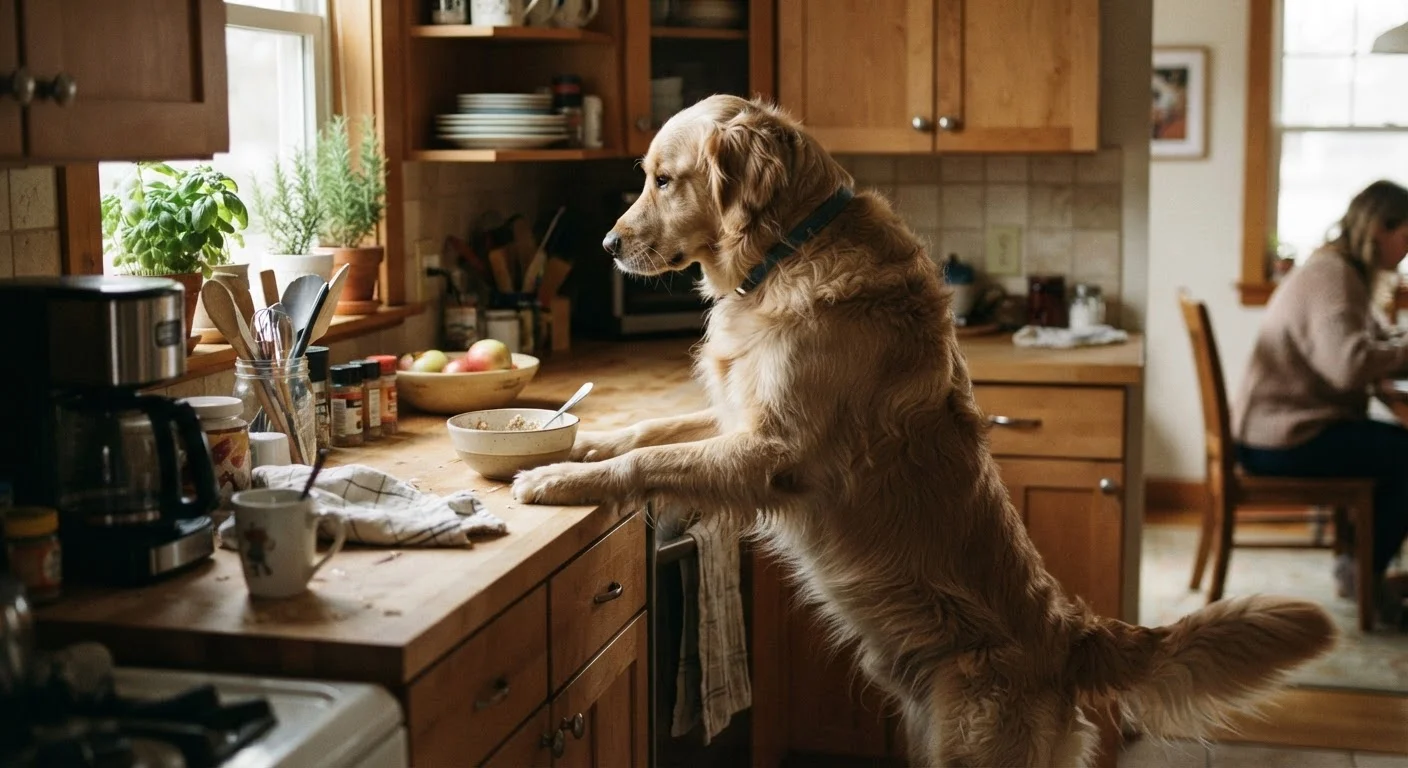
Why These Behaviors Happen
Counter-surfing, jumping on people, and excessive barking frustrate millions of dog owners - but each behavior has a clear, logical origin. Dogs aren't misbehaving out of spite. They're doing what has worked for them before, or what their biology drives them toward. Understanding the why is the foundation of any lasting fix.
| Most common nuisance behaviors | Counter-surfing, jumping, and barking |
| Primary driver of nuisance behavior | Past reinforcement (intentional or accidental) |
| Most effective training principle | Consistent responses from all household members |
| When to seek professional help | If behavior is severe, sudden, or linked to anxiety or aggression |
| Key management strategy | Remove access to rewards before changing the behavior |
Counter-surfing is almost always reinforced by reward: your dog found food up there once, and that memory is strong. Jumping greets people because it brings face-to-face contact - something dogs naturally seek. Barking serves communication: alerting, seeking attention, expressing anxiety, or responding to other dogs. The common thread is that each behavior has delivered a payoff at some point, which is why consistent responses from owners matter so much.
For a deeper look at what your dog is actually communicating before these behaviors escalate, see Body Language Every Dog Owner Should Recognize.
Counter-Surfing: What It Is and How to Address It
Counter-surfing describes any behavior in which a dog places paws on a surface - kitchen counter, dining table, coffee table - to investigate or steal food or objects. It's especially common in tall, food-motivated breeds, though any dog can develop the habit.
Why It Persists
Even one successful food theft puts the behavior on what behaviorists call a variable reinforcement schedule - the most powerful schedule for maintaining any habit. The dog doesn't know when the counter will pay off again, so it keeps trying.
General Approaches
- Management first: Remove the reward. Keep counters clear of food when unsupervised. A dog that never succeeds eventually stops attempting.
- Teach an incompatible behavior: "Four on the floor" or a reliable "place" cue gives the dog something else to do when in the kitchen.
- Avoid punishment-only approaches: Punishing after the fact is ineffective; dogs don't reliably connect delayed correction to a previous action.
Jumping: Managing Excited Greetings
Jumping is one of the most socially disruptive nuisance behaviors - and one of the most commonly reinforced. Every time a jumping dog receives eye contact, a push, or even a verbal reprimand, it registers social engagement as a reward.
Variable reinforcement schedule
A reward pattern in which a behavior is reinforced unpredictably rather than every time. This schedule produces the most persistent behaviors and is why occasional food theft makes counter-surfing so hard to extinguish.
Incompatible behavior
A behavior that physically cannot occur at the same time as the problem behavior. Teaching a dog to sit, for example, is incompatible with jumping because a dog cannot do both simultaneously.
Demand barking
Vocalization used by a dog to solicit attention, food, or play from a person. It is strengthened whenever the owner responds - even with a correction.
Trigger stacking
The cumulative effect of multiple low-level stressors that push a dog past its threshold for calm behavior. A dog that barks excessively may be responding to several stacked triggers rather than a single event.
Consistent Responses Are Critical
The biggest obstacle to stopping jumping is inconsistency. If jumping is ignored by one family member but rewarded with attention by another, the behavior strengthens. Everyone in the household - and regular visitors - needs to respond the same way.
Effective Strategies
- Withdraw attention completely: Turn away, cross arms, avoid eye contact. Attention of any kind - even negative - can reinforce jumping.
- Reward four on the floor: The moment all paws are down, deliver calm praise or a treat. You're teaching the dog what does earn attention.
- Practice structured greetings: Ask for a sit before opening the door to guests. Repetition builds the habit.
Owners of consistently well-behaved dogs tend to share one trait: they respond the same way every time, removing guesswork for the animal.
Barking: Reading the Type Before Responding
Not all barking is the same, and treating it as a single problem leads to ineffective solutions. Dogs bark to alert, to seek attention, out of fear or frustration, or in response to territorial triggers. Identifying the type of barking is the first step.
When Barking May Signal a Health Issue
A sudden increase in barking - especially in older dogs - can sometimes indicate pain, cognitive decline, or hearing loss rather than a behavioral issue. If your dog's vocalization pattern changes abruptly without an obvious environmental cause, a veterinary checkup is a sensible first step before pursuing behavioral training alone.
Common Barking Categories
- Alert barking
- Triggered by sounds or movement outside. Often self-limiting once the stimulus passes.
- Demand barking
- Used to solicit food, play, or attention. Reinforced when the owner responds to it.
- Anxiety or frustration barking
- Occurs during confinement, separation, or unmet needs. May require structured behavior modification and veterinary input if severe.
- Social barking
- Triggered by other dogs barking nearby. Can become a conditioned response over time.
General Approaches by Type
- For alert barking, limit access to high-stimulus windows or teach a reliable "enough" cue followed by redirection.
- For demand barking, withhold all reward until the dog is quiet - even briefly - then reinforce the silence.
- For anxiety-based barking, address the underlying trigger rather than the symptom. Consult a certified professional trainer or veterinary behaviorist if the behavior is persistent or distressing.
Understanding how a dog's behavior patterns shift across life stages - including when problem behaviors tend to peak - is covered in Understanding Pet Behavior From Puppyhood Through Senior Years.
This article is for general informational purposes only and is not a substitute for professional veterinary or behavioral advice. If your dog's behavior is causing safety concerns or appears linked to a medical issue, consult a licensed veterinarian or certified applied animal behaviorist.
The content provided on our blog site traverses numerous categories, offering readers valuable and practical information. Readers can use the editorial team’s research and data to gain more insights into their topics of interest. However, they are requested not to treat the articles as conclusive. The website team cannot be held responsible for differences in data or inaccuracies found across other platforms. Please also note that the site might also miss out on various schemes and offers available that the readers may find more beneficial than the ones we cover.