

Our Verdict
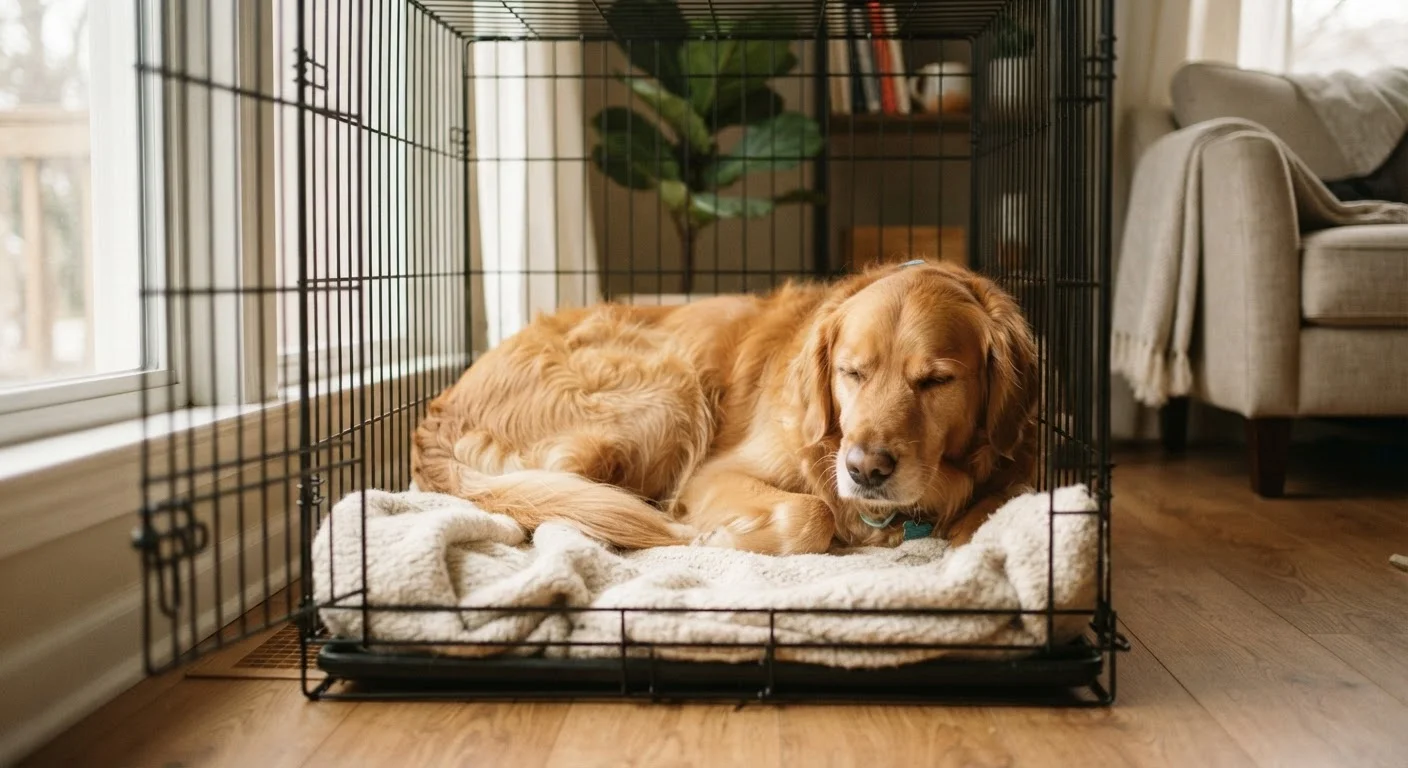
Crate training is a genuinely useful tool when applied thoughtfully and humanely - it supports housetraining, protects curious puppies, and gives dogs a defined safe space. Its value depends entirely on how it is introduced and how much time a dog spends inside it. Used as a shortcut for convenience or a substitute for engagement, a crate quickly becomes counterproductive.
Crate training is best suited to puppy owners working through housetraining, owners managing a dog's recovery from illness or injury, and households where a structured safe space genuinely improves a dog's comfort and confidence.
Why Crates Divide Opinion
Few dog training topics generate as much disagreement as crate use. For some owners, a crate is a non-negotiable housetraining essential. For others, shutting a dog in a box feels intuitively cruel. Both reactions are understandable - and both can be correct, depending on how the crate is actually used.
The honest answer is that a crate is neither inherently good nor bad. It is a tool, and like any tool, its value comes down to application. Understanding what crates genuinely offer - and where they fall short - helps owners make an informed choice rather than defaulting to either camp out of habit or emotion.
For a broader perspective on how training decisions affect outcomes, see our look at reward-based versus correction-based training methods.
The Real Benefits of Crate Training
When introduced correctly, crates offer dogs and owners several concrete advantages.
Accelerates housetraining in puppies and new dogs
Dogs instinctively avoid soiling their sleeping area, making a correctly sized crate a reliable aid for building bladder control and establishing a consistent outdoor schedule.
Prevents access to household hazards
Unsupervised dogs - especially puppies - can chew electrical cords, swallow foreign objects, or access toxic substances. A crate eliminates these risks during periods when direct supervision isn't possible.
Provides a defined retreat space
When introduced positively, many dogs voluntarily use their crate as a quiet resting spot, which can reduce overstimulation in busy or multi-pet households.
Supports recovery from illness or surgery
Veterinarians frequently recommend crate rest following procedures or injuries to restrict movement during healing - a dog already comfortable in a crate tolerates this far better.
Eases travel and veterinary stays
Crate-comfortable dogs handle car travel, airline transport, and overnight veterinary stays with less stress, because confinement in those contexts already feels familiar and safe.
Housetraining is arguably the clearest use case. Dogs are naturally reluctant to soil the space they sleep in, which makes a properly sized crate a reliable way to build bladder control in puppies. Paired with a consistent outdoor schedule, it accelerates the process considerably.
Safety management is equally important. Puppies and newly adopted dogs explore with their mouths. Unsupervised access to a home can lead to chewed electrical cords, swallowed hazards, or damaged belongings - risks a crate eliminates during the hours supervision isn't possible.
The Limitations Owners Often Overlook
Crates solve specific problems. They do not solve all problems - and misapplying them can create new ones.
Can worsen existing separation anxiety
Dogs with separation anxiety often experience heightened distress when confined, potentially leading to self-injury or destructive escape attempts. Crating is not an appropriate intervention for anxiety-based behavior problems.
Overuse leads to physical and behavioral problems
Excessive daily confinement restricts exercise, social interaction, and mental stimulation - all of which are essential for canine welfare. Dogs confined too long may develop frustration, hyperactivity, or depression.
Not suitable for every individual dog
Some dogs - particularly those with prior trauma involving confinement - never become comfortable in a crate regardless of how carefully it is introduced. Forcing the issue worsens trust and sets back training broadly.
Often misused as punishment
Sending a dog to a crate after misbehavior teaches the dog to associate the space with negative emotion, undermining the calm, positive association the crate relies on to be effective.
Creates dependency if never phased out
Dogs kept on a crate schedule indefinitely may struggle to self-regulate in open spaces when circumstances change, limiting their flexibility and the owner's freedom.
One underappreciated issue involves dogs who are already anxious. For a dog with separation anxiety, a crate can intensify distress rather than provide comfort. These dogs may injure themselves attempting to escape, and confining them does nothing to address the underlying anxiety. If your dog shows signs of significant distress when left alone, consult a veterinary behaviorist or certified applied animal behaviorist before introducing crate confinement. This article provides general information and is not a substitute for professional behavioral guidance.
If training progress has stalled after introducing a crate, broader patterns may be at play - this guide on common training derailments is worth reviewing.
Crate Size Matters More Than Most Owners Realize
A crate should be large enough for the dog to stand, turn around, and lie down comfortably - but not so large that one end becomes a bathroom corner. For puppies expected to grow significantly, many owners use dividers to adjust the usable space as the dog develops. An oversized crate removes the natural reluctance to soil sleeping quarters that makes housetraining work.
How to Use a Crate Without Creating Problems
The difference between a crate that helps and one that harms comes down to introduction method and daily time limits.
Gradual desensitization - feeding meals near the crate, rewarding calm entry, building duration slowly - teaches a dog that the crate predicts good things rather than isolation. Rushing this process, or using the crate as a reaction to misbehavior, undermines the association you are trying to build.
Time limits deserve equal attention. Veterinary and behavioral guidance generally suggests adult dogs should not be confined for more than four to six hours at a time, and puppies far less. A crate used for eight or more hours on workdays is a welfare concern, not a training strategy.
4-6 hrs
Maximum recommended adult dog crating time
Most veterinary and animal welfare guidance suggests adult dogs should not be crated for more than four to six consecutive hours during the day.
1 hr/month
Approximate puppy bladder-hold guideline
A commonly cited behavioral guideline suggests puppies can hold their bladder roughly one hour per month of age, up to a maximum of around four hours.
The long-term goal matters too. A crate is most useful during the housetraining window and early settling-in period. Many dogs, once reliably housetrained and comfortable in the home, no longer need it - and many owners find the crate door stays permanently open as a voluntary resting spot. That transition is the success state, not permanent daily confinement.
Rescue dog owners in particular should approach crate introduction with patience. Dogs arriving from shelters may have unknown histories with confinement. Training an adult rescue dog requires building trust first, with tools introduced gradually rather than imposed immediately.
The content provided on our blog site traverses numerous categories, offering readers valuable and practical information. Readers can use the editorial team’s research and data to gain more insights into their topics of interest. However, they are requested not to treat the articles as conclusive. The website team cannot be held responsible for differences in data or inaccuracies found across other platforms. Please also note that the site might also miss out on various schemes and offers available that the readers may find more beneficial than the ones we cover.