

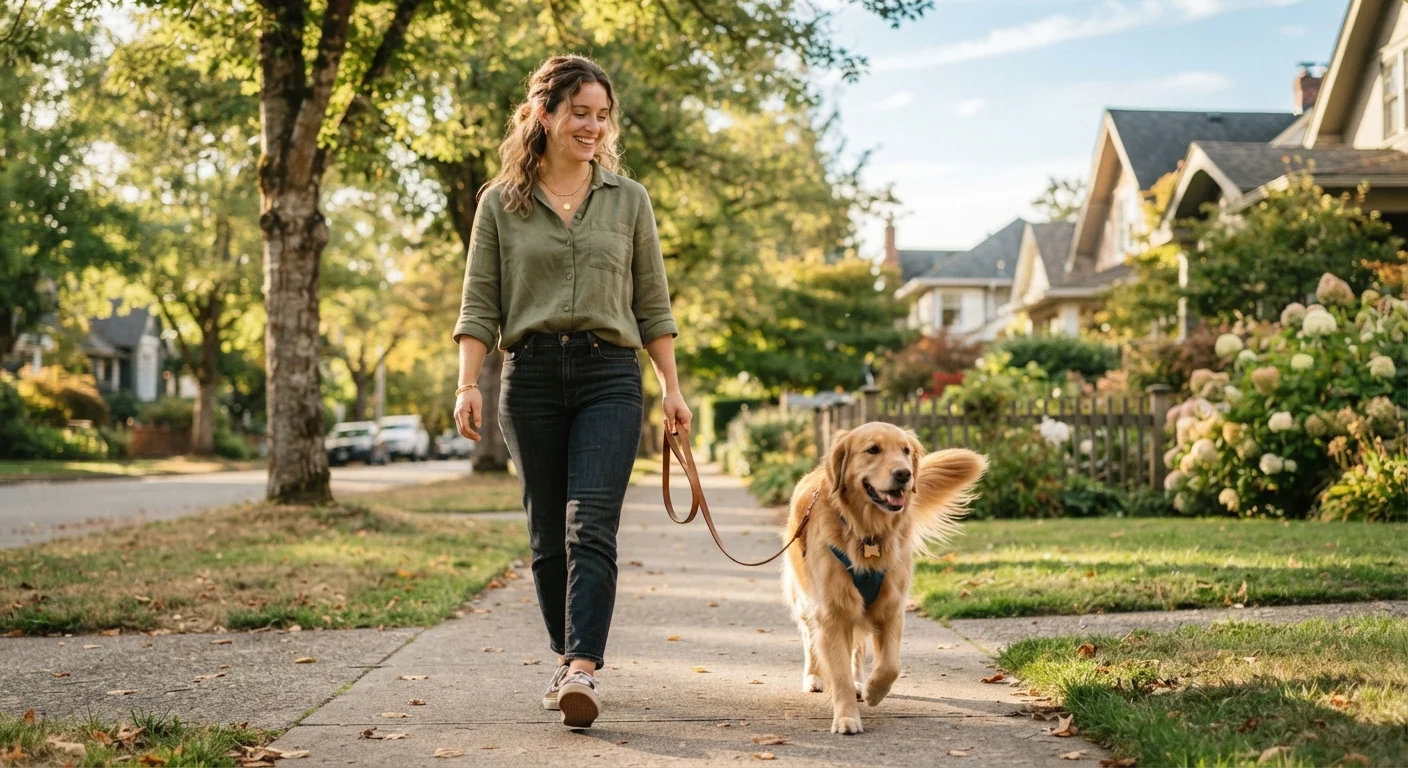
Why Dogs Pull - and Why It's Not About Dominance
Dogs pull on leashes for a straightforward reason: it has worked. Every time a pulling dog reaches the fire hydrant, the other dog, or the interesting smell, the behavior is reinforced. Pulling is not a power struggle or a sign of disrespect - it is a learned habit shaped by outcomes. Understanding this matters because it shifts the training goal from suppressing a dog's will to simply changing what the dog finds rewarding.
Breed tendencies also play a role. Dogs bred for scent work, herding, or pulling tasks often have higher baseline arousal and stronger environmental draw. That doesn't make loose-leash walking impossible - it means those dogs may need more repetitions and higher-value rewards before the habit takes hold.
If you're building foundational skills with a young dog, the first weeks of training are an ideal time to introduce leash manners before pulling has a chance to become ingrained.
What you will need
Equipment, Setup, and What to Expect
The right equipment makes a meaningful difference, but no tool teaches walking by itself - only consistent training does. A front-clip harness reduces the mechanical advantage a dog gains when it leans forward, which makes pulling less effective without requiring any correction from the handler. Standard flat collars are fine for many dogs, but can put pressure on the trachea during sustained pulling. Slip leads and prong or choke collars are not recommended for this method, as they rely on discomfort rather than communication.
Retractable leashes are particularly counterproductive during training. They teach dogs that pressure on the leash causes extension - the opposite of the lesson you're trying to deliver. A fixed 4-6 foot leash keeps feedback clear.
Front-clip harness
Redirects forward pulling force to the dog's side, making pulling physically less effective.
Standard 4-6 ft leash
Gives the handler precise control and clear feedback through leash tension.
High-value training treats
Motivates the dog to choose walking near the handler over pursuing distractions.
Clicker or verbal marker
Precisely marks the exact moment the dog performs the desired loose-leash behavior.
Treat pouch
Keeps rewards accessible for rapid, well-timed delivery during outdoor sessions.
Expect real progress within 2-4 weeks of consistent daily practice for most dogs, though individual variation is significant. If progress stalls or the dog's pulling is accompanied by lunging, reactivity toward other dogs, or anxiety, consider consulting a certified professional dog trainer. The choice between group classes and private sessions depends on your dog's specific challenges and your training goals.
Sniff Breaks Are Part of the Deal
Allowing your dog to stop and sniff on walks isn't a training failure - it's necessary mental enrichment. Build designated sniff breaks into your walk by releasing the dog with a cue like "go sniff" at a chosen spot. This makes the structured walking portions clearer by contrast and gives the dog something to work toward.
Troubleshooting Common Setbacks
Even with good technique, progress isn't always linear. A few patterns derail loose-leash training more often than others:
- Inconsistent responses: If you sometimes let pulling slide - when you're in a hurry, or the dog is very excited - you're placing the behavior on a variable reinforcement schedule, which actually makes it more persistent, not less. Common training patterns that quietly stall progress include exactly this kind of unintentional inconsistency.
- Treat dependency fears: Many owners worry their dog will only walk well when treats are visible. Gradually vary when and how often you reward - the goal is an unpredictable reward schedule that keeps the dog checking in. Over time, praise, sniff breaks, and forward movement become their own rewards.
- Regression after a break: Dogs that walk well for weeks may regress after illness, a household change, or simply a gap in practice. Return to an easier environment rather than pushing through the previous level.
Leash walking is one of the most practiced skills in a dog's life - and one of the most worth getting right. A dog that walks politely is a dog that gets walked more often, which benefits its physical health, mental stimulation, and the broader human-animal relationship.
Reactivity Requires Professional Support
If your dog lunges, growls, or snaps at other dogs, people, or vehicles during walks, loose-leash training alone is not sufficient. These behaviors indicate leash reactivity - a specific behavioral issue that benefits from assessment by a certified professional dog trainer or veterinary behaviorist. Attempting to manage reactivity without guidance can escalate the behavior or put others at risk.
The content provided on our blog site traverses numerous categories, offering readers valuable and practical information. Readers can use the editorial team’s research and data to gain more insights into their topics of interest. However, they are requested not to treat the articles as conclusive. The website team cannot be held responsible for differences in data or inaccuracies found across other platforms. Please also note that the site might also miss out on various schemes and offers available that the readers may find more beneficial than the ones we cover.