

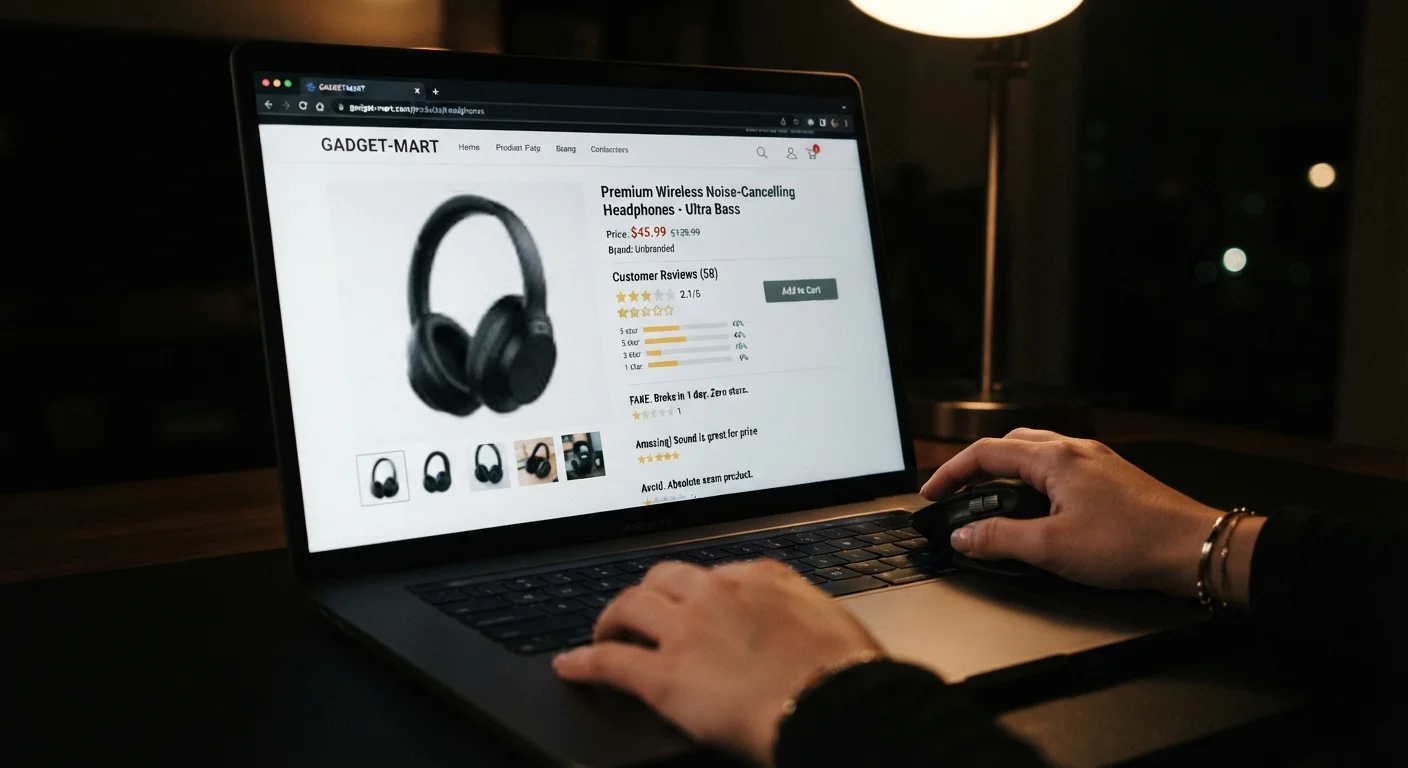
Why Marketplace Red Flags Matter
Online marketplaces have made it possible to buy almost anything from almost anywhere - but that openness works in both directions. The same platforms that connect consumers to legitimate small businesses also host misleading listings, counterfeit goods, and outright scams. The problem isn't that bad sellers are impossible to spot; it's that most shoppers don't know what to look for until after they've been burned.
This isn't about avoiding online shopping altogether. It's about reading the signals that are already embedded in every listing. Once you know the patterns, a five-minute review of any product page tells you far more than the seller intends. The red flags below are consistent across categories - whether you're buying electronics, clothing, home goods, or pet supplies.
For a broader framework before committing to any purchase, see our complete consumer protection guide.
Blurry, stolen, or stock-only photos
A legitimate seller who actually holds inventory photographs it. When a listing relies entirely on manufacturer stock images - or worse, shows blurry, low-resolution photos that obscure details - it's often because the seller has never handled the product. Reverse-image searching the photos (right-click on desktop browsers) frequently reveals they've been lifted from unrelated sources or recycled across dozens of separate listings. Real products have shadows, imperfections, and context. Stock photos don't.
If a seller can't photograph their own inventory, question whether they have it at all.
Review patterns that don't add up
A 4.8-star average sounds reassuring until you examine the composition. Watch for clusters of reviews posted on the same day, reviews that read identically or use suspiciously similar phrasing, and a disproportionate split between five-star and one-star ratings with almost nothing in between. Verified purchase labels help but are not foolproof. Review manipulation is more common than most shoppers expect - reading the one- and two-star reviews in detail often reveals recurring quality or shipping issues that the aggregate score hides.
The distribution of reviews matters more than the average star rating.
No return policy, or one buried in vague language
"All sales final" and "returns accepted" are not the same thing, but many listings blur the line. Before purchasing, find the actual return window, who pays return shipping, whether restocking fees apply, and what counts as a valid return reason. Sellers who make this information difficult to locate are structuring things so you can't easily get your money back. Our breakdown of what return policies actually say walks through the specific clauses worth checking.
A vague return policy is a financial risk transferred entirely to the buyer.
Prices that defy category norms
Extreme underpricing is a signal, not a gift. When a product is listed at a fraction of what comparable items consistently sell for - across multiple sellers and platforms - the explanation is rarely that you've found a hidden deal. More commonly it means counterfeit materials, misrepresented specifications, or a listing designed to collect payment without delivering. Verifying authenticity before paying is especially important when price is the primary selling point.
Prices far below category norms usually reflect what's actually in the box.
Seller profiles with thin or inconsistent history
Marketplace seller profiles carry meaningful accountability signals. A seller with fewer than a handful of completed transactions, an account created recently, or a name that doesn't match the storefront branding warrants more scrutiny. Look for a verifiable business address, functioning customer service contact, and a feedback history that extends across time - not just a sudden burst of recent activity. Copycat storefronts and newly created accounts are among the most common vehicles for marketplace fraud.
A seller's account history is a transparency record - thin history means thin accountability.
Product descriptions full of errors or keyword stuffing
Listing copy that's full of grammatical errors, inconsistent product names, or irrelevant keyword lists crammed into the title is frequently a sign of a drop-shipping operation that has copied descriptions without understanding or verifying them. It can also indicate machine-translated text from a source with no direct knowledge of the product. Compare the listing description against manufacturer documentation when possible, and be skeptical of specifications that are vague, contradictory, or lifted verbatim from an unrelated product. For a practical pre-purchase review process, see our product evaluation checklist.
Incoherent listing copy signals a seller with no direct knowledge of what they're selling.
Before You Click Buy
No single red flag means a listing is automatically fraudulent - but multiple flags appearing together should stop you cold. The goal is to build a habit of quick, systematic checks rather than relying on gut feeling or a headline price.
Use Payment Methods With Dispute Protection
When shopping on any marketplace, using a credit card or a payment service with documented buyer protection gives you a recourse path if a transaction goes wrong. Debit cards, wire transfers, and gift card payments typically offer no protection once funds are sent. This is a structural safeguard, not a substitute for pre-purchase scrutiny.
If a deal is triggering urgency - a countdown timer, a "only 3 left" warning, or a price that seems impossibly low - slow down deliberately. Our guide on deals that aren't really deals explains the pricing tactics designed to override your judgment. And before buying anything trending on social media, run it through our pre-purchase checklist first.
This article is for general informational purposes only. It does not constitute legal or financial advice. If you believe you have been the victim of fraud, contact your payment provider and relevant consumer protection authorities.
The content provided on our blog site traverses numerous categories, offering readers valuable and practical information. Readers can use the editorial team’s research and data to gain more insights into their topics of interest. However, they are requested not to treat the articles as conclusive. The website team cannot be held responsible for differences in data or inaccuracies found across other platforms. Please also note that the site might also miss out on various schemes and offers available that the readers may find more beneficial than the ones we cover.