

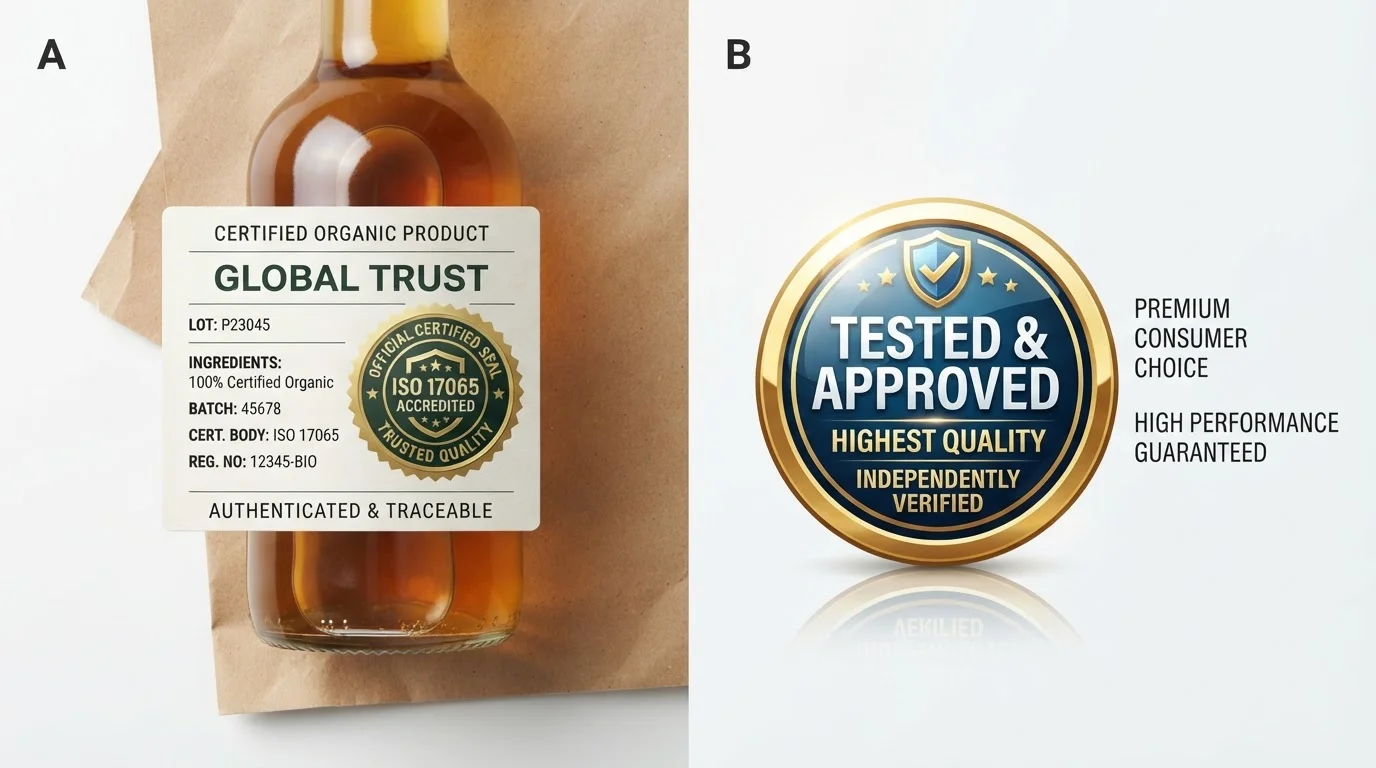
Option A
Third-Party Certifications
Independent, standardized verification from an outside authority.
Best for: Consumers who need reliable, audited assurance that a product meets defined safety, quality, or environmental standards.
Option B
Brand Claims
Self-reported marketing language controlled entirely by the seller.
Best for: Getting a quick sense of how a company positions its product - but requiring additional scrutiny before being taken at face value.
Why the Source of a Claim Changes Everything
Walk through any retail site and you'll see product pages loaded with confidence-inspiring language: "clinically tested," "dermatologist-approved," "certified organic," "lab-verified." These phrases feel authoritative, but they sit on a wide spectrum of reliability - from rigorous independent audits to language a marketing team wrote over a Tuesday lunch.
The fundamental distinction is accountability. A brand claim is self-reported. The company decides what "tested" means, runs whatever process it sees fit, and publishes the result with no outside check. A third-party certification, by contrast, is issued by an independent organization operating against a defined public standard - one the brand didn't write and can't quietly revise.
As the complete product evaluation framework outlines, certifications are among the most durable signals of quality because they exist outside any single seller's control. That accountability gap between a brand's word and an auditor's verdict is exactly what consumers need to understand before a purchase.
| Criterion | Third-Party Certifications | Brand Claims |
|---|---|---|
| Who sets the standard | Independent external organization | The brand itself |
| Verification process | Audits and testing by certifier | Defined and conducted internally |
| Transparency | Standards published publicly | Methodology rarely disclosed |
| Ongoing oversight | Periodic re-audits required | No external renewal process |
| Cross-brand comparability | Consistent - same standard applies to all | Inconsistent - definitions vary by brand |
| Verifiability | Searchable in certifier registry | Generally not independently verifiable |
| Accountability for failure | Certification can be revoked | No formal consequence mechanism |
What a Legitimate Third-Party Certification Actually Looks Like
Not every seal is created equal - but genuine certifications share a few recognizable traits. First, the certifying body is named and independently identifiable: organizations like UL (Underwriters Laboratories) for electrical safety, NSF International for water filtration and food equipment, or USDA Organic for agricultural products. These bodies publish their standards publicly and maintain searchable registries of certified products.
Second, certification involves ongoing oversight. A product isn't certified once and forgotten - periodic audits, re-testing, and renewal requirements keep the standard meaningful. If a product fails to meet updated requirements, certification can be revoked.
Third, the standard itself is transparent. You can look up what ISO 9001 or ENERGY STAR actually requires. This separates real certifications from "trust badges" - those official-looking shield graphics that some brands generate in-house or purchase from pay-to-play services that impose no actual testing requirements.
~30%
Products with misleading eco-labels
A 2021 European Commission screening found roughly 42 of 150 reviewed green claims were exaggerated, vague, or unsubstantiated - approximately 30% of those assessed.
700+
Ecolabels tracked globally
Ecolabel Index, an independent tracking site, catalogues over 700 environmental certification schemes worldwide, highlighting significant variation in rigor and independence.
A practical rule: if you can't find the certifying organization through a basic search, verify the product on that organization's own website, and confirm the standard being referenced - treat the mark with the same skepticism you'd apply to any brand claim.
Where Brand Claims Blur Into Misleading Territory
Brand claims aren't inherently dishonest, but the language most commonly used is almost structurally designed to overstate. Terms like "natural," "safe," "premium," and "tested" have no standardized legal definitions in most product categories. A company that says its cleaner is "tested for safety" may mean it passed an internal checklist - or it may mean nothing more than that employees tried it without incident.
This problem is especially pronounced in food and personal care. As our companion article on reading food marketing claims explains, terms like "natural" and "multigrain" operate in largely unregulated space, allowing significant latitude in how brands apply them.
The same logic extends to durability. When a brand says a product is "built to last," there's typically no standard being referenced. Durability claims rarely mean what consumers assume - they're marketing shorthand, not engineering specifications.
Watch for 'Pay-to-Play' Certification Look-Alikes
Some organizations issue seals primarily in exchange for a fee, with minimal or no independent testing. These aren't inherently fraudulent, but they don't carry the same weight as certifications from bodies with transparent, published standards and audit requirements. If a certification mark is unfamiliar, search for its governing organization and confirm what, specifically, it requires a product to demonstrate before the seal is granted.
One useful habit: when you encounter a claim, ask what the brand would have to do differently if the claim were false. If the answer is "not much," the claim is doing little informational work.
How to Evaluate What's in Front of You
In practice, most products present a mix of both signals. Here's a quick triage approach:
- Identify any certification marks. Look for the name of the certifying body, not just a graphic. Cross-reference on that organization's registry to confirm the specific product is listed.
- Assess the category. Some industries (electrical, organic food, medical devices) have well-established mandatory or widely adopted voluntary standards. Others (general "wellness" products, many apparel claims) are far less regulated, making brand claims easier to inflate.
- Interrogate vague language. Words like "tested," "verified," or "approved" should always prompt the question: tested by whom, to what standard, and where are the results?
- Look for specificity. Legitimate quality signals are specific. "Meets ASTM F963 toy safety standards" is verifiable. "Safe for kids" is not.
For a broader toolkit, judging product quality without hands-on testing covers additional evidence-based signals - from materials specs to construction details - that hold up even when you can't physically inspect a product before buying.
The content provided on our blog site traverses numerous categories, offering readers valuable and practical information. Readers can use the editorial team’s research and data to gain more insights into their topics of interest. However, they are requested not to treat the articles as conclusive. The website team cannot be held responsible for differences in data or inaccuracies found across other platforms. Please also note that the site might also miss out on various schemes and offers available that the readers may find more beneficial than the ones we cover.