

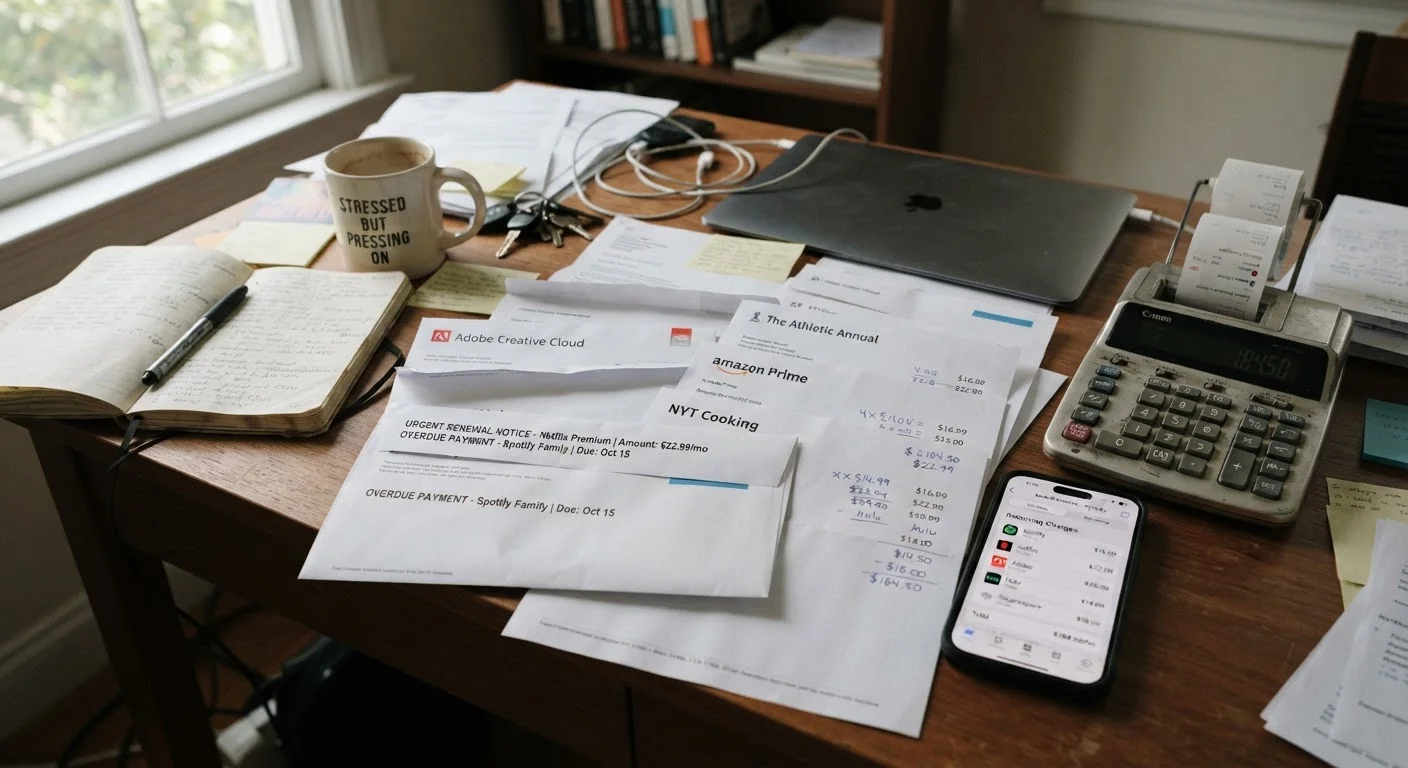
Why Small Charges Are Hard to Notice
A $6.99 charge doesn't feel like a problem. Neither does $9.99. Or $14.99. But when you have eight of them running simultaneously, you're looking at roughly $80 to $100 leaving your account every month - money you may not have consciously decided to spend.
Subscription billing is designed to reduce friction. Charges post automatically, notifications are easy to dismiss, and the small amounts rarely trigger the kind of attention a large purchase would. This is not an accident. Recurring revenue models benefit from low visibility, and the structure of automatic billing removes the moment of decision that would naturally prompt reconsideration.
Annual subscriptions compound this further. A charge that appears once a year is easy to forget entirely - until it appears on a statement twelve months later, by which point the service may have gone months without meaningful use.
This Is General Financial Information
This article is intended to explain a common spending pattern and provide general educational guidance. It is not personalized financial advice. For decisions specific to your financial situation, consult a qualified financial professional.
The Compounding Effect Over Time
Subscription creep doesn't just affect your monthly cash flow - it shapes your savings trajectory. Money that exits automatically each month is money that isn't building toward any goal. This connects directly to less obvious ways savings erode: recurring charges sit in the same category as low-yield account parking and lifestyle inflation - costs that feel passive but are entirely within your control.
Consider what $80 per month in unused subscriptions amounts to annually: $960. Over five years, assuming even modest savings growth, that's a meaningful sum redirected toward nothing in particular. This isn't meant to induce anxiety - it's meant to make the math visible, because subscription creep thrives on invisibility.
$219/mo
Average estimated subscription spend per U.S. household
Consumer research from West Monroe Partners found that Americans significantly underestimate their total monthly subscription costs, with actual spending often far exceeding self-reported estimates.
2-3x
How much households underestimate their subscription spending
Multiple consumer surveys have found a consistent gap between what people think they spend on subscriptions and what bank statements reveal when examined carefully.
$1,000+
Annual cost of unaudited subscription portfolios
When all recurring charges - streaming, apps, memberships, software - are totaled annually, many households find the figure exceeds $1,000, much of it for services with low or zero recent usage.
How to Run a Subscription Audit
An audit doesn't require special tools - just time and your bank or credit card statements. Here's a practical approach:
- Pull three to six months of statements and flag every recurring charge, no matter how small.
- List each subscription with its cost, billing frequency, and the last time you actually used it.
- Categorize by value: actively used and worth the cost, occasionally used but questionable, and unused or forgotten.
- Cancel the unused tier immediately. Don't wait for the next billing cycle to "get your money's worth" - that thinking usually delays cancellation indefinitely.
- Reassess the middle tier honestly. If you can't recall using something in the past 30 days, that's informative.
For the subscriptions you keep, note the renewal dates - especially annual ones - in a calendar with a reminder set a week before. That's enough lead time to cancel if circumstances have changed.
Set a Calendar Reminder Before Every Annual Renewal
When you sign up for any annual subscription, immediately add a calendar reminder seven to ten days before the renewal date. This gives you a clear decision window without scrambling after the charge has already posted. Most services allow cancellation up to the renewal date for a full remaining period.
Habits That Prevent Creep From Returning
An audit clears the backlog, but the behavior patterns that allowed creep to accumulate in the first place tend to persist. A few adjustments can interrupt the cycle:
- Use a dedicated card for subscriptions. Routing all recurring charges to a single card makes future audits faster and keeps subscription spending visible as a category.
- Treat free trials with skepticism. Before entering payment details, decide in advance whether you'd pay for the service at full price. If the answer is uncertain, the trial isn't worth the future cancellation effort.
- Build subscription review into your regular budgeting cadence. The monthly budget health check is a natural place to include this - it takes five minutes once the habit is established.
These habits align with broader spending patterns worth building - small structural changes that prevent budget erosion over time without requiring constant willpower.
Frequently Asked Questions
Estimates vary, but consumer finance surveys consistently find that households underestimate their total subscription spending by a wide margin - sometimes by hundreds of dollars per year. The exact figure depends on the number of active subscriptions and whether annual plans are included in the mental tally.
Review three to six months of bank and credit card statements, searching for recurring charges. Also check email inboxes for billing confirmation messages. Some banking apps include subscription-detection features, though these may not catch every charge.
Yes, this is a common enrollment pattern. Free trials typically require payment details upfront, and the conversion to a paid plan happens automatically unless you cancel before the trial ends. See our related guide on <a href="/smart-shopping/avoiding-bad-buys/subscription-traps-how-free-trials-become-charges-you-didnt-expect">how free trials become unexpected charges</a> for more detail.
A quarterly review works well for most people. At minimum, build a subscription check into your monthly budget review - our <a href="/money-matters/budgeting-basics/monthly-budget-health-check">monthly budget health check</a> offers a practical framework for this.
Rarely. Applying <a href="/smart-shopping/evaluating-products/cost-per-use-the-math-that-changes-how-you-value-purchases">cost-per-use thinking</a> to subscriptions is clarifying: if you use a service once a month, divide the monthly fee by one - that's your cost per use. Low usage almost always signals a cancellation candidate.
Redirect those freed funds intentionally - toward savings, debt repayment, or a specific financial goal. Unallocated savings from cancellations tend to get absorbed back into spending without a deliberate plan.
The content provided on our blog site traverses numerous categories, offering readers valuable and practical information. Readers can use the editorial team’s research and data to gain more insights into their topics of interest. However, they are requested not to treat the articles as conclusive. The website team cannot be held responsible for differences in data or inaccuracies found across other platforms. Please also note that the site might also miss out on various schemes and offers available that the readers may find more beneficial than the ones we cover.