

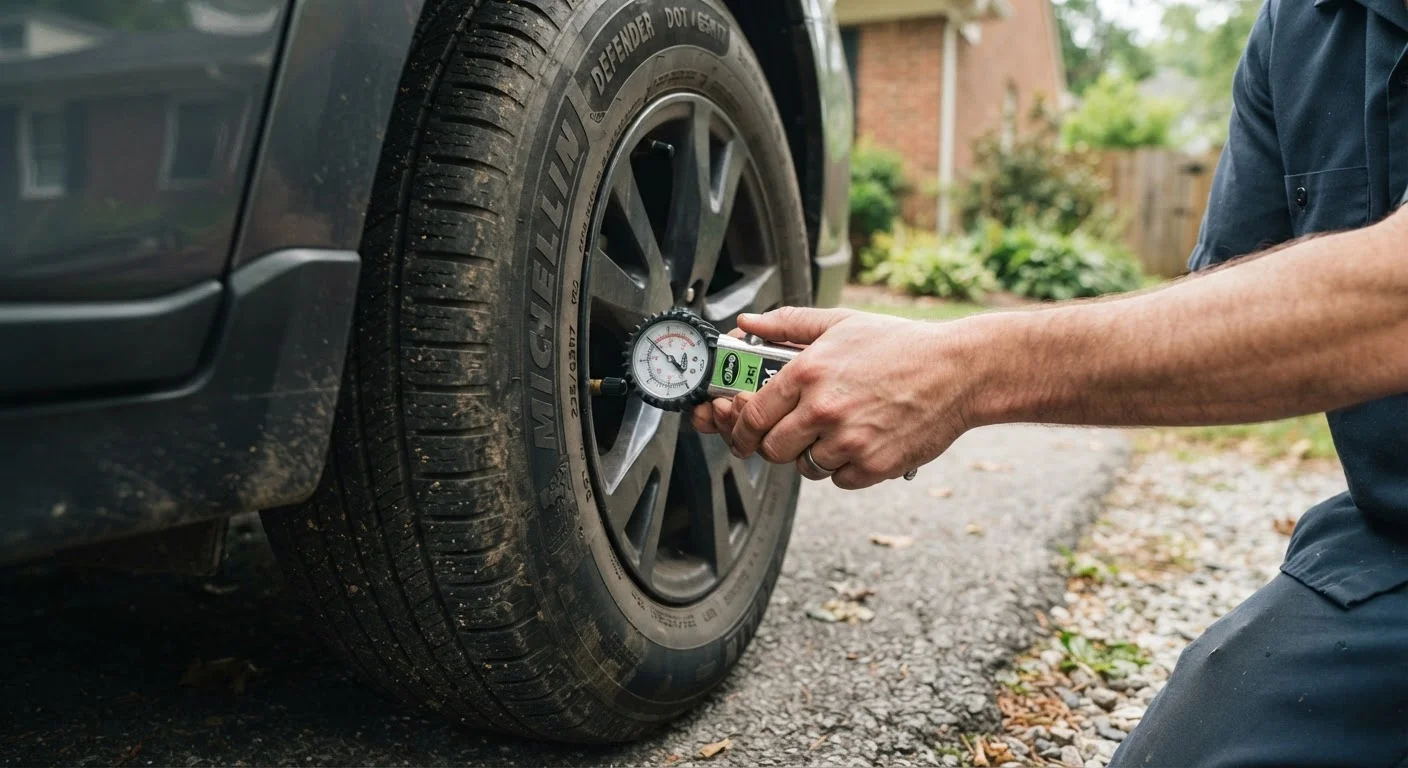
The Number on the Tire Isn't What You Think
Most drivers glance at the sidewall of their tire and see a number like MAX 51 PSI - and assume that's what their tires should be inflated to. It isn't. That figure is the tire's maximum rated pressure, not the operating target for your vehicle.
The right number for your car is found on the driver's door jamb sticker - a small placard that lists the automaker's recommended PSI for both front and rear tires. It can also be found in your owner's manual. As covered in our guide to using your owner's manual, that document contains specifications tailored specifically to your vehicle - tire pressure included. For most passenger cars, the recommended range falls between 30 and 35 PSI, though trucks and SUVs may differ.
Front vs. Rear Tire Pressure May Differ
Many vehicles call for slightly different PSI in the front and rear tires. This is particularly common on rear-wheel-drive vehicles and trucks. Always check both the front and rear specifications on your door jamb sticker - don't assume they're identical.
What Underinflation Actually Does to Your Car
Running tires even a few PSI below the recommended level has measurable consequences. An underinflated tire flexes more with each rotation, generating excess heat. Over time, that heat breaks down the tire's internal structure - increasing the risk of a blowout, particularly at highway speeds.
Beyond safety, there's a direct cost to your wallet. Low tire pressure increases rolling resistance, which means your engine burns more fuel to maintain speed. The U.S. Department of Energy has noted that proper tire inflation can improve fuel economy, and cumulative underinflation across tens of thousands of miles adds up at the pump.
Underinflated tires also wear unevenly - the outer edges of the tread degrade faster than the center. This can shorten tire life significantly, pushing you toward replacement sooner than necessary. For a deeper look at how maintenance habits affect long-term costs, see the car ownership habits that lead to expensive repairs.
~1 PSI
Pressure lost per 10°F temperature drop
This relationship is documented by the U.S. Department of Transportation and is why seasonal checks matter for all drivers.
25%
Pressure loss before TPMS light activates
Federal TPMS standards require a warning only at this threshold - well below the point where safety and efficiency are already affected.
~0.5%
Fuel economy lost per 1 PSI underinflation
The U.S. Department of Energy estimates this approximate relationship between tire pressure and fuel efficiency across typical driving.
Overinflation: The Less-Discussed Risk
Pumping tires above the recommended PSI is sometimes done with good intentions - the thinking goes that firmer tires roll more efficiently. There's a narrow grain of truth to it, but the tradeoffs are significant.
An overinflated tire has a smaller contact patch with the road surface. Less rubber touching the asphalt means reduced traction, longer stopping distances, and more unpredictable handling in wet conditions. The tire also becomes more rigid, making it more susceptible to damage from potholes, curbs, and road debris - exactly the hazards American roads regularly present.
Overinflation also causes center-tread wear, where the middle of the tire degrades faster than the edges. Like underinflation, this shortens the usable life of the tire and leads to premature replacement costs.
Check Pressure Before You Add Air
If you're unsure whether a tire needs air, measure it first with a gauge before connecting to a pump. Adding air to an already correctly inflated tire is a common mistake. Most gas station air pumps also allow you to release air if you've overinflated - press the small pin in the center of the valve stem briefly to let air escape, then recheck.
Temperature, Seasons, and Your Monthly Check
Tire pressure is not static. For every 10°F drop in outside temperature, tires lose roughly 1 PSI. This means that a tire properly inflated in late summer may be 5-8 PSI low by January in colder climates - without a single slow leak.
This is why monthly pressure checks are a standard recommendation from automotive professionals, with particular attention during seasonal transitions. A quality digital tire gauge costs only a few dollars and takes under two minutes to use. Check pressure when tires are cold - before driving or after sitting parked for at least three hours - since driving heats the air inside and inflates the reading.
Don't rely solely on the Tire Pressure Monitoring System (TPMS), which is federally required on vehicles manufactured after 2008. The TPMS warning light typically activates only when pressure drops about 25% below the recommended level - by which point the safety and efficiency costs are already accumulating. Think of it as a last resort, not a substitute for routine checks.
For a full breakdown of tire metrics that affect your safety, our tire pressure, tread depth, and load rating field guide covers everything worth knowing. And if you've believed some common myths about car care, it's worth reviewing the maintenance myths that can actually hurt your vehicle - tire pressure misconceptions are among the most prevalent.
Frequently Asked Questions
Look for a sticker on the inside edge of the driver's door or door jamb - it lists the manufacturer's recommended PSI for front and rear tires. Your owner's manual also contains this information. Do not rely on the maximum PSI printed on the tire sidewall, which is the tire's limit, not your car's recommendation.
Most automotive experts recommend checking tire pressure at least once a month and before any long road trip. Temperature swings - especially in fall and winter - can cause significant pressure drops that happen gradually without any visible sign.
The Tire Pressure Monitoring System (TPMS) light illuminates when one or more tires drops approximately 25% below the recommended PSI. By the time this light appears, the pressure loss is already significant. Regular manual checks help catch drops before the warning activates.
Yes. Overinflated tires reduce the tire's contact patch with the road, making braking less effective and handling less predictable. They also make tires more vulnerable to damage from potholes and road debris.
Underinflated tires increase rolling resistance, which forces your engine to work harder and burn more fuel. The U.S. Department of Energy has noted that proper tire inflation can measurably improve fuel efficiency over time.
Always check pressure when tires are cold - before driving or after the vehicle has been parked for at least three hours. Driving heats the air inside tires, raising pressure artificially and giving you an inaccurate reading.
The content provided on our blog site traverses numerous categories, offering readers valuable and practical information. Readers can use the editorial team’s research and data to gain more insights into their topics of interest. However, they are requested not to treat the articles as conclusive. The website team cannot be held responsible for differences in data or inaccuracies found across other platforms. Please also note that the site might also miss out on various schemes and offers available that the readers may find more beneficial than the ones we cover.