

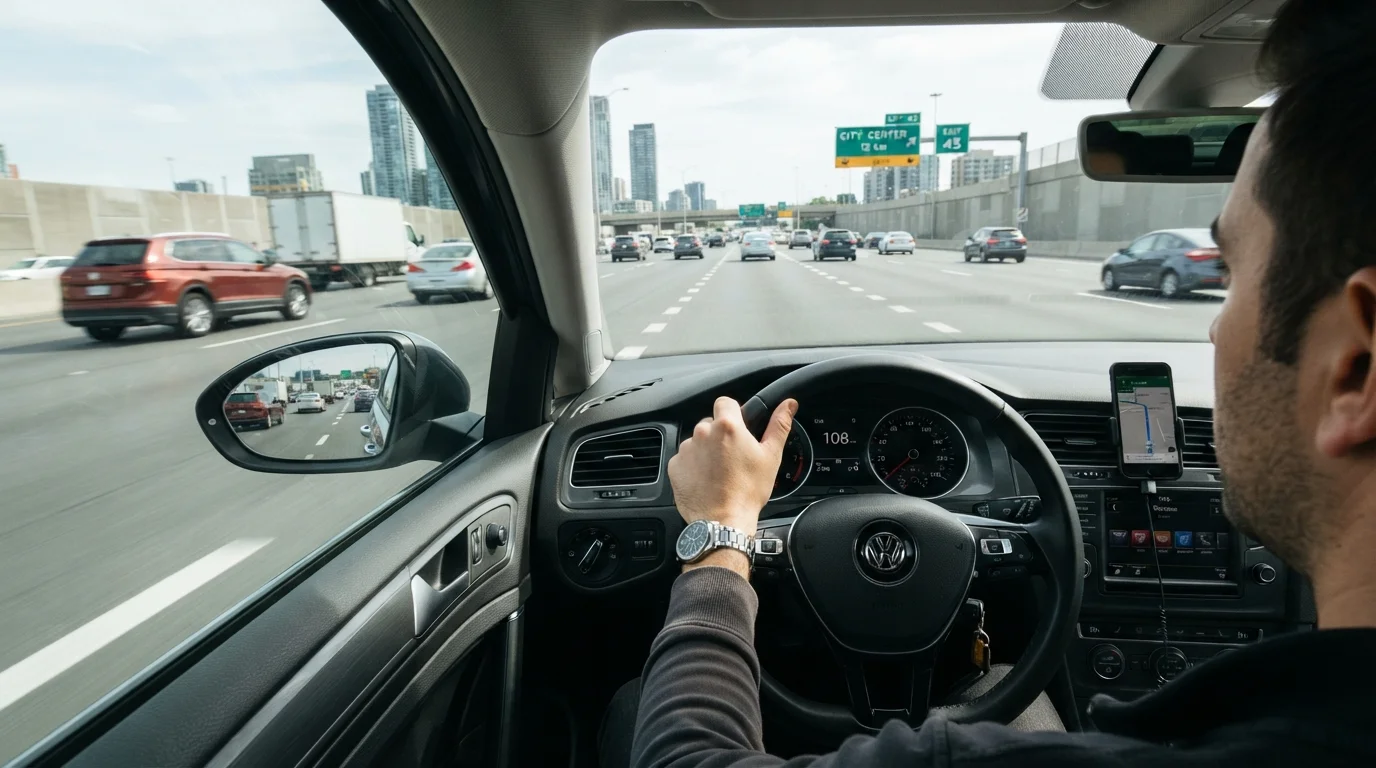
Why Sideswipes Happen - and Why Mirrors Alone Aren't Enough
Sideswipe collisions - where the sides of two vehicles traveling in the same direction make contact - account for a significant share of highway crashes each year in the United States. The National Highway Traffic Safety Administration (NHTSA) consistently identifies improper lane changes as a primary contributing factor. What makes these crashes frustrating is that they are almost entirely preventable when drivers understand the physics of visibility.
Every vehicle has blind spots: zones around the car that neither the driver's direct vision nor standard mirrors can cover. On a typical sedan, the largest blind spots sit roughly diagonally behind each rear quarter panel - the area where an adjacent car can travel completely hidden from the driver's line of sight. Larger vehicles like SUVs, pickup trucks, and vans have proportionally larger blind spots. No factory-installed mirror setup eliminates them entirely.
The common mistake is trusting mirrors as a complete picture of surrounding traffic. Mirrors show what's directly behind and slightly to the side - they don't cover the full adjacent lane. That gap is where sideswipes are born. Understanding this limitation is the first step toward building habits that compensate for it. See our guide to defensive driving principles for broader context on managing what you can't always see.
Setting Your Mirrors Correctly: The Foundation Everything Else Builds On
Most drivers set their side mirrors to show a sliver of their own car's rear quarter panel. This feels reassuring - it creates a visual anchor - but it actually wastes mirror coverage on your own vehicle instead of the road beside you.
A more effective approach, endorsed by safety researchers and driving instructors, positions side mirrors outward so that your own vehicle just disappears from view. From the driver's seat, lean slightly left toward the window and adjust the left mirror until the side of your car barely vanishes. Do the same on the right, leaning slightly right. This expanded angle pushes the mirror's field of view farther into the adjacent lane, shrinking (though not eliminating) the blind spot.
Adjust Mirrors Before Every Drive
Mirror position can shift if someone else has driven your vehicle, or simply from vibration over time. Taking ten seconds to verify your mirror angles before pulling out of a parking spot costs nothing and ensures you're working with accurate coverage throughout your drive. Make it a habit on par with buckling your seatbelt.
Combined with a properly adjusted center rearview mirror - set to frame the full rear window - this three-mirror system creates a more continuous band of rearward visibility. A vehicle should be visible in your center mirror, then transition into your side mirror, then briefly disappear before reappearing in your peripheral vision as it pulls alongside. If there's a gap in that sequence, your mirrors need adjustment.
The Correct Lane-Change Sequence - Every Time
Safe lane changes are not improvised - they follow a deliberate sequence. Skipping steps, even occasionally, is how experienced drivers get into crashes they never saw coming. Overconfidence is a documented factor in exactly this type of error.
Signal before you check - not after
Activating your turn signal is a communication act, not a formality to complete after you've already decided to move. Signaling first gives surrounding drivers time to respond - slowing to yield space or adjusting their position - before you begin your lateral movement.
Check all three mirrors in sequence before moving
The center mirror shows what's directly behind; the side mirrors show the lanes beside and slightly behind. Scanning all three in quick succession gives you a mental map of where every nearby vehicle is positioned before you commit to moving.
Always perform a physical head check into the blind spot
No mirror setup eliminates blind spots entirely. A quick shoulder turn - approximately 45 degrees toward the destination lane - takes less than a second and reveals vehicles that mirrors cannot show. This step is non-negotiable.
Change one lane at a time
Crossing multiple lanes in a single continuous movement compounds blind spot exposure and eliminates the ability to respond to hazards in intermediate lanes. Each lane is its own discrete move with its own signal-check-look sequence.
Match the speed of the destination lane before completing the merge
Entering a lane significantly slower or faster than surrounding traffic creates a speed differential that reduces other drivers' reaction time and increases the force of any contact that occurs. Speed matching is a courtesy and a safety measure.
One additional factor that deserves emphasis: speed matching. Before completing a lane change, your vehicle should be traveling at approximately the same speed as traffic in the destination lane. Moving into a faster lane while still accelerating, or merging into a slower lane without easing off the throttle, creates a speed differential that compresses reaction time for everyone involved and increases sideswipe severity if contact does occur.
On highways specifically, lane discipline and merging habits differ meaningfully from city driving - higher speeds mean blind spots pass through faster, making the head check even more time-sensitive.
Quick Wins You Can Apply on Your Next Drive
Building better lane-change habits doesn't require a course or a new car. Several adjustments can be made immediately and will reduce your sideswipe exposure starting today.
Blind Spot Monitoring Systems Have Limits
Many newer vehicles include blind spot monitoring (BSM) systems that alert drivers when a vehicle is detected in an adjacent lane. These are genuinely useful tools, but they are not substitutes for mirror checks or head checks. BSM sensors can miss motorcycles, cyclists, or vehicles at certain speeds and angles. Treat these systems as a backup layer, not the primary check.
It's also worth considering how conditions affect the challenge. In rain, fog, or low light, adjacent vehicles are harder to spot during a head check, and stopping distances grow. Night driving compounds these risks further - headlights can mask speed and distance in ways that daylight doesn't. Adjust your lane-change timing accordingly: allow more gap, signal earlier, and move more gradually when visibility is reduced.
The content provided on our blog site traverses numerous categories, offering readers valuable and practical information. Readers can use the editorial team’s research and data to gain more insights into their topics of interest. However, they are requested not to treat the articles as conclusive. The website team cannot be held responsible for differences in data or inaccuracies found across other platforms. Please also note that the site might also miss out on various schemes and offers available that the readers may find more beneficial than the ones we cover.