

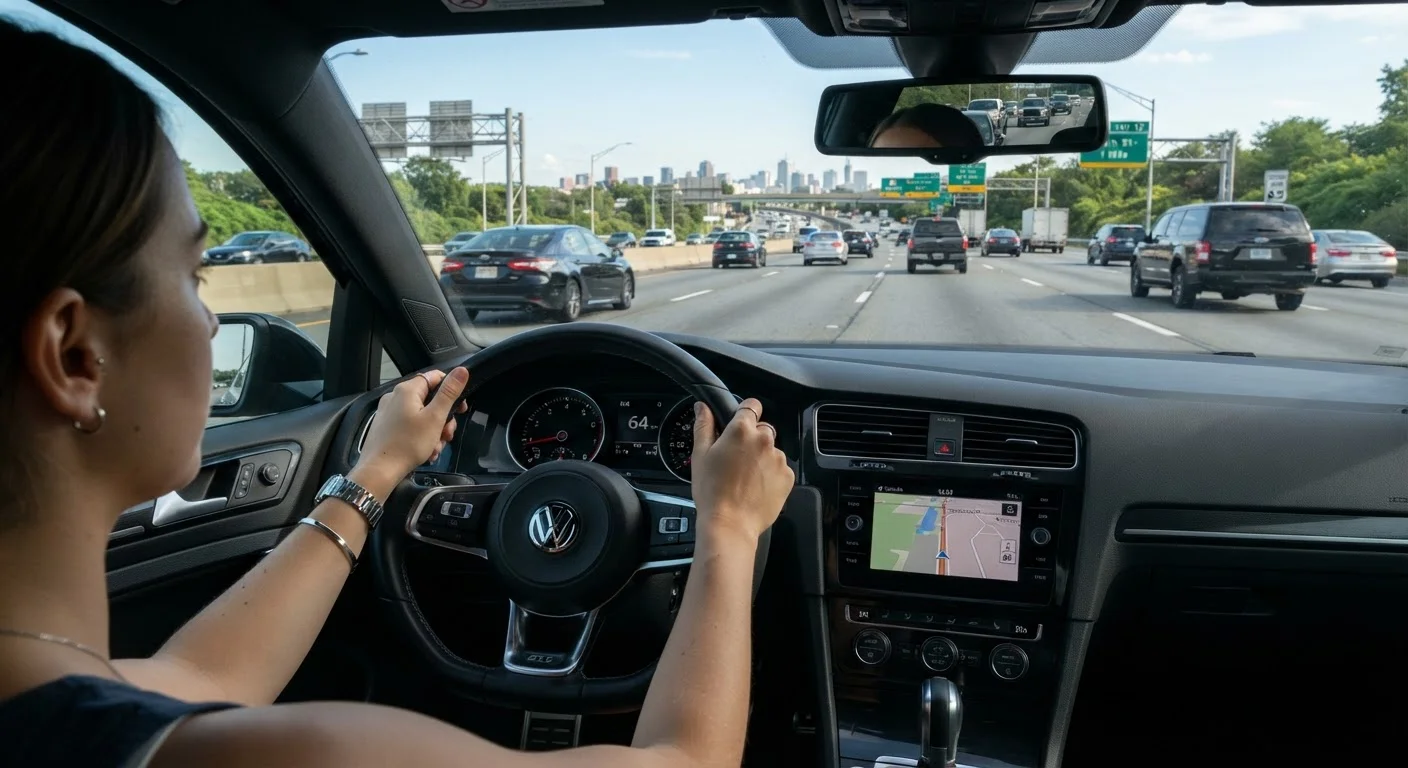
What Defensive Driving Actually Means
Defensive driving is often misunderstood as timid or overcautious driving. In reality, it's the opposite: a disciplined, confident approach that keeps you in control of your own safety rather than leaving it to chance or to the behavior of drivers around you.
The National Safety Council defines it as driving to save lives, time, and money - in spite of the conditions around you and the actions of others. That framing matters. Defensive driving acknowledges that you cannot control road conditions, traffic signals, or other people's decisions. What you can control is your own positioning, speed, attention, and preparedness.
For new drivers just getting comfortable behind the wheel, this mindset is foundational. See our guide for first-year drivers for a broader introduction to the habits and situational awareness that build early confidence.
94%
Crashes attributed to human error
According to the National Highway Traffic Safety Administration, approximately 94% of serious crashes involve human choice or error as a critical factor.
3 sec
Minimum recommended following distance
Traffic safety organizations consistently recommend a minimum three-second following distance under normal driving conditions, extended in adverse weather.
10-15 sec
Recommended forward scanning distance
Defensive driving curricula widely teach scanning 10 to 15 seconds ahead, giving drivers time to respond before situations escalate into emergencies.
The Space Cushion: Your First Line of Defense
One of the most effective and immediately actionable defensive driving principles is maintaining adequate space around your vehicle at all times. A space cushion - the buffer between you and the vehicles in front, behind, and beside you - is what gives you time to react.
The standard guidance is the three-second following distance rule: pick a fixed point on the road, watch the vehicle ahead pass it, then count. If you reach the same point in under three seconds, you're too close. In poor weather, at night, or when towing, four to six seconds is more appropriate.
Tailgating is one of the most dangerous and common habits on American roads. It collapses your reaction time to near zero, and at highway speeds, even a momentary distraction can make a collision unavoidable.
Use a Fixed Object to Measure Following Distance
The three-second rule is easy to apply: when the car ahead passes a highway sign, overpass, or shadow line on the road, count 'one-thousand-one, one-thousand-two, one-thousand-three.' If you reach the same landmark before finishing the count, you're following too closely. Increase the count to five or six seconds in rain, fog, or when carrying extra load.
For a deeper look at how space management interacts with lane changes and blind spots, see our article on blind spots and sideswipe crash prevention.
Scanning Ahead and Managing Your Field of View
Most drivers look only at the vehicle directly in front of them. Defensive drivers look much farther ahead - typically 10 to 15 seconds of travel time down the road. At 60 mph, that's roughly a quarter mile. This scanning distance is what converts potential hazards into manageable situations rather than emergencies.
Effective scanning includes regularly checking your mirrors every five to eight seconds, not just when you intend to change lanes. It means noticing brake lights three or four cars ahead, not just the one immediately in front of you. It means reading intersections before you enter them and watching pedestrian curbs.
Develop a habit of checking all three mirrors in sequence every five to eight seconds, not just when you feel the need. Regular mirror sweeps prevent the tunnel vision that builds during monotonous highway driving.
Most drivers underestimate how quickly their awareness of rear and side traffic degrades when they focus solely on the road ahead. Systematic mirror checking keeps the full picture current.
When stopped at a red light behind another vehicle, leave enough space to see the rear tires of the car in front touching the pavement. This gives you room to maneuver if you need to pull around a stalled vehicle or respond to an emergency.
Drivers stopped bumper-to-bumper have no exit path if a situation develops in front of them, turning a minor inconvenience into a trapped position.
The habits that work on surface streets need some adjustment at highway speeds. Our comparison of highway vs. city driving habits breaks down exactly how your scanning and following distance should shift between environments.
Speed, Conditions, and the Limits of Posted Signs
Posted speed limits are set for ideal conditions: dry pavement, good visibility, and normal traffic flow. They are a legal ceiling, not a recommended target for every situation. Driving at the limit in rain, fog, heavy traffic, or on unfamiliar mountain roads is not defensive - it's overconfident.
Adjust your speed based on:
- Visibility: If you cannot see far enough ahead to stop safely, you are going too fast for conditions.
- Road surface: Wet roads extend stopping distances considerably; ice or snow can multiply them many times over.
- Traffic density: Merging zones, construction areas, and congested exits require lower speeds and higher attention.
Posted Speed Is Not Always Safe Speed
Driving at the legal speed limit does not automatically mean driving safely. In wet, icy, foggy, or high-traffic conditions, the posted limit may be far higher than what your stopping distance and visibility can support. Adjust speed to match actual conditions, not just the sign on the side of the road.
Overconfidence is one of the most documented contributors to serious crashes. Experienced drivers who feel comfortable on familiar roads are particularly vulnerable to complacency. Our article on overconfidence behind the wheel identifies the specific habit patterns that develop when drivers stop giving familiar roads the attention they deserve.
Anticipating Other Drivers' Mistakes
Defensive driving requires you to assume that other drivers will make errors - because statistically, they do. The Federal Highway Administration attributes the vast majority of crashes to human error, not mechanical failure. That means your safety depends partly on your ability to read the behavior of others before it becomes a problem.
Practical anticipation looks like this: when you see a driver drifting in their lane, you create more space. When a parked car's wheels turn toward traffic, you prepare for it to pull out. When a driver at an intersection is looking the wrong direction, you slow before crossing their path even if you have the right of way.
“The goal of defensive driving is not to be fearful of other drivers - it's to be prepared for them. You drive for yourself and for everyone else on the road.”
— National Safety Council, Nonprofit organization focused on eliminating preventable deaths in the US
This isn't paranoia - it's pattern recognition applied systematically. The more consistently you apply it, the more automatic it becomes.
Building Defensive Habits That Stick
Knowledge of defensive driving principles means little if the habits don't carry through into daily driving. The gap between knowing what to do and actually doing it under routine conditions is where most drivers fall short.
A few approaches that help habits form and persist:
- Treat every drive as practice. Even a five-minute commute is an opportunity to reinforce good habits rather than coast on autopilot.
- Eliminate in-vehicle distractions deliberately. Put your phone on do-not-disturb before starting the engine, not after you're already moving.
- Reset after close calls. Near-misses should prompt reflection, not just relief. Ask what you could have seen earlier or done differently.
Keeping your vehicle in good mechanical condition is also part of the equation - brakes, tires, and lights that work properly give you the mechanical margin to match your defensive instincts. See our car maintenance guide for new drivers for a practical framework on that side of road safety.
Defensive driving is not a course you take once and forget. It's a set of habits applied every time you sit behind the wheel - and the cumulative effect of those habits, over thousands of miles, is a measurably safer driving record.
The content provided on our blog site traverses numerous categories, offering readers valuable and practical information. Readers can use the editorial team’s research and data to gain more insights into their topics of interest. However, they are requested not to treat the articles as conclusive. The website team cannot be held responsible for differences in data or inaccuracies found across other platforms. Please also note that the site might also miss out on various schemes and offers available that the readers may find more beneficial than the ones we cover.