

Why Right-of-Way Rules Still Trip Up Experienced Drivers
Most drivers learned right-of-way rules for their licensing exam, then promptly filed them away. The problem: intersections are where a significant share of traffic crashes occur in the United States, and ambiguity about who goes first is a leading contributing factor. Whether you're approaching a roundabout, a four-way stop, or an unmarked yield situation, the rules are consistent - but they require active recall, not instinct.
This reference guide breaks down exactly who yields in each common scenario, so you can make fast, confident decisions. For a broader look at how road signs communicate these rules visually, see our road signs reference.
| Most common crash type at intersections | Angle crashes (T-bone collisions) (NHTSA intersection safety data) |
| Rule at a four-way stop tie | Yield to the driver on your right |
| Roundabout entry rule | Yield to all traffic already inside the circle |
| Yield sign meaning | Slow and give way; stop only if necessary |
| Pedestrian priority | Pedestrians have right of way at all marked crosswalks (Uniform Vehicle Code; enforced in all 50 states) |
| Left turn rule | Turning left must always yield to oncoming straight traffic |
Four-Way Stops: A Clear Order of Priority
All-way stop intersections follow a specific hierarchy that most drivers only partially remember:
- First to stop, first to go. The vehicle that arrives and comes to a complete stop first has the right of way.
- Simultaneous arrival: yield to the right. If two vehicles stop at the same time, the driver on the left yields to the driver on the right.
- Opposite directions, going straight: Both may proceed simultaneously if neither is turning left across the other's path.
- Left turns yield to oncoming straight traffic. A vehicle turning left must always yield to a vehicle going straight through, even if it arrived first.
The single most common error at four-way stops is the courtesy wave - one driver waves another through out of turn. While the gesture feels polite, it can create confusion and is not legally recognized as a right-of-way transfer. Proceed only when it is actually your turn.
Right of way
The legal right of a driver, cyclist, or pedestrian to proceed through a space ahead of others. Right of way is assigned by law - it cannot be given away by one driver to another.
Uncontrolled intersection
An intersection with no traffic signals, stop signs, or yield signs governing either approach. The yield-to-the-right rule applies in these situations.
Circulating traffic
Vehicles already traveling within a roundabout. All entering drivers must yield to circulating traffic before merging into the circle.
Conflict point
A location where two vehicle paths cross, merge, or diverge, creating potential for a crash. Roundabouts reduce the number of conflict points compared to traditional four-way intersections.
All-way stop
An intersection where every approach is controlled by a stop sign, requiring all drivers to come to a complete stop before proceeding based on arrival order.
Roundabouts: Yield Before You Enter, Not After
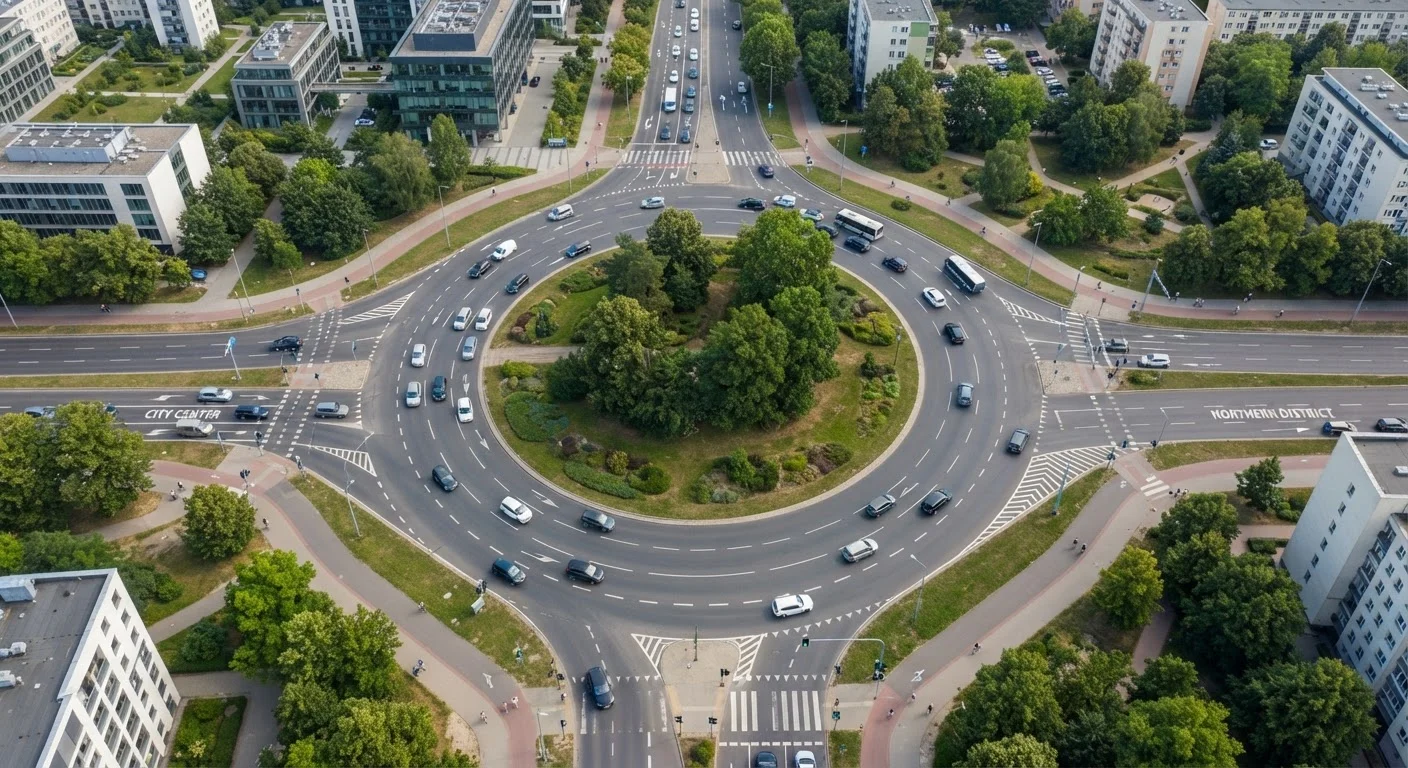
Roundabouts follow one simple rule: traffic already inside the circle has the right of way. Every entering driver must yield to circulating traffic before merging in.
Common mistakes include:
- Stopping inside the roundabout to let someone enter - this is incorrect and dangerous.
- Treating the yield line as a stop sign and waiting indefinitely even when the circle is clear.
- Failing to signal when exiting, which confuses drivers waiting to enter.
In multi-lane roundabouts, lane selection matters before you enter. Use the right lane for right turns or going straight (first exit), and the left lane for going straight past the first exit or turning left. Changing lanes inside the roundabout is not permitted.
Roundabouts are demonstrably safer than traditional signalized intersections for one key reason: conflict points (places where vehicle paths cross) are reduced, and all conflicts occur at low speed and shallow angles. Adapting smoothly to roundabouts is also part of the broader skill set covered in our highway vs. city driving guide.
Emergency Vehicles Always Have Priority
Regardless of who has the right of way at any intersection type, drivers must yield immediately to emergency vehicles displaying lights or sounding a siren. Pull to the right and stop until the vehicle has passed. Re-entering traffic at a roundabout mid-circle may be necessary - do so carefully by exiting at the nearest available exit, then pulling over.
Yield Signs and Uncontrolled Intersections
A yield sign means slow down, check for cross-traffic and pedestrians, and give way if necessary - but do not stop unless required. Running through a yield without checking is as dangerous as ignoring a stop sign.
At uncontrolled intersections (no sign or signal for either direction), the right-of-way rule mirrors the four-way stop tie-breaker: yield to the vehicle on your right. This rule is often forgotten because uncontrolled intersections are rare in urban areas but common in residential neighborhoods and rural roads.
Pedestrians and cyclists hold right-of-way at marked crosswalks regardless of whether you face a yield or stop sign. When turning at any intersection, you must yield to pedestrians crossing the road you are turning onto - even on a green light. For a fuller picture of how conditions affect these judgments, see driving in adverse conditions.
If you are a newer driver still building comfort with these situations, our first-year driver guide offers practical confidence-building strategies for exactly these moments.
~40%
Of U.S. traffic crashes occur at or near intersections
According to the Federal Highway Administration, intersections account for a disproportionate share of total roadway crashes each year.
Up to 75%
Reduction in serious injury crashes at roundabouts vs. stop-controlled intersections
Research cited by the Insurance Institute for Highway Safety (IIHS) comparing roundabout safety outcomes to traditional intersections.
The content provided on our blog site traverses numerous categories, offering readers valuable and practical information. Readers can use the editorial team’s research and data to gain more insights into their topics of interest. However, they are requested not to treat the articles as conclusive. The website team cannot be held responsible for differences in data or inaccuracies found across other platforms. Please also note that the site might also miss out on various schemes and offers available that the readers may find more beneficial than the ones we cover.