

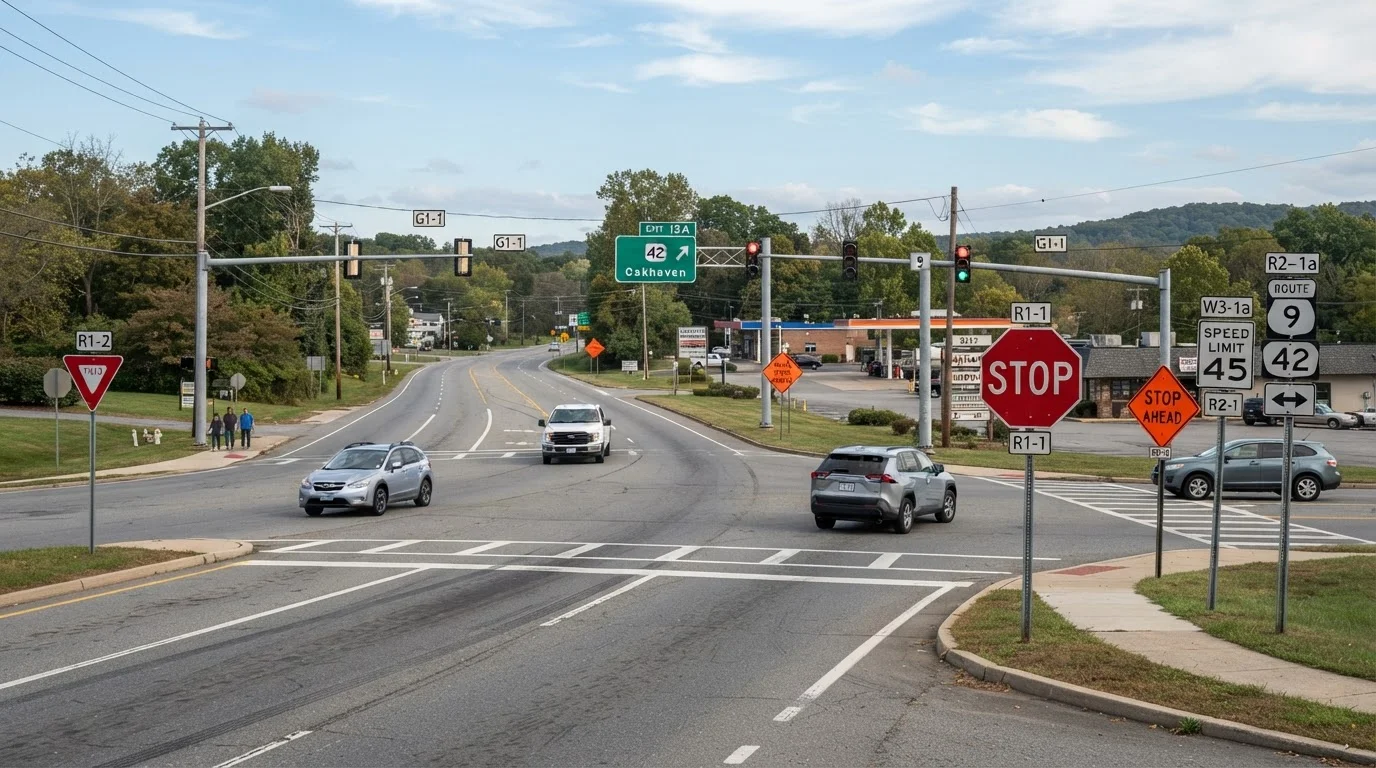
The Sign System: Shape, Color, and Meaning
Road signs in the United States follow a standardized visual language established by the MUTCD, a federal standard that governs sign design nationwide. Before reading the text or symbol on a sign, its shape and color already carry a message - and recognizing that layer of meaning is what separates confident drivers from reactive ones.
| Total MUTCD sign categories | 6 primary categories (MUTCD, Federal Highway Administration) |
| Shape for stop signs | Octagon (8-sided) (MUTCD standard) |
| Color for construction zones | Orange background (MUTCD standard) |
| Color for motorist services | Blue background (MUTCD standard) |
| Shape for yield signs | Inverted triangle (MUTCD standard) |
| Work zone fine doubling | Common across most U.S. states (Varies by state law) |
Shape rules: Octagons mean stop. Inverted triangles mean yield. Pentagons mark school zones. Diamond shapes signal warnings. Circles appear on railroad crossings. Rectangles carry regulatory or informational content depending on their orientation.
Color rules: Red signals prohibition or danger. Yellow signals general warnings. Orange marks construction and work zones. Green provides guidance and distance information. Blue indicates motorist services. Brown designates recreational and cultural sites. White backgrounds carry regulatory content like speed limits.
Understanding this system means you can begin processing a sign's intent before you're close enough to read it - a meaningful advantage at highway speeds. See our guide to what speed limit signs legally require for a deeper look at one of the most commonly misunderstood regulatory signs.
Regulatory Signs: Rules You Must Follow
Regulatory signs inform drivers of traffic laws in effect at that location. Ignoring them can result in traffic violations or collisions. The most commonly encountered include:
- Stop (red octagon): Come to a complete halt before the stop line or crosswalk. Proceed only when clear.
- Yield (red-bordered inverted triangle): Slow down and give the right of way to cross-traffic or pedestrians. Stop only if necessary.
- Do Not Enter / Wrong Way: These red-and-white signs mark one-way road exits. Entering is illegal and extremely dangerous.
- No Turn on Red: Prohibits right turns at red lights, typically near pedestrian-heavy intersections or limited sight-line locations.
- Speed Limit: White rectangular signs posting the maximum legal speed under ideal conditions. Conditions - weather, visibility, traffic - may legally require slower speeds.
- Lane control signs: Arrows indicating which turns are permitted from a given lane. Overhead or post-mounted.
Right-of-way situations tied to these signs can be more nuanced than they appear. Our article on who goes first at stops and yield signs covers the practical application in detail.
MUTCD
The Manual on Uniform Traffic Control Devices - the federal standard governing the design, placement, and use of all traffic signs, signals, and road markings in the United States.
Regulatory sign
A sign that communicates a specific traffic law or requirement in effect at that location. Drivers are legally obligated to comply.
Warning sign
A sign that alerts drivers to a condition, hazard, or change in road character ahead. Typically diamond-shaped and yellow or orange.
Right of way
The legal or practical priority one driver has to proceed through an intersection or merge point before another. Yield and stop signs establish these priorities.
Grade crossing
A point where a road and a railroad track intersect at the same level. Marked by circular advance warning signs and often by crossbuck signs at the crossing itself.
Warning and Informational Signs: Reading the Road Ahead
Warning signs (yellow or orange diamonds) alert you to conditions requiring extra attention. They don't command a specific action but signal that one may be needed. Common examples:
- Curve ahead: Indicates a sharp or winding bend. Reduce speed before entering.
- Merging traffic: Another roadway joins yours. Adjust speed and position to accommodate merging vehicles.
- Pedestrian crossing: Expect foot traffic crossing the roadway, especially near schools, parks, or urban centers.
- Slippery when wet: Surface loses traction significantly in rain or ice. Increase following distance.
- Railroad crossing (circular, black and yellow): A grade crossing ahead. Look, listen, and be prepared to stop.
- Construction zone (orange): Speed limits drop, lane configurations change, and workers may be present. Fines are often doubled in work zones.
Informational signs - green for highways, blue for services, brown for parks - tell you where you are and what's nearby. Exit numbers, route markers, and mileage signs fall into this category. They don't impose rules but give you data to make decisions safely and efficiently.
Staying aware of both what your signs say and what your vehicle is telling you is equally important. Our related guide, Your Car's Warning Lights, Decoded, helps you pair road awareness with dashboard literacy for a complete picture of safe driving.
The content provided on our blog site traverses numerous categories, offering readers valuable and practical information. Readers can use the editorial team’s research and data to gain more insights into their topics of interest. However, they are requested not to treat the articles as conclusive. The website team cannot be held responsible for differences in data or inaccuracies found across other platforms. Please also note that the site might also miss out on various schemes and offers available that the readers may find more beneficial than the ones we cover.