

Our Verdict
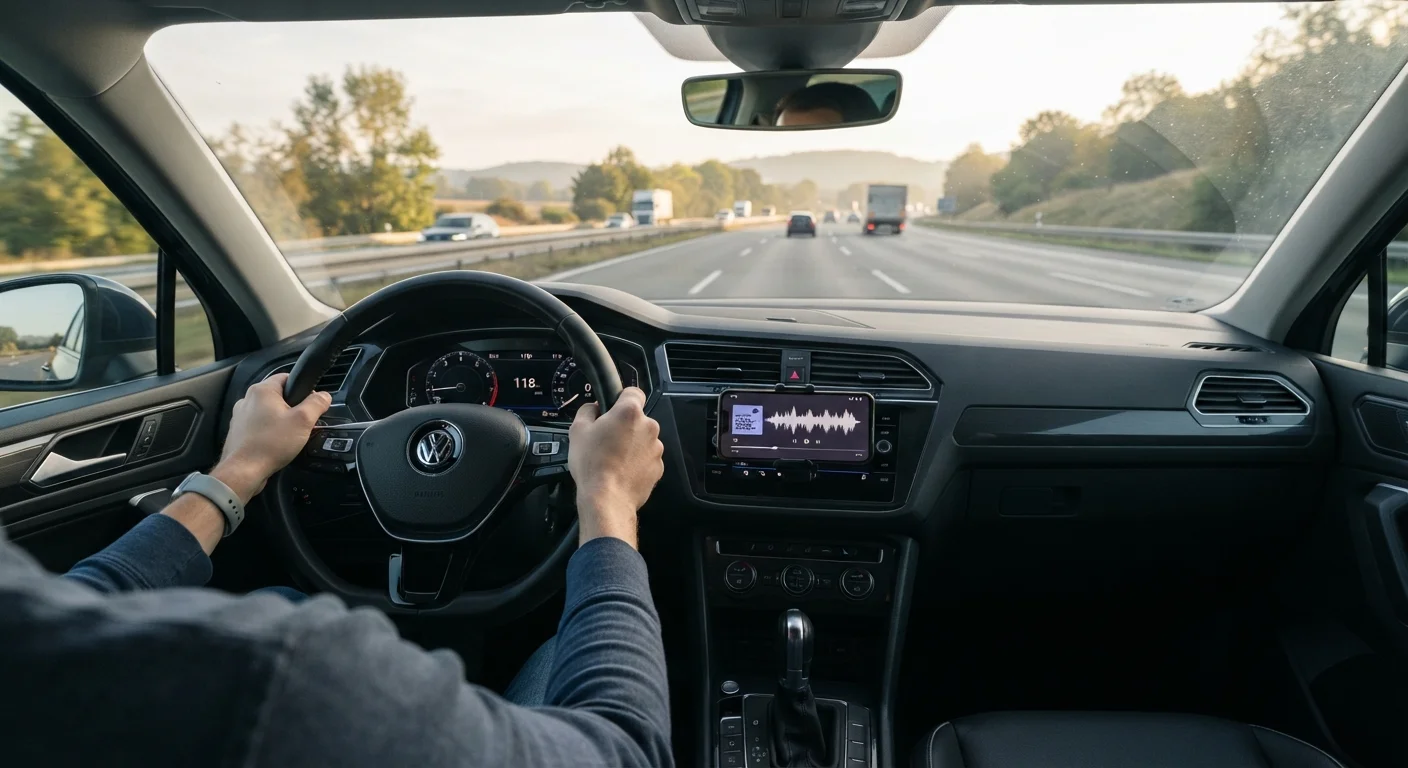
Listening to audio while driving isn't inherently dangerous, but it isn't consequence-free either. The risk or benefit depends heavily on audio type, volume, road complexity, and driver experience. Treating in-car audio as something you actively manage-rather than a passive backdrop-puts you in a safer position.
Drivers who are mindful of when to lower the volume, pause a podcast during tricky merges, or silence audio entirely in high-demand situations will get the most benefit with the least risk.
Why This Question Actually Matters
Most American drivers listen to something behind the wheel. Whether it's a curated playlist, talk radio, or a true-crime podcast, in-car audio has become part of the driving experience. But the relationship between what you hear and how you drive is more nuanced than a simple thumbs-up or thumbs-down.
Road safety researchers have studied audio distraction for decades, and their findings don't support a blanket ban-nor do they give drivers a free pass to crank up the volume. The real answer depends on the type of audio, the driving environment, and how well a driver recognizes the limits of divided attention. For a deeper look at how attention demands shift by setting, see our guide to highway vs. city driving habits.
The Case For Listening While You Drive
Reduces alertness dips on monotonous highway stretches
Repetitive road environments can cause attention to fade even in rested drivers. Moderate audio provides enough stimulation to sustain focus without overwhelming other senses.
Can moderate mood and reduce driving frustration
Research suggests that calming or familiar music may help regulate emotional responses in slow or stop-and-go traffic, leading to fewer impulsive lane changes or aggressive following distances.
Makes long commutes more mentally sustainable
Lengthy drives without any sensory variety contribute to mental fatigue. Audio can pace a trip and reduce the perceived burden of time behind the wheel.
Familiar music requires minimal active processing
Songs a driver has heard many times demand very little cognitive decoding, meaning they can provide mood and alertness benefits with relatively low attention cost.
The strongest argument for in-car audio is its effect on alertness during long, monotonous drives. Silence and road hypnosis are a real pairing - the repetitive visual input of a straight highway can cause attention to drift even in well-rested drivers. Familiar music or an engaging podcast can sustain arousal without overwhelming the senses.
There's also a mood component. Moderate-tempo music has been associated with more stable driving behavior in some studies, helping regulate frustration during slow traffic. Drivers who feel calmer tend to make fewer impulsive decisions. Audio also makes long commutes more tolerable, reducing the mental fatigue that builds from staring at brake lights for 45 minutes - a factor worth considering alongside drowsy driving risks.
The Case Against-or at Least, the Cautions
Spoken-word audio competes directly for cognitive resources
Understanding dialogue-podcasts, audiobooks, talk radio-uses the same mental bandwidth as reading signs and anticipating hazards. The overlap is real even when it doesn't feel that way.
High volume can mask critical auditory warnings
Emergency sirens, horns from adjacent vehicles, and tire or mechanical sounds all serve as safety cues. Loud audio reduces a driver's ability to detect and respond to them in time.
Emotionally engaging content can spike risk-taking behavior
Some research has found associations between high-arousal music and faster driving speeds or reduced following distances, suggesting that what you feel while listening influences how you drive.
Drivers consistently underestimate audio's distraction effect
Because listening feels passive, most people don't notice when their attention has shifted from the road to what they're hearing-making it harder to self-correct in the moment.
The risks aren't always obvious, which is part of what makes audio distraction tricky. Unlike glancing at a phone, listening feels passive. But cognitive science distinguishes between perceptual tasks (seeing) and cognitive tasks (understanding speech), and both compete for limited mental bandwidth.
Podcast dialogue, audiobooks, and talk radio all require language processing - the same brain resources you use to read signage, anticipate lane changes, and process unexpected hazards. That overlap is where risk creeps in. It's worth reading our piece on distracted driving myths for more on why cognitively demanding audio gets underestimated as a risk factor.
Volume and Legal Considerations
Several U.S. states restrict or prohibit the use of headphones or earbuds while driving, treating them as an impediment to hearing emergency vehicles. Speaker volume inside a vehicle is less regulated but still subject to general distracted-driving statutes in some jurisdictions. Check your state's motor vehicle laws if you're unsure of local rules - and treat any audio level that drowns out external sounds as a practical hazard regardless of legality.
Volume compounds every risk factor. Audio loud enough to mask sirens, horns, or tire-screeching sounds creates a genuine hazard - not a theoretical one. Many states have laws restricting headphone use while driving, though regulations on vehicle speaker volume vary.
How to Listen Smarter
The practical takeaway isn't to unplug entirely - it's to treat audio as something you actively manage, not passively consume. A few habits worth building:
- Lower volume during complex maneuvers - merging, parallel parking, navigating unfamiliar interchanges, or driving in heavy rain all benefit from reduced cognitive load.
- Choose audio by context - instrumental or familiar music is generally lower-demand than a new podcast episode or an emotionally charged talk show.
- Pause, don't power through - if you find yourself replaying audio in your head to catch what was said, your attention has left the road. Pause it.
- Recognize overconfidence - experienced drivers often underestimate how much audio affects them, partly because habit masks the distraction. Our article on overconfidence behind the wheel explains why familiarity breeds complacency.
At night, the calculus shifts further. Reduced visibility already taxes your perceptual system - adding cognitively demanding audio narrows your safety margin. See what experienced drivers do differently at night for context on managing those conditions.
~30%
Reduction in road hazard detection with complex audio
Studies in driving simulation environments have found that cognitively demanding audio tasks can reduce detection rates for unexpected road events by roughly a quarter to a third compared to driving in silence.
2-3 sec
Additional reaction time lag under cognitive load
Research on divided attention and driving suggests that active listening to speech can add meaningful fractions of a second to hazard response - significant at highway speeds.
The content provided on our blog site traverses numerous categories, offering readers valuable and practical information. Readers can use the editorial team’s research and data to gain more insights into their topics of interest. However, they are requested not to treat the articles as conclusive. The website team cannot be held responsible for differences in data or inaccuracies found across other platforms. Please also note that the site might also miss out on various schemes and offers available that the readers may find more beneficial than the ones we cover.