

Why Distraction Myths Are Dangerous
Most drivers consider themselves attentive. Yet distracted driving consistently ranks among the leading contributors to crashes on American roads, according to the National Highway Traffic Safety Administration (NHTSA). The gap between self-perception and actual behavior often comes down to widely held myths - beliefs that feel logical but are contradicted by traffic safety research.
These aren't fringe misconceptions. Many are reinforced by everyday habits, technology marketing, and a general tendency to overestimate our own ability behind the wheel. Understanding where these beliefs break down is the first step toward genuinely safer driving. For a broader look at how overconfidence shapes risky habits, see Overconfidence Behind the Wheel.
Myth
Hands-free calling is essentially risk-free because my hands stay on the wheel and my eyes stay on the road.
Fact
Hands-free calls still impose significant cognitive distraction - your brain is partly engaged in the conversation, not fully in the driving environment.
The danger of phone use while driving isn't primarily physical - it's cognitive. Research from the AAA Foundation for Traffic Safety found that voice-based tasks create measurable mental workload that delays reaction times and causes drivers to miss visual cues, including stop signs and pedestrians entering crosswalks. This effect is called inattention blindness: your eyes point forward, but your brain processes less of what it sees. A conversation with a passenger is generally less distracting because passengers naturally pause when driving conditions worsen - a phone caller cannot read the road.
Myth
It's fine to read a quick text at a red light - I'm stopped, so there's no real risk.
Fact
Checking your phone at a red light creates real risk, both at the intersection and in the seconds after the light changes when your attention hasn't fully returned.
When a light turns green, the driver who just read a message is operating with divided attention. Research on cognitive recovery suggests that attention doesn't snap back instantly after a distraction - there is a measurable lag. Intersections are also among the most complex and high-risk environments in everyday driving, involving crossing traffic, pedestrians, cyclists, and turning vehicles. NHTSA data repeatedly identifies intersection-related crashes as a major fatality category. A phone in hand also signals nearby drivers and pedestrians that your attention may be delayed, compounding risk for everyone in the intersection.
Myth
I can multitask effectively - I've always been a good multitasker in general life.
Fact
True simultaneous multitasking is not how the human brain works. What feels like multitasking is actually rapid task-switching, which degrades performance on each task.
Cognitive neuroscience research has consistently found that the brain does not run two attention-demanding tasks in parallel. Instead, it switches between them quickly - and each switch carries a performance cost. Applied to driving, this means the moment you allocate attention to a phone, a complex conversation, or even an absorbing podcast during a demanding traffic situation, your processing of road information degrades. The illusion of multitasking is partly why drivers routinely underestimate how distracted they actually are. Self-reported distraction and measured distraction frequently diverge in research settings.
Myth
I know this route by heart, so I can afford to be a little less focused than usual.
Fact
Familiarity with a route does not reduce the cognitive cost of distraction - and may increase risk by lowering overall alertness.
Familiar routes can create a form of autopilot that reduces general vigilance. Drivers on known roads may miss unexpected hazards - a child running into the street, a vehicle stopped unexpectedly ahead, or a changed signal pattern - precisely because they're less actively scanning. When distraction is added on top of this reduced vigilance, the combined effect is greater than either factor alone. Road conditions also change independently of your familiarity with a route: weather, construction, and traffic patterns are never identical twice. Treating every drive as requiring full attention is one of the foundational principles of defensive driving.
Myth
A glance away from the road for just a second or two can't really cause a crash.
Fact
At highway speeds, two seconds of inattention means traveling more than 170 feet - roughly half a city block - without processing the road ahead.
Speed transforms brief moments into significant distances. At 60 mph, a vehicle covers approximately 88 feet per second. A two-second distraction - well within the average time it takes to glance at and read a notification - means roughly 176 feet of road passed without full attention. If a vehicle ahead brakes suddenly or an obstacle appears, stopping distance requirements may exceed the gap available. This is part of why following distance matters so much: it provides a buffer that a distracted driver has already sacrificed before the emergency occurs.
Building Habits That Reflect Reality
Recognizing these myths matters most when it changes daily behavior. A few practical adjustments can make a measurable difference:
- Silence your phone before moving - not just setting it face-down. Out of sight reduces temptation, but notifications still register cognitively if audible.
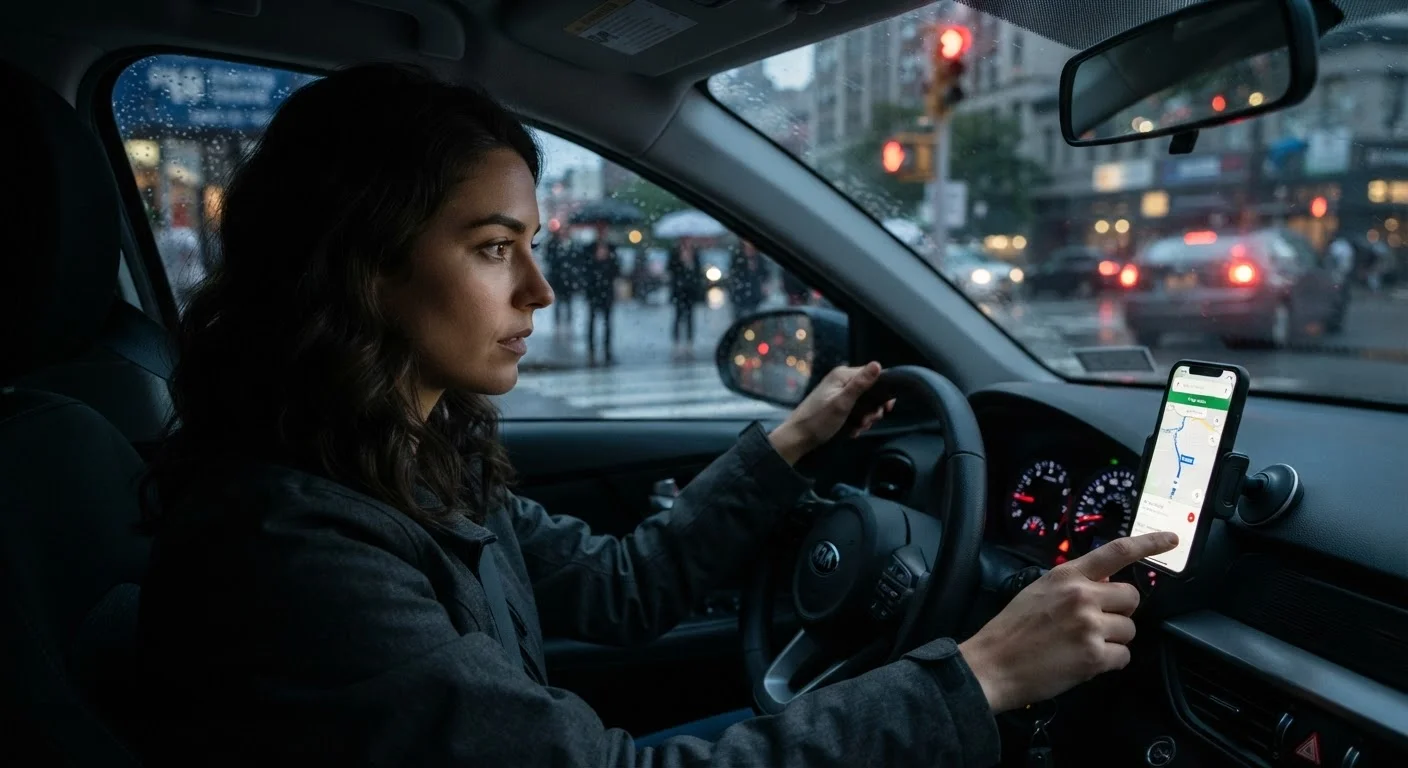
- Pre-program navigation before departure. Adjusting a GPS app while moving - even at low speed - qualifies as manual and visual distraction simultaneously.
- Treat conversations differently than you would at a desk. If a call becomes emotionally charged or cognitively demanding, pull over safely before continuing.
- Acknowledge unfamiliar conditions as a trigger to reduce audio and conversation stimulation. Rain, heavy traffic, and construction zones all increase the cognitive load driving already demands.
Distraction compounds with other impairments. Fatigue, for example, narrows attention in ways that make distraction far more consequential - explore that relationship in Fatigue at the Wheel. Similarly, if you're curious how audio choices affect focus, The Case for and Against Driving with Music or Podcasts offers a measured look at in-car listening habits.
~3,000
Annual US traffic fatalities involving distraction
NHTSA reports approximately 3,000 deaths per year in the United States attributed to distracted driving, though experts note the figure is likely an undercount.
23x
Crash risk increase when texting while driving
A foundational study by the Virginia Tech Transportation Institute found that texting while driving increased crash risk by approximately 23 times compared to undistracted driving.
27%
Drivers using handheld phones at any moment
Observational studies by NHTSA have found that at any given daylight moment, a meaningful percentage of drivers are visibly using handheld electronic devices.
Developing true awareness behind the wheel also means understanding the broader landscape of safe driving - from managing blind spots during lane changes to the core discipline of defensive driving. Addressing distraction myths is one piece of that larger picture.
No Distraction Habit Is Truly Low-Risk
Research does not support a hierarchy of 'acceptable' distracted driving behaviors - hands-free, voice-to-text, or brief glances all carry documented risk. The only evidence-based approach is to keep your phone out of use while the vehicle is in motion. If a situation demands your attention, pulling safely off the road and stopping is the appropriate response, not managing the distraction while driving.
The content provided on our blog site traverses numerous categories, offering readers valuable and practical information. Readers can use the editorial team’s research and data to gain more insights into their topics of interest. However, they are requested not to treat the articles as conclusive. The website team cannot be held responsible for differences in data or inaccuracies found across other platforms. Please also note that the site might also miss out on various schemes and offers available that the readers may find more beneficial than the ones we cover.