

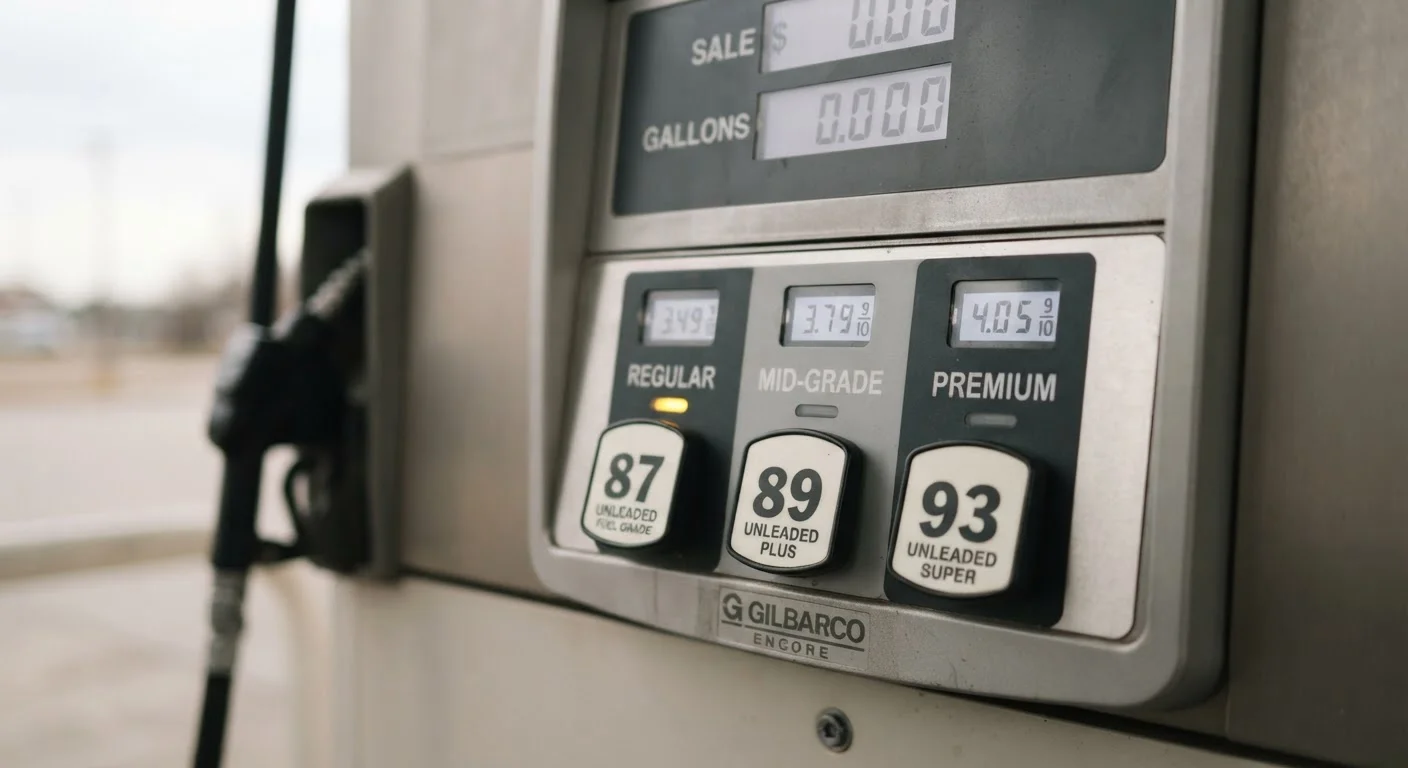
What the Number at the Pump Actually Means
Pull up to any gas station in America and you'll see three numbers: 87, 89, and 91 (sometimes 93). Most drivers assume higher means better - cleaner, more powerful, better for the engine. That assumption drives billions of dollars in unnecessary premium fuel purchases every year.
The octane number measures one thing: how well a fuel resists engine knock (also called pre-ignition or detonation). In a gasoline engine, the air-fuel mixture is supposed to ignite only when the spark plug fires. If that mixture ignites too early - due to heat or pressure - you get knock. It's inefficient, potentially damaging, and the octane rating tells you how much compression a fuel can handle before that happens.
To understand why compression matters, it helps to know the basics of how combustion works. See our plain-language engine explainer for context on pistons, compression ratios, and the combustion cycle.
~70%
U.S. vehicles designed for regular 87 octane
Industry estimates consistently show the large majority of passenger cars on American roads are engineered for regular unleaded fuel, not premium.
$2.1B
Estimated annual spend on unnecessary premium fuel
AAA has estimated that American drivers spend billions per year on premium gasoline in vehicles that don't require or benefit from it.
Required vs. Recommended: A Critical Distinction
Your owner's manual will use one of two phrases: premium required or premium recommended. These are not interchangeable, and conflating them is a common - and costly - mistake.
Premium required means the engine's compression ratio and timing are calibrated specifically for high-octane fuel. Running regular in these engines - typically found in turbocharged or high-performance vehicles - forces the engine's knock sensor to retard ignition timing, reducing power and efficiency. Sustained use can place additional stress on engine components.
Premium recommended means the engine is designed to run on regular but may deliver slightly better performance with premium. In practice, most drivers see minimal real-world difference, and regular unleaded is perfectly acceptable.
If your car calls for regular 87, there is no engineering case for spending more on premium. The fuel cannot be utilized differently - your engine's compression ratio is fixed.
Check the Fuel Door, Not Just the Manual
Many vehicles have a sticker inside the fuel door that states the required octane grade. This is the fastest on-the-spot reference when you're at the pump. If it says 'regular unleaded,' no upgrade is necessary - or beneficial.
How Modern Engines Adapt - and Why That's Not a Safety Net
Nearly all modern gasoline engines are equipped with a knock sensor - a device that detects detonation and signals the engine control unit to retard ignition timing. This is a protective mechanism, not a license to use the wrong fuel grade indefinitely.
When a premium-required engine is fed regular fuel, it will adjust. You likely won't hear knock. But that adjustment comes at a cost: reduced power output and lower fuel efficiency. Over time, running consistently on the wrong grade in an engine that truly requires premium can contribute to wear patterns the manufacturer didn't design for.
Think of the knock sensor as a seatbelt, not an excuse to drive carelessly. It catches problems - it doesn't eliminate them.
Altitude Can Affect Octane Needs
At high altitudes, air is thinner, which naturally reduces the tendency for knock. Some manufacturers note that regular fuel may be used in premium-recommended (not required) vehicles at elevations above 4,000 feet. Check your owner's manual for altitude-specific guidance before adjusting your fuel grade.
The Economics: When Premium Pays and When It Doesn't
For the overwhelming majority of passenger vehicles on U.S. roads - those designed for regular 87 - switching to premium is a financial loss with zero mechanical gain. According to AAA research, American drivers waste significant amounts annually by voluntarily upgrading to premium fuel in vehicles that don't require it.
Where premium does pay is in turbocharged, high-compression, or performance engines that genuinely require it. In these cases, using regular won't just reduce performance - it may, over time, affect long-term engine health in ways that cost far more than the fuel price difference.
Just as using the wrong specification can cost you in other areas of car maintenance, fuel grade matters as part of a broader maintenance mindset. Our article on conventional vs. synthetic motor oil explores a similar principle: the right product for your specific engine, not the most expensive one.
Frequently Asked Questions
Not if your engine is designed for regular fuel. Premium only benefits engines engineered to take advantage of its higher knock resistance. In a standard engine, you'll see no gains in power or fuel economy.
Modern engines with knock sensors will retard ignition timing to compensate, reducing power and efficiency. Long-term use of lower-grade fuel in a premium-required engine can stress engine components over time.
Not inherently. All fuel grades sold in the U.S. must meet minimum EPA detergency standards. The octane number reflects knock resistance only, not purity or additive quality.
It's a metallic pinging or rattling sound from the engine, especially under acceleration or load. It signals that combustion is occurring unevenly, which is harmful to engine internals over time.
Check your owner's manual or the sticker inside the fuel door. It will say 'regular unleaded,' 'premium recommended,' or 'premium required' - follow that guidance.
Yes. Ethanol has a high octane rating itself, and E85 blends have significantly higher octane than standard pump gasoline. However, ethanol also contains less energy per gallon, affecting fuel economy in flex-fuel vehicles.
The content provided on our blog site traverses numerous categories, offering readers valuable and practical information. Readers can use the editorial team’s research and data to gain more insights into their topics of interest. However, they are requested not to treat the articles as conclusive. The website team cannot be held responsible for differences in data or inaccuracies found across other platforms. Please also note that the site might also miss out on various schemes and offers available that the readers may find more beneficial than the ones we cover.