

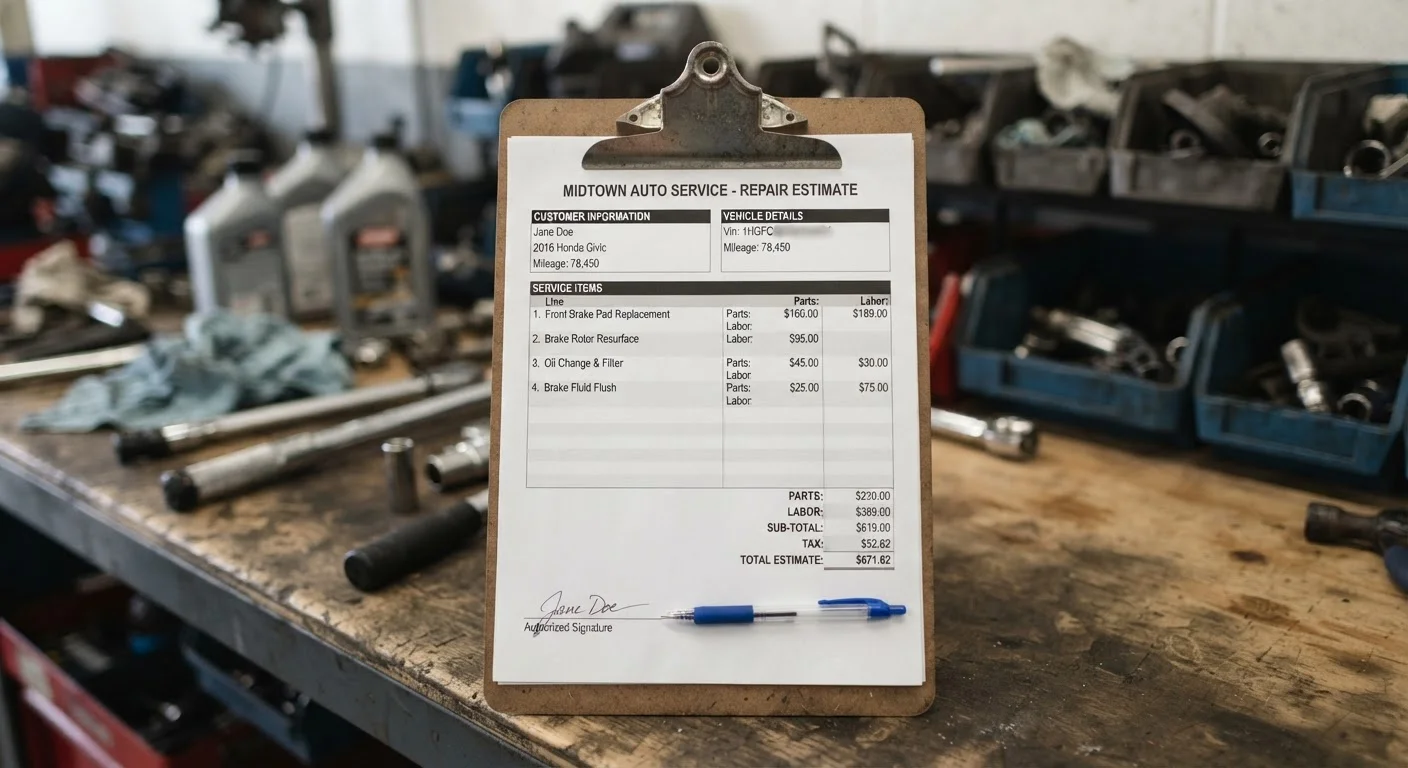
What You're Actually Looking At
A mechanic's estimate is a written breakdown of the work a shop proposes to perform on your vehicle, along with the projected cost of each component. At first glance it can look like a foreign language - line codes, labor times, part numbers - but the structure is consistent across virtually every shop in the country. Once you understand the three core categories, the document becomes manageable.
Those three categories are: parts (the physical components being replaced or repaired), labor (the technician's time to perform the work), and fees (charges such as diagnostic time, shop supplies, or environmental disposal). Every line item belongs to one of these buckets. If you're ever unsure, ask the service advisor to tell you which category a charge falls into - that single question often brings clarity immediately.
For a broader look at decoding line-item estimates across different trades, the same logic applies whether you're reading an automotive quote or a home project bid. See how the two compare in our article on reading a contractor's bid.
What you will need
Breaking Down Each Section of the Estimate
Parts: OEM vs. Aftermarket vs. Remanufactured
Parts listings will typically show a part number, a description, a unit cost, and a quantity. The markup on parts is a legitimate revenue stream for shops, but the type of part matters as much as the price. OEM (Original Equipment Manufacturer) parts are made by or for the vehicle's manufacturer and are engineered to exact factory specifications. Aftermarket parts are produced by third-party companies; quality ranges from excellent to poor depending on the manufacturer. Remanufactured parts are OEM cores that have been rebuilt to meet original specs - often a sound middle ground on cost and reliability.
You have the right to ask which type is being quoted and to request alternatives. Your owner's manual can confirm fluid specifications and sometimes part standards specified by the manufacturer.
Labor: Flat-Rate Hours Explained
Labor charges are calculated using a flat-rate system. Industry guides - published by sources such as Mitchell or Chilton - assign a standard number of hours to nearly every repair procedure. A water pump replacement might be rated at 2.5 hours whether the actual job takes a skilled technician 90 minutes or three hours. The shop charges the flat rate, not the clock. This system is standard industry practice across independent shops and dealerships alike.
Labor rates (the hourly dollar amount) vary by region and shop type. Dealerships typically charge higher rates than independent garages, though neither is inherently better. What matters is the quality of the work and the warranty behind it.
Diagnostic Fees
A diagnostic fee covers the time a technician spends identifying the root cause of a problem - connecting a scan tool, test-driving the vehicle, inspecting components. Many shops credit this fee toward the final repair cost if you approve the work. Ask upfront whether this applies. If a shop charges a diagnostic fee and then cannot explain what they found in plain language, that's a signal to ask more questions or seek a second opinion.
Ask for the Diagnosis in Plain Language
If a service advisor can't explain what's wrong with your car in terms you understand, ask them to try again. A competent technician should be able to describe the root cause and the consequence of not repairing it without resorting to jargon. This explanation - not the line-item code - is what you're paying the diagnostic fee to receive.
Shop Supplies and Environmental Fees
These small line items cover consumables like rags, solvent, and disposal of used oil or refrigerant. They are typically a flat charge or a small percentage of the labor total. While not negotiable in most shops, they should be listed transparently - not buried.
Questions to Ask Before You Sign
Knowing the structure of an estimate is only useful if you act on it. Before authorizing any repair, consider asking the following:
Confirm the estimate is written and itemized
Before any work begins, ask for a written estimate that lists each repair separately with individual part costs and labor hours. Most US states legally require shops to provide this upon request. A single lump-sum figure gives you nothing to evaluate.
Ask what type of parts are being used
For each part listed, ask whether it's OEM, aftermarket, or remanufactured. Request the reason for that choice and whether alternatives are available. If the repair is covered under warranty, using non-OEM parts could affect your coverage - verify this with your warranty documentation.
Verify the labor hours against the described work
Ask the service advisor how many flat-rate hours are assigned to each procedure. You can cross-reference common repairs using free resources online to get a general sense of typical labor times. A significant discrepancy - for instance, 5 hours billed for a job commonly rated at 1.5 - warrants a direct question.
Clarify whether the diagnostic fee is credited toward repair
Ask directly: 'If I approve the repair, is the diagnostic fee applied toward the total?' Many shops say yes - get the answer in writing on the estimate itself. If the shop cannot explain the diagnosis in terms you understand, ask them to try again. A good technician can describe the problem without excessive jargon.
Request your old parts back
Ask the shop to return your replaced parts when the job is complete. Reputable shops accommodate this without objection. Receiving your old parts confirms that the components were actually swapped - not just billed. Some parts (like brake cores) may be subject to a core charge that is refunded when the shop returns them to the supplier, which is a legitimate exception.
Get a second opinion on large or unexpected repairs
For any repair estimated above a threshold you're uncomfortable with - or for a diagnosis that surprises you - take the written estimate to a second shop. Describe the symptoms; do not lead with the first shop's diagnosis. Compare both the diagnosis and the cost. A reputable shop will never object to you seeking a second opinion.
Never Authorize Work Verbally Alone
Verbal agreements are difficult to dispute if a billing disagreement arises. Always confirm your authorization in writing - either by signing an itemized estimate or, if authorizing additional work by phone, asking for a written follow-up before the work proceeds. Keep copies of every document until the repair warranty period has passed.
For a comprehensive pre-authorization checklist - especially useful at dealership service departments - review our guide on what to verify before approving any repair. And if you're weighing whether to handle any maintenance yourself, our article on DIY car maintenance vs. taking it to a mechanic lays out where the line typically falls.
For any unfamiliar terms you encounter on an estimate, our glossary of car terms drivers actually encounter offers plain-language definitions. Understanding the terminology is the first step to feeling - and being - in control of the repair process.
The content provided on our blog site traverses numerous categories, offering readers valuable and practical information. Readers can use the editorial team’s research and data to gain more insights into their topics of interest. However, they are requested not to treat the articles as conclusive. The website team cannot be held responsible for differences in data or inaccuracies found across other platforms. Please also note that the site might also miss out on various schemes and offers available that the readers may find more beneficial than the ones we cover.