

Option A
Whole Grains
The nutritionally complete, minimally processed option.
Best for: People looking to support digestive health, blood sugar stability, and sustained energy through everyday food choices.
Option B
Refined Grains
The versatile, widely used processed alternative.
Best for: Situations where texture, shelf life, or culinary function matter more than nutritional density.
What Happens Inside the Mill
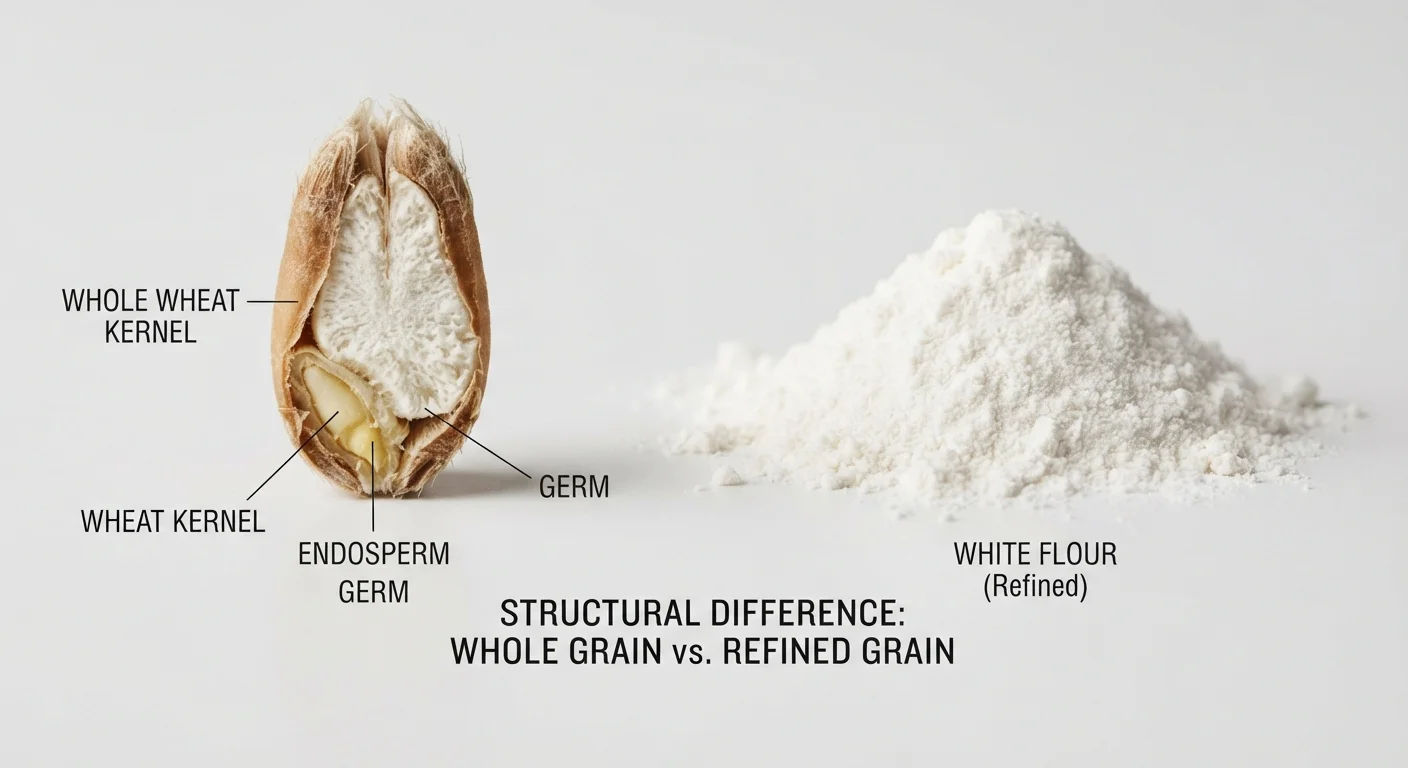
A grain kernel has three distinct parts: the bran (the fibrous outer layer), the germ (the nutrient-dense core that can sprout), and the endosperm (the starchy middle that makes up most of the grain's volume). Whole grains keep all three parts intact. Refined grains do not.
When wheat is milled into white flour, the bran and germ are mechanically separated and discarded, leaving only the endosperm. The result is a smoother, lighter flour - but one that has lost the majority of its fiber, B vitamins (thiamine, riboflavin, niacin, folate), vitamin E, iron, magnesium, and antioxidants. These aren't minor trace amounts; some estimates suggest milling removes more than 20 nutrients in meaningful quantities.
To partially compensate, many refined grain products are enriched - meaning manufacturers add back a handful of nutrients (typically iron and some B vitamins) after processing. Enrichment is required by U.S. law for many refined grain products. However, enrichment does not restore everything: fiber is not added back, and several phytonutrients and minerals remain absent.
| Criterion | Whole Grains | Refined Grains |
|---|---|---|
| Kernel parts retained | Bran, germ, and endosperm | Endosperm only |
| Dietary fiber | High (bran intact) | Very low (bran removed) |
| B vitamins | Naturally present | Partially added back (enriched) |
| Minerals (iron, magnesium) | Naturally present | Reduced; some restored by enrichment |
| Phytonutrients & antioxidants | Present | Largely removed; not restored |
| Shelf life | Shorter (germ contains fats) | Longer (germ removed) |
| Texture | Denser, heartier | Lighter, finer |
| Common examples | Whole wheat bread, oats, brown rice | White bread, white rice, white pasta |
Reading Labels: How to Actually Find Whole Grains
Food marketing can make this genuinely confusing. Terms like "multigrain," "made with whole grain," "seven-grain," and "wheat bread" are not regulated to guarantee a meaningful whole grain content. A loaf labeled "multigrain" may contain multiple refined grains - none of them whole. This is explored in more detail in our guide on reading food marketing claims.
The most reliable way to identify a whole grain product is to check the ingredient list. The first ingredient should include the word "whole" - such as "whole wheat flour," "whole oats," or "whole grain corn." If the first ingredient is "enriched flour," "wheat flour," or "rice flour" without the word "whole," the primary grain is refined regardless of other claims on the package.
"Whole Wheat" vs. "Wheat Flour" - Not the Same
"Whole wheat flour" and "wheat flour" are legally distinct terms in the U.S. "Wheat flour" on an ingredient list refers to refined white flour made from wheat - the word "whole" must be present to indicate the complete grain. This distinction trips up many careful label readers, so it's worth a second look before assuming a product is a whole grain source.
It's also worth noting that not all whole grains look like bread. Oats, brown rice, quinoa, barley, bulgur, and popcorn are all whole grains in their common forms. Incorporating variety makes it easier to meet recommendations without overhauling your diet entirely.
Why Dietary Guidelines Favor Whole Grains - and What the Research Shows
Major health organizations, including the U.S. Dietary Guidelines Advisory Committee, consistently recommend that at least half of all grains consumed come from whole grain sources. This guidance is grounded in a substantial body of observational research linking higher whole grain intake to lower risks of type 2 diabetes, cardiovascular disease, and certain digestive issues.
3+ servings/day
Whole grain intake linked to reduced cardiovascular risk
A 2016 meta-analysis published in the BMJ found that consuming about three servings of whole grains daily was associated with lower risk of heart disease, stroke, and type 2 diabetes.
~5%
Americans meeting whole grain recommendations
According to data from the Dietary Guidelines for Americans, only a small fraction of U.S. adults consistently meet the recommendation to make at least half their grains whole grains.
20+
Nutrients reduced during grain refining
Nutritional analyses of the milling process estimate that refining wheat removes meaningful quantities of more than 20 vitamins, minerals, and phytonutrients from the whole kernel.
It's worth being clear about what that research can and can't tell us. Most evidence comes from large observational studies, which show associations but can't prove direct cause and effect. People who eat more whole grains also tend to eat more vegetables and fewer ultra-processed foods, making it difficult to isolate grain type as the single variable. That said, the convergence of evidence across many populations and study designs has been consistent enough that the whole grain recommendation is broadly accepted in nutrition science.
What's not supported by evidence is an extreme view in either direction - that refined grains are toxic or that whole grains are a cure-all. For most people, the practical goal is a gradual shift in proportion: more whole, fewer refined, without turning every meal into a nutritional audit. For a related perspective, see our piece on why your salad might not be as nutritious as you think.
This article is for general informational and educational purposes only and is not a substitute for professional medical or dietary advice. Consult a qualified healthcare provider or registered dietitian for guidance tailored to your individual health needs.
The content provided on our blog site traverses numerous categories, offering readers valuable and practical information. Readers can use the editorial team’s research and data to gain more insights into their topics of interest. However, they are requested not to treat the articles as conclusive. The website team cannot be held responsible for differences in data or inaccuracies found across other platforms. Please also note that the site might also miss out on various schemes and offers available that the readers may find more beneficial than the ones we cover.