

Our Verdict
Envelope budgeting is a genuinely effective tool for people who struggle to control day-to-day discretionary spending. Its simplicity is a real strength - there's no software to learn and no complicated math. However, it requires consistent upkeep, works poorly with digital transactions, and can feel rigid when life doesn't follow a predictable pattern.
People new to budgeting who want a concrete, hands-on system to manage grocery, dining, and entertainment spending without relying on apps or spreadsheets.
How Envelope Budgeting Works
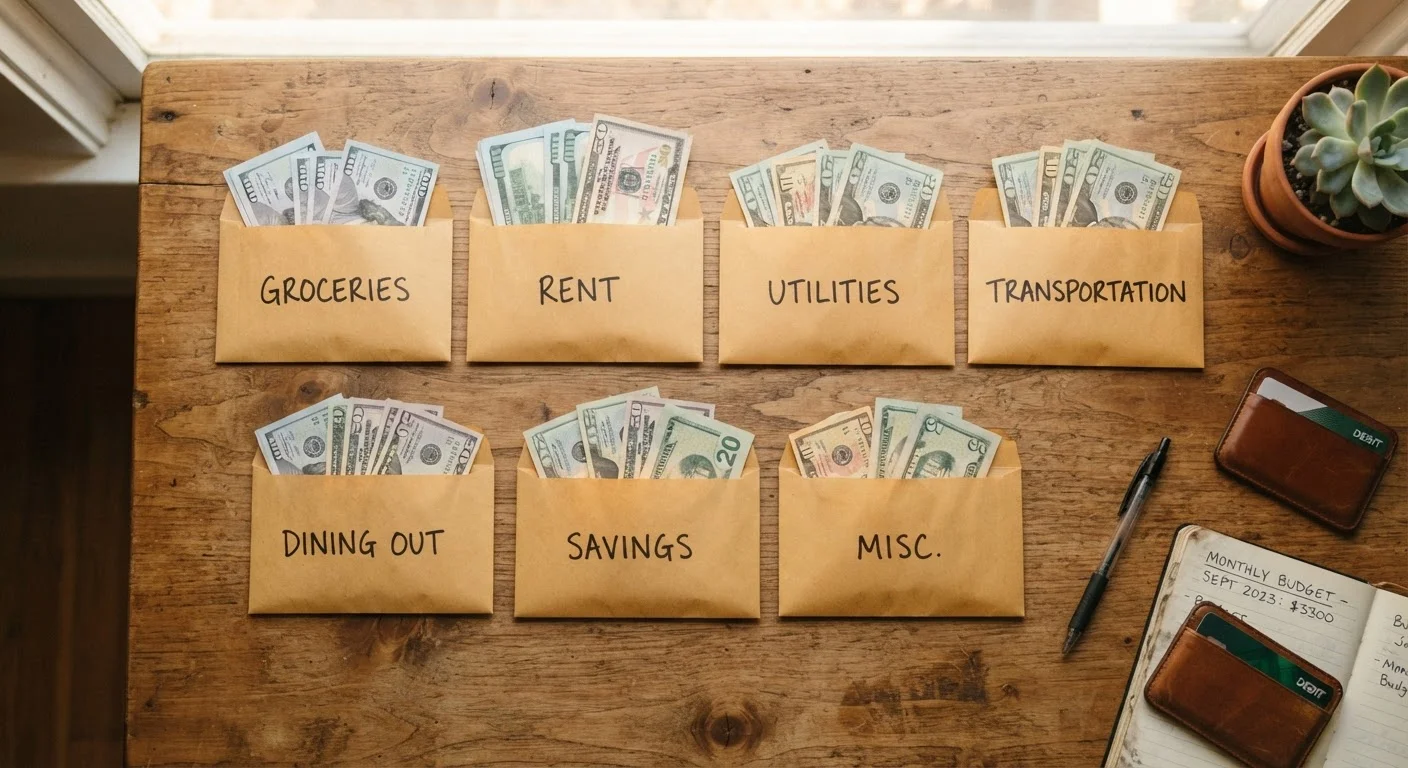
The envelope method is one of the oldest personal budgeting approaches around. The idea is straightforward: at the start of each pay period, you divide your take-home income into labeled envelopes - one for groceries, one for gas, one for dining out, and so on. Each envelope gets a fixed dollar amount in cash. When that envelope is empty, spending in that category stops until the next pay period.
It's a physical system built on a simple truth: money you can hold in your hand feels more real than a number on a screen. That psychological friction is the whole point. For a fuller picture of what budgeting actually means before diving into methods, see what a personal budget actually is.
Modern variations let you run the same system digitally using budgeting apps that replicate envelope categories without requiring cash. The core logic stays the same - money is pre-assigned to a purpose before it gets spent.
What Envelope Budgeting Gets Right
Spending limits are visible in real time
An empty envelope signals a hard stop immediately, unlike digital statements that show overspending days later when it's already done.
No technical knowledge or tools required
The system needs only envelopes, cash, and a pen - making it one of the most accessible budgeting methods for anyone starting from scratch.
Reduces impulse spending on discretionary categories
Research in behavioral economics consistently shows that paying with physical cash creates more psychological friction than swiping a card, which tends to result in more deliberate spending decisions.
Forces intentional income allocation upfront
Dividing cash at the start of a pay period requires you to actively decide where money goes, rather than spending first and accounting for it later.
Easy to adapt for specific problem categories
If dining out is your budget weak spot, a single dedicated envelope can contain it - without overhauling your entire financial system.
The biggest advantage is immediacy. Unlike reviewing a bank statement two weeks later, an empty envelope delivers real-time feedback. You know exactly where you stand because the evidence is in your hand. That immediacy tends to change behavior more reliably than abstract tracking.
For anyone who has tried and abandoned complex budgeting systems, the envelope method's simplicity is a genuine relief. There's no learning curve, no subscription, and no spreadsheet skills required. If you've ever wondered why budgeting myths persist about needing special knowledge or high income, the evidence tells a different story.
Where the System Struggles
Poor fit for digital and card-based transactions
Most recurring bills - rent, utilities, streaming services - can't be paid with cash from an envelope, leaving a significant portion of household spending outside the system entirely.
Carrying cash creates security and convenience risks
Lost or stolen cash has no protection, unlike a debit or credit card that can be frozen. Carrying multiple envelopes through daily life is also genuinely cumbersome for many people.
Requires consistent weekly maintenance
Withdrawing, sorting, and replenishing cash each pay period takes time and routine. Many people find this upkeep fades quickly, especially during busy or stressful stretches.
Rigid structure can backfire when plans shift
An unexpected car repair or medical co-pay can throw off multiple envelopes at once, and the system offers no built-in mechanism for graceful reallocation beyond manually moving cash between envelopes.
Difficult to use with variable or irregular income
Pre-assigning cash to fixed categories assumes a predictable paycheck; freelancers and gig workers often find the system breaks down when monthly earnings fluctuate significantly.
The most practical limitation is that modern life is heavily digital. Rent, utilities, subscriptions, and most online purchases don't fit neatly into a cash envelope. Forcing every transaction to be cash-based is inconvenient at best and impractical at worst for most American households.
The system also requires discipline in a different way than people expect. You have to physically withdraw cash, sort it, and carry the right envelopes - every pay period. That maintenance load causes many people to quietly abandon the method after a few weeks.
Comparing Envelope Budgeting to Other Methods
Envelope budgeting is just one of several structured approaches to managing monthly spending. Zero-based budgeting follows similar logic - every dollar gets a job - but works entirely on paper or in an app, making it more compatible with digital transactions. The 50/30/20 method takes a broader, percentage-based view that suits people who prefer less granular tracking. Understanding how these methods differ can help you decide whether the envelope system is the right starting point or whether a different structure fits your life better.
If you want to compare how envelope budgeting stacks up against more structured approaches, zero-based and 50/30/20 budgeting offer useful contrasts in flexibility and effort.
Who It Fits - and Who It Doesn't
Envelope budgeting tends to work well for people with steady, predictable paychecks who spend most of their discretionary money on tangible categories like groceries, clothing, and dining. The system gives them clear guardrails without requiring much financial literacy.
It's a harder fit for freelancers, gig workers, or anyone with variable monthly income. When you don't know exactly what you'll earn this month, pre-allocating fixed cash amounts to envelopes is genuinely difficult. Similarly, households that pay most bills automatically online will find the system only covers a fraction of their actual spending.
~33%
Americans who follow a formal budget
Gallup polling has consistently found that only about one-third of American adults maintain a detailed household budget, suggesting most people lack a structured spending system of any kind.
12-18%
Typical reduction in discretionary overspending
Studies in consumer behavior suggest that cash-based payment methods can reduce overspending in discretionary categories compared to card payments, though individual results vary widely.
For people who do adopt it, the envelope method can serve as a solid entry point into more comprehensive budgeting. From there, a monthly budget health check can help ensure the system stays working as life changes. And for a full grounding in budgeting fundamentals, personal budgeting from the ground up covers every essential from income tracking to irregular expenses.
This article is for general informational purposes only and does not constitute personalized financial advice. Consider consulting a licensed financial professional for guidance specific to your situation.
The content provided on our blog site traverses numerous categories, offering readers valuable and practical information. Readers can use the editorial team’s research and data to gain more insights into their topics of interest. However, they are requested not to treat the articles as conclusive. The website team cannot be held responsible for differences in data or inaccuracies found across other platforms. Please also note that the site might also miss out on various schemes and offers available that the readers may find more beneficial than the ones we cover.