

Why Scoring Models and Ranges Matter
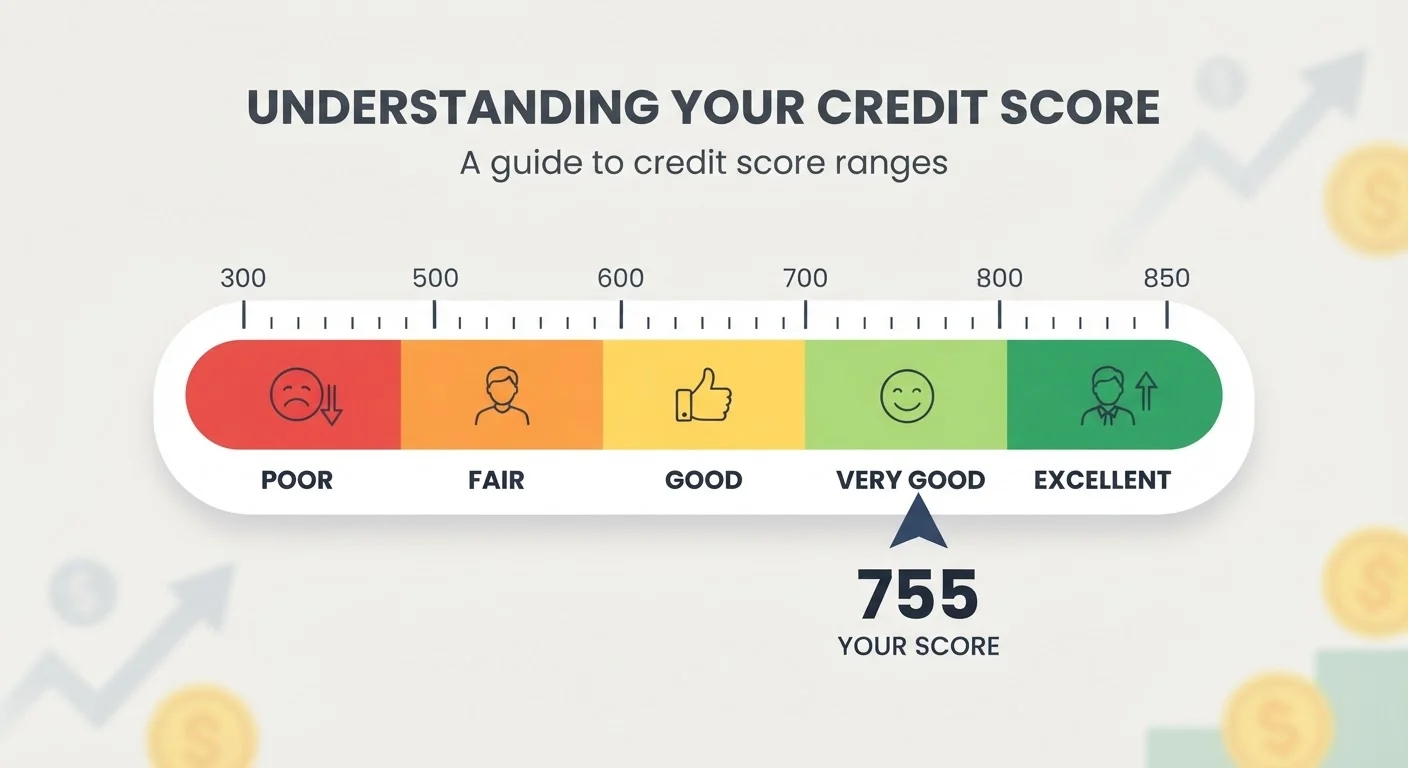
Your credit score is a three-digit number, but that number means different things depending on which scoring model produced it. Two models dominate the U.S. market: FICO (developed by Fair Isaac Corporation) and VantageScore (created jointly by the three major credit bureaus). Both run on a 300-850 scale, but they organize that range into tiers differently and weight certain behaviors differently.
Understanding where you land on each model helps you interpret what lenders may see when they pull your credit. It also prevents the confusion that happens when a score from one source looks noticeably different from a score you checked elsewhere. For a deeper look at what actually goes into the number itself, see our primer on what credit scores measure.
| Score range (both models) | 300-850 |
| FICO 'Good' threshold | 670 (FICO published score ranges) |
| VantageScore 'Good' threshold | 661 (VantageScore published score ranges) |
| Minimum history for FICO score | ~6 months (FICO scoring criteria) |
| Minimum history for VantageScore | ~1 month (VantageScore scoring criteria) |
| Primary U.S. credit bureaus | Equifax, Experian, TransUnion |
FICO Score Ranges
FICO is the most widely used scoring model among lenders - mortgage companies in particular rely heavily on it. FICO organizes its 300-850 range into five tiers:
| Tier | Score Range | General Lender Signal |
|---|---|---|
| Exceptional | 800-850 | Lowest risk; typically qualifies for most favorable terms |
| Very Good | 740-799 | Low risk; strong approval odds and competitive rates |
| Good | 670-739 | Near or above average; broadly acceptable to most lenders |
| Fair | 580-669 | Subprime territory; approval possible but terms may be less favorable |
| Poor | 300-579 | High risk; limited options, may require secured products or a co-signer |
The 670 mark is a common threshold. Scores above it are generally considered within the acceptable range for conventional lending products, though each lender sets its own standards. If you're just getting started, our guide on building credit from scratch walks through early steps that move the needle on FICO.
VantageScore Ranges
VantageScore 3.0 and 4.0 - the versions most commonly distributed by credit monitoring services - use the same 300-850 scale but divide it into four tiers:
| Tier | Score Range | General Lender Signal |
|---|---|---|
| Excellent | 781-850 | Very low risk; strong position for competitive terms |
| Good | 661-780 | Low to moderate risk; broadly lendable |
| Fair | 601-660 | Moderate risk; approval varies by lender and product |
| Poor | 300-600 | Higher risk; limited mainstream options |
One meaningful difference: VantageScore can generate a score with as little as one month of credit history and one account reported in the past two years. FICO generally requires at least six months of history and a recently active account. This is why someone new to credit might have a VantageScore but no FICO score yet.
FICO Score
A credit score produced by Fair Isaac Corporation, widely used by U.S. lenders to assess borrower risk. It ranges from 300 to 850 and is calculated using data from a consumer's credit report.
VantageScore
A credit scoring model developed collaboratively by Equifax, Experian, and TransUnion. It uses the same 300-850 scale as FICO but applies different weighting and tier cutoffs.
Credit Tier
A labeled band (e.g., Poor, Fair, Good, Exceptional) that groups a range of scores together to signal relative risk to lenders. Tier definitions vary between scoring models.
Subprime
A general term for borrowers whose credit scores fall below the threshold most lenders consider standard risk. Subprime borrowers may face higher interest rates, stricter terms, or limited product options.
Credit Bureau
A company that collects consumer credit data from lenders and other sources and compiles it into credit reports. The three major U.S. bureaus are Equifax, Experian, and TransUnion.
Key Differences and Practical Takeaways
The two models agree more than they disagree - both reward on-time payments, low credit utilization, and a seasoned credit history. But the tier cutoffs shift, so a score of 660 lands in FICO's "Fair" band while placing near the top of VantageScore's "Fair" tier. Neither number is universally "right"; the relevant score is whichever one a specific lender pulls.
~67%
Americans with a 'Good' or higher FICO score
According to FICO data, roughly two-thirds of scored U.S. consumers fall at or above the 670 'Good' threshold.
40+
Distinct FICO score versions in use
FICO has released multiple score versions over the years; different lenders use different versions depending on their industry and risk models.
A few practical points worth keeping in mind:
- Lenders choose their model. Mortgage lenders typically use older FICO versions (FICO 2, 4, and 5). Credit card issuers may use FICO 8 or 9, or VantageScore.
- Score variation is normal. Scores from different bureaus (Equifax, Experian, TransUnion) can differ because not all creditors report to all three.
- Both models penalize the same core behaviors. Missed payments and high balances relative to limits hurt your score across all major models. Understanding how credit utilization works is useful for either model.
Before applying for a significant loan, it's worth knowing which scoring model that lender uses and pulling the appropriate score. A qualified financial adviser or HUD-approved housing counselor can help you interpret your scores in the context of a specific decision. This article provides general educational information - it is not personalized financial advice.
The content provided on our blog site traverses numerous categories, offering readers valuable and practical information. Readers can use the editorial team’s research and data to gain more insights into their topics of interest. However, they are requested not to treat the articles as conclusive. The website team cannot be held responsible for differences in data or inaccuracies found across other platforms. Please also note that the site might also miss out on various schemes and offers available that the readers may find more beneficial than the ones we cover.