

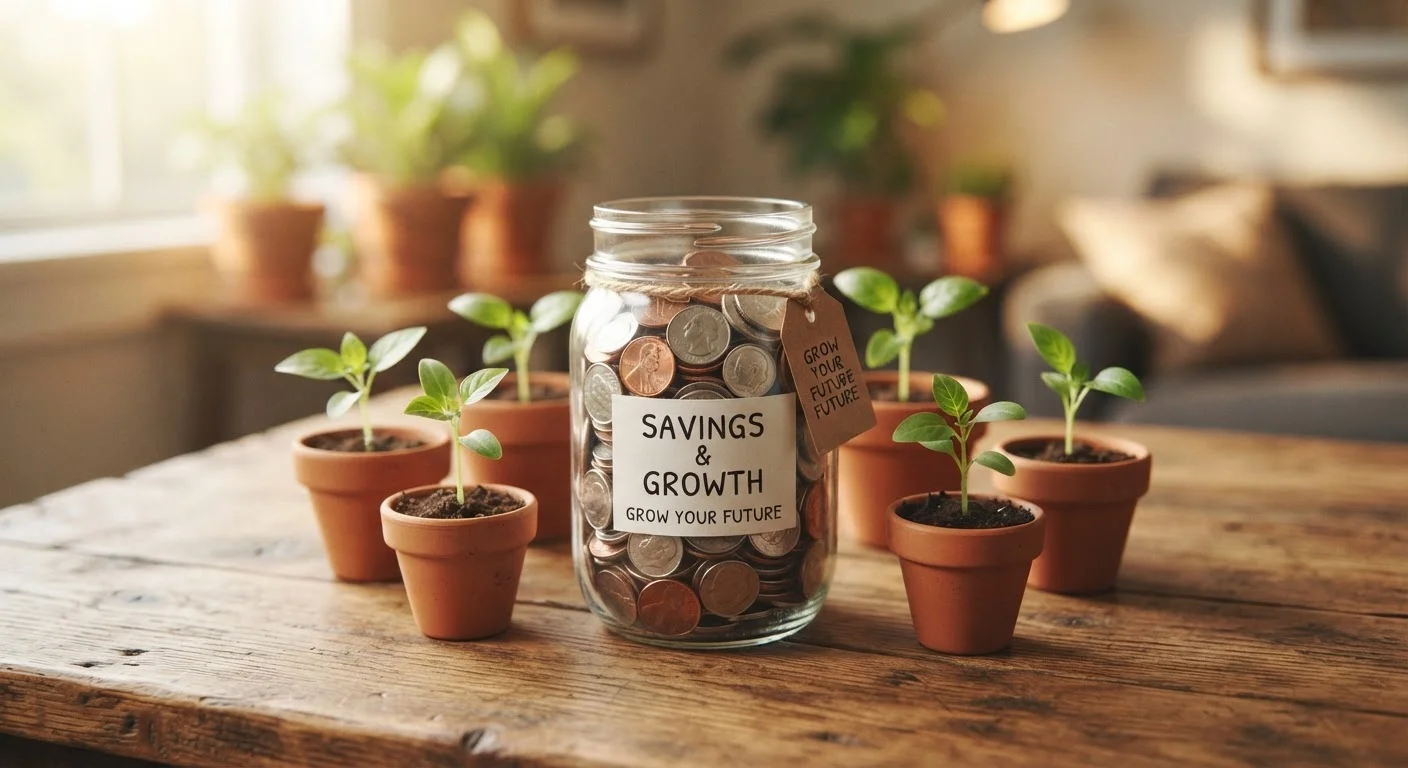
The Basic Idea: Interest Earning Interest
Think of compound interest like a snowball rolling downhill. It starts small, but as it rolls, it picks up more snow - and the bigger it gets, the more it picks up with each rotation.
Here's a simple illustration. Say you deposit $1,000 into a savings account earning 5% interest per year. After year one, you've earned $50 - giving you $1,050. In year two, you earn 5% on $1,050, not the original $1,000. That's $52.50. The next year, you earn on $1,102.50. Each year, your interest earnings grow slightly larger without you adding anything.
That's the core mechanic: your earnings get folded back into your balance and begin earning their own interest. The longer you leave money untouched, the more pronounced that effect becomes.
For a deeper look at how this fits into your overall financial picture, see our comprehensive savings starting point.
10 years
Time needed to roughly double money at 7% annual compound growth
Based on the Rule of 72, a widely cited financial estimation tool - divide 72 by the annual interest rate to estimate doubling time.
~$15,000+
Extra interest paid on a $5,000 balance at 20% APR with minimums only
Estimates vary by balance and rate, but consumer finance analyses consistently show minimum payments on high-rate cards can triple the effective cost of borrowing.
365x/year
How often many savings accounts compound interest
Daily compounding, offered by many online savings accounts, means interest is added to your balance every day - slightly accelerating growth compared to monthly compounding.
Why Time Is the Most Powerful Variable
People often assume that how much they save is the most important factor. In reality, when you start matters just as much - and in many cases, more.
Consider two people, both saving for retirement. One starts at 25, contributing $200 a month. The other waits until 35 to start but contributes $300 a month - 50% more per month. By the time both reach 65, the person who started a decade earlier will likely have a significantly larger balance, even though they contributed less total money. The extra ten years of compounding does the heavy lifting.
This isn't magic - it's math. The earlier deposits have more time to earn returns on their returns. Each year of delay means losing a layer of compounding that can never fully be recovered by contributing more later.
Start Sooner, Not Larger
If you're waiting until you can afford to save a 'real' amount, you may be costing yourself more than you realize. Even $50 a month started at 25 outperforms $150 a month started at 40 in many compounding scenarios. Consistency and time are the ingredients - the amount matters less than you think when you're starting out.
The Other Side: How Compound Interest Works Against You
The same mechanics that grow your savings can quietly grow your debt. Credit card balances are a common example. When you carry a balance and only make the minimum payment each month, interest is added to what you owe - and next month, you're charged interest on that higher amount.
Left unchecked, a $3,000 credit card balance at a high interest rate can take years to pay off with minimum payments alone, costing far more than the original amount borrowed. The math behind minimum payment cycles explains exactly why this trap is so common.
Similarly, loans with deferred interest or fees buried in the fine print can raise what you actually owe well beyond the headline rate. Understanding hidden loan costs alongside compound interest gives you a fuller picture of borrowing's true price.
Putting It to Work in Your Own Life
You don't need a large lump sum to benefit from compounding. The practical starting point is consistency: setting aside even a modest fixed amount each month and leaving it to grow. Many employer-sponsored retirement plans and savings accounts are structured specifically to take advantage of this - contributions come out automatically and compound over decades.
On the debt side, paying more than the minimum - even $25 or $50 extra a month - chips away at the principal faster and reduces the base on which interest compounds. That small extra payment saves disproportionately more over time than it might appear. For readers working through multiple debts, debt consolidation is one strategy worth understanding, though it carries trade-offs.
Building a working budget is often the first step toward freeing up money to save or apply toward debt. Our budgeting basics hub covers straightforward strategies for tracking spending and finding room in a tight budget.
Compound interest rewards patience and consistency more than size or sophistication. Starting with what you have, today, beats waiting for the perfect moment to begin.
This article is for general informational and educational purposes only and does not constitute personalized financial, investment, tax, or legal advice. For guidance specific to your situation, consult a qualified financial professional.
Frequently Asked Questions
Simple interest is calculated only on the original amount (called the principal). Compound interest is calculated on the principal plus any interest already earned. Over long periods, compound interest produces significantly larger totals than simple interest at the same rate.
Both. On savings accounts or retirement contributions, it works in your favor - your balance grows faster over time. On credit card balances or unpaid loans, it works against you - what you owe can grow surprisingly quickly if you only make minimum payments.
It depends on the account or loan. Many savings accounts compound daily or monthly, while some loans compound monthly. More frequent compounding means interest adds up slightly faster - check your account disclosures for the specific terms.
Not always. In standard savings accounts or certificates of deposit, compound interest grows your balance predictably. In investment accounts, returns vary and can go negative - there is no guarantee of growth. This article covers general education, not investment advice.
Small, consistent contributions still benefit from compounding over time. The key variable is time - even modest deposits made regularly can accumulate meaningfully over years or decades. Starting small is better than waiting until you can save more.
The content provided on our blog site traverses numerous categories, offering readers valuable and practical information. Readers can use the editorial team’s research and data to gain more insights into their topics of interest. However, they are requested not to treat the articles as conclusive. The website team cannot be held responsible for differences in data or inaccuracies found across other platforms. Please also note that the site might also miss out on various schemes and offers available that the readers may find more beneficial than the ones we cover.