

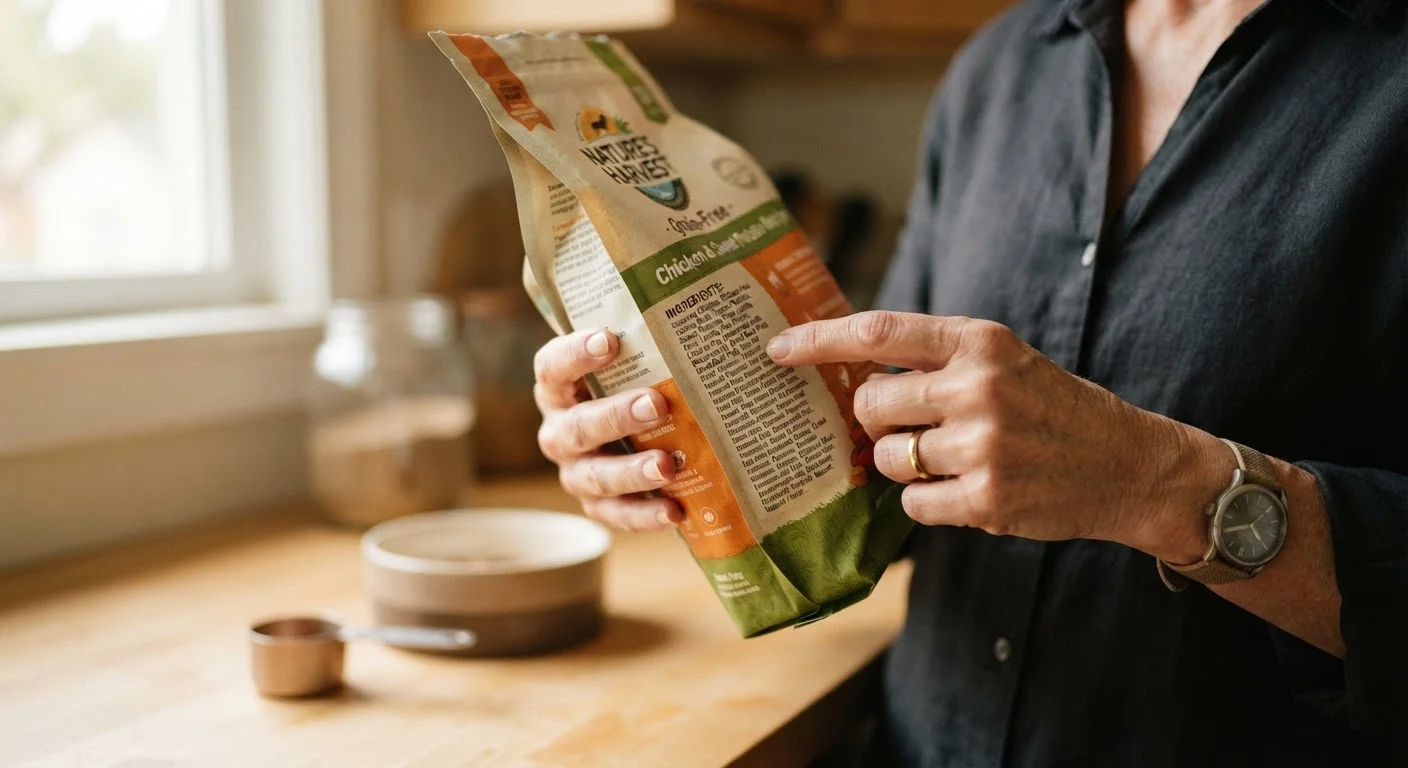
How the Ingredients List Is Structured
Every ingredient on a pet food label must be listed in descending order by weight - specifically, by weight as the ingredient exists before cooking or processing. This is a federal requirement, and it applies whether you're reading a bag of kibble or a can of wet food.
That rule sounds straightforward, but it creates a key nuance. Fresh meats - chicken, beef, salmon - contain significant water weight, often 70% or more. Once that moisture is cooked off during processing, the actual dry-matter contribution of that ingredient shrinks considerably. A food that lists 'fresh chicken' first may contain less protein from chicken than one listing 'chicken meal' (which is already dried and concentrated) in a lower position.
This doesn't make fresh meat a bad ingredient - it's simply a structural feature of how labels work. The takeaway: evaluate the first five to seven ingredients as a group rather than treating the top slot as the definitive signal of quality.
For a deeper look at the full range of nutrition terms you'll encounter, see the plain-language glossary of pet nutrition terms that explains everything from 'crude protein' to 'complete and balanced.'
~70%
Water content in fresh meat ingredients
Fresh meats are mostly water by weight, meaning their dry-matter protein contribution after processing is significantly lower than their label position suggests.
2
Methods AAFCO uses to validate nutritional adequacy
Pet foods can meet AAFCO standards either through nutrient-profile formulation calculations or through controlled animal feeding trials - each with different levels of real-world validation.
Multiple
Forms one ingredient can appear in on a label
A single base ingredient like corn or peas can be split into several named forms - ground corn, corn flour, corn gluten meal - each listed separately to reduce its apparent prominence.
Ingredient Splitting and Why It Can Mislead You
One of the most important things to understand about pet food labels is a practice called ingredient splitting. It works like this: a manufacturer lists a single raw material - say, corn - under several different names: ground corn, corn gluten meal, corn flour. Because each form is weighed separately, none of them individually ranks high enough to appear near the top of the list. Taken together, however, they may represent a substantial portion of the food.
Splitting is not illegal, but it can obscure the actual composition of a diet. When you spot multiple forms of the same base ingredient scattered through the list, treat them as a combined presence and assess accordingly.
The practice isn't limited to grains. Peas, potatoes, and other ingredients can appear in several forms across the same label. For a more detailed look at how this and other labeling tactics play out, reading the ingredient list like a nutritionist covers the mechanics thoroughly.
Spot Splitting Quickly With This Trick
When scanning an ingredients list, mentally group any items that share a root word or base ingredient - corn, peas, potatoes, chicken, rice. If you see three or four variations of the same source clustered across the list, add their positions together conceptually. That combined presence may outweigh what appears to be the dominant first ingredient.
What AAFCO Statements and By-Product Terms Actually Mean
Near the ingredients list, most pet foods carry an AAFCO nutritional adequacy statement. This is one of the most meaningful pieces of information on the entire package. It tells you two things: whether the food meets minimum nutritional standards, and which life stage it's designed for - typically 'adult maintenance,' 'growth and reproduction' (puppies and kittens), or 'all life stages.'
A food formulated for adult maintenance may not provide sufficient nutrients for a growing puppy. A food labeled 'for supplemental feeding only' is not intended as a complete diet. These distinctions matter practically.
The statement also indicates how the claim was established - either by formulation (calculated to meet nutrient profiles) or by feeding trial (tested in animals over time). Neither method is inherently superior, but feeding-trial-validated foods have cleared an additional real-world checkpoint.
On the subject of by-products: AAFCO defines 'meat by-products' as the clean, non-rendered parts of slaughtered animals other than meat - including organs such as liver, kidney, and lungs. Organ meats can be nutritionally rich sources of vitamins and minerals. The word 'by-product' carries a stigma in marketing, but its presence on a label is not automatically a red flag. What matters more is whether the manufacturer is transparent about sourcing and quality controls.
To understand the full nutritional picture your dog actually needs, nutrients every dog actually needs breaks down each category - protein, fat, vitamins, and minerals - and where they come from in commercial food.
Grain-Free Formulas: A Note on Ongoing Research
The FDA has been investigating a potential association between grain-free diets - particularly those high in legumes and potatoes - and dilated cardiomyopathy (DCM) in dogs. Research is ongoing and a definitive causal link has not been established. Pet owners considering grain-free options should discuss the current evidence with their veterinarian. For more context, see why grain-free isn't automatically healthier.
Marketing Language vs. Regulated Claims
Pet food packaging is covered in language designed to build trust: 'premium,' 'holistic,' 'human-grade,' 'natural.' Some of these terms have defined meanings under AAFCO guidelines; many do not.
'Natural,' for instance, has a working AAFCO definition - it generally means ingredients derived from plant, animal, or mined sources without artificial chemical alterations - but it does not imply nutritional superiority or absence of synthetic additives (which may be added separately while maintaining the 'natural' claim for other ingredients). 'Holistic' and 'premium' carry no regulatory definition at all in the context of pet food.
The practical approach: use marketing language as a prompt to investigate further, not as a conclusion. Check the AAFCO statement, review the ingredient list with the structural rules in mind, and if you're evaluating a food for a pet with health concerns, consult your veterinarian before committing to a new diet.
The checklist for evaluating a pet food before you commit walks through this process systematically. And for context on how similar labeling tactics appear in human food products, reading food marketing claims on human products offers a useful parallel perspective.
This article provides general educational information about pet food labeling and is not a substitute for personalized veterinary nutrition advice. Consult a licensed veterinarian for guidance specific to your pet's health needs.
Frequently Asked Questions
The first ingredient is the heaviest by weight before processing, but that doesn't always mean it dominates the finished food. Ingredients like fresh chicken contain a lot of water, so their actual contribution after cooking can be smaller than their position suggests. Look at the first several ingredients together rather than focusing on number one alone.
'Complete and balanced' means the food has been formulated or tested to meet AAFCO's minimum nutritional profiles for a specific life stage - such as adult maintenance or growth and reproduction. It's a meaningful regulatory claim, not just marketing language. A food without this statement may not be suitable as a sole diet.
Not necessarily. AAFCO defines meat by-products as clean, non-rendered parts other than meat - such as organs, which are often nutritionally dense. Quality varies by manufacturer, and by-products from reputable sources can be a legitimate protein contribution. The term alone doesn't indicate poor quality.
Ingredient splitting occurs when a single ingredient - like corn - appears in multiple forms (corn flour, corn gluten meal, ground corn) under separate names. Because each form is weighed separately, they each rank lower on the list, masking how much of that ingredient is actually present in total. It can make a less-desirable ingredient appear less dominant than it is.
Look for the AAFCO nutritional adequacy statement, which specifies the life stage the food is designed for. Your veterinarian is the most reliable resource for assessing whether a specific food suits your individual pet's age, health status, and dietary requirements. General label reading is a starting point, not a substitute for professional guidance.
Not automatically. Grain-free formulas replace grains with other carbohydrate sources like potatoes or legumes, which are not inherently superior. Ongoing research has examined a possible link between certain grain-free diets and dilated cardiomyopathy in dogs, though the relationship is not fully established. Consult your vet before choosing a grain-free diet.
The content provided on our blog site traverses numerous categories, offering readers valuable and practical information. Readers can use the editorial team’s research and data to gain more insights into their topics of interest. However, they are requested not to treat the articles as conclusive. The website team cannot be held responsible for differences in data or inaccuracies found across other platforms. Please also note that the site might also miss out on various schemes and offers available that the readers may find more beneficial than the ones we cover.