

Why This Glossary Exists
Stand in the pet food aisle long enough and the terminology starts to blur: crude protein, moisture basis, chelated minerals, AAFCO statement. These aren't marketing inventions - most are regulated terms with precise meanings. But manufacturers aren't required to explain them, which leaves pet owners guessing at what actually matters.
This reference cuts through that confusion. Every definition below reflects how the term is used in U.S. pet food regulation and nutritional science. For a deeper walkthrough of how these elements appear on an actual label, see what pet food labels are actually telling you.
Complete and balanced
A regulated phrase indicating the food meets all nutrient requirements established by AAFCO for a specific life stage. It is not a marketing claim - a manufacturer must substantiate it through formulation analysis or feeding trials.
Crude protein
A measurement of total nitrogen content in a food, used to estimate protein levels. It is called 'crude' because the method doesn't distinguish between highly digestible protein sources and lower-quality ones - it measures all nitrogen-containing compounds.
Crude fat
The total fat content measured by a standard solvent-extraction method. This figure covers all lipids in the food, including both beneficial omega fatty acids and saturated fats.
Crude fiber
A minimum measure of indigestible plant material. It tends to underestimate total dietary fiber because the laboratory method used doesn't capture all fiber types present in the food.
Moisture
The water content of the food, expressed as a maximum percentage. Dry kibble typically runs 10-12%, while canned wet food commonly reaches 75-82%. Moisture level affects how other nutrients appear on the label.
Dry matter basis
A calculation method that removes moisture from the equation so nutrient levels in different food formats - wet, dry, raw - can be compared fairly. Divide a nutrient's as-fed percentage by the dry matter percentage of the food.
AAFCO statement
A required label declaration stating whether a food is nutritionally complete, which life stage it targets, and how adequacy was determined - by formulation or by an actual feeding trial. It is the single most important line on a pet food label.
Chelated minerals
Minerals bonded to an organic molecule (such as an amino acid) to improve absorption in the digestive tract. They appear on labels as, for example, 'zinc proteinate' or 'ferrous bisglycinate.'
By-product
Parts of a slaughtered animal other than skeletal muscle - including organ meats, which can be highly nutritious. The term has a negative connotation in marketing, but many by-products are legitimate, nutrient-dense ingredients.
Meal (as in chicken meal)
A rendered, concentrated form of an animal ingredient with most moisture removed. Because water weight is gone, meal can actually represent a denser protein source by weight than a fresh-meat listing at the top of an ingredient list.
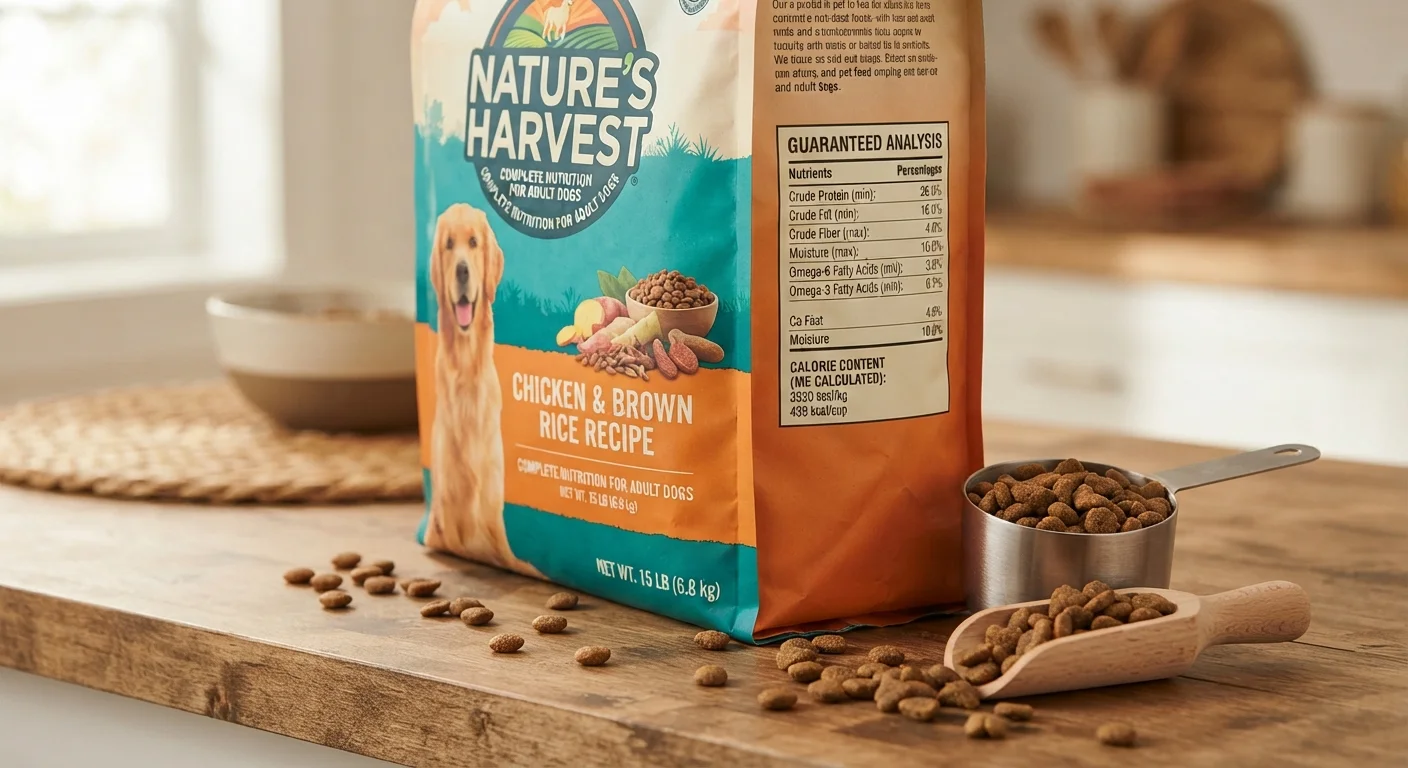
Guaranteed analysis
The panel on pet food packaging that lists minimum or maximum percentages for key nutrients - typically crude protein, crude fat, crude fiber, and moisture. Figures are on an as-fed basis.
Life stage
A classification - growth, adult maintenance, reproduction, or all life stages - that indicates which animals the food is formulated to nourish. Nutrient requirements differ substantially across life stages.
Key Numbers and What They Measure
Pet food labels carry specific figures in a section called the Guaranteed Analysis. Knowing what those numbers actually represent - and what they don't - gives you a much clearer picture of nutritional value.
| Crude protein (minimum) | Lowest guaranteed amount of protein; actual content may be higher (AAFCO Pet Food Labeling Guide) |
| Crude fat (minimum) | Lowest guaranteed fat content on an as-fed basis (AAFCO Pet Food Labeling Guide) |
| Crude fiber (maximum) | Highest guaranteed fiber level; actual fiber may be lower (AAFCO Pet Food Labeling Guide) |
| Moisture (maximum) | Highest guaranteed water content; affects all other nutrient percentages (AAFCO Pet Food Labeling Guide) |
| Ash (sometimes listed) | Inorganic mineral residue remaining after combustion; not a harmful additive (National Research Council, Nutrient Requirements of Dogs and Cats) |
| Caloric content (optional but increasingly common) | Kilocalories per kilogram or per cup/can, used to assess energy density (AAFCO Model Bill & Regulations) |
One detail that trips up many pet owners: all Guaranteed Analysis figures are given on an as-fed basis, meaning they reflect the food's nutrient content at its actual moisture level. Comparing a wet food directly to a dry food using these raw numbers is misleading. To make a fair comparison, you'd need to convert both to a dry matter basis - a straightforward calculation that removes moisture from the equation. For a step-by-step breakdown of evaluating what these numbers mean in context, see how to evaluate a pet food before committing to it.
Minimums vs. Maximums - Why It Matters
In the Guaranteed Analysis, protein and fat are listed as minimums, meaning the actual amount in the food could be higher. Fiber and moisture are listed as maximums - the real amounts could be lower. This means the panel sets boundaries, not exact values. For precise nutritional data, some manufacturers publish full nutrient profiles on their websites or through a nutritionist - worth checking if you're managing a pet with a specific health condition.
Terms That Indicate Nutritional Completeness
Not every pet food is designed to be a full diet. These terms tell you how a product is intended to be used - and whether it can stand alone as your pet's primary food source.
The most important phrase on any bag or can is the AAFCO nutritional adequacy statement. This line tells you whether the food meets the nutrient profiles established by the Association of American Feed Control Officials (AAFCO), and whether that was confirmed through laboratory analysis or feeding trials. It also specifies which life stage the food is formulated for - a detail that matters significantly for puppies, kittens, and pregnant or nursing animals.
Foods labeled for intermittent or supplemental use only are not nutritionally complete and should not be a pet's sole diet. Treats, toppers, and many raw-frozen products fall into this category. The ingredients list decoding guide explains how to spot these distinctions quickly. For a broader view of nutritional needs by category, the nutrient-by-nutrient breakdown for dogs is a useful companion resource.
2
Validation methods for AAFCO nutritional adequacy
Foods can qualify via laboratory formulation analysis or through controlled animal feeding trials - the latter is considered a more rigorous real-world test.
4+
Life stage categories recognized by AAFCO
Growth, adult maintenance, reproduction, and all life stages each carry distinct nutrient minimums and maximums that foods must meet to carry the corresponding label claim.
This article provides general educational information about pet food labeling and is not a substitute for guidance from a licensed veterinarian. Always consult your vet for diet recommendations tailored to your specific pet's health needs.
The content provided on our blog site traverses numerous categories, offering readers valuable and practical information. Readers can use the editorial team’s research and data to gain more insights into their topics of interest. However, they are requested not to treat the articles as conclusive. The website team cannot be held responsible for differences in data or inaccuracies found across other platforms. Please also note that the site might also miss out on various schemes and offers available that the readers may find more beneficial than the ones we cover.