

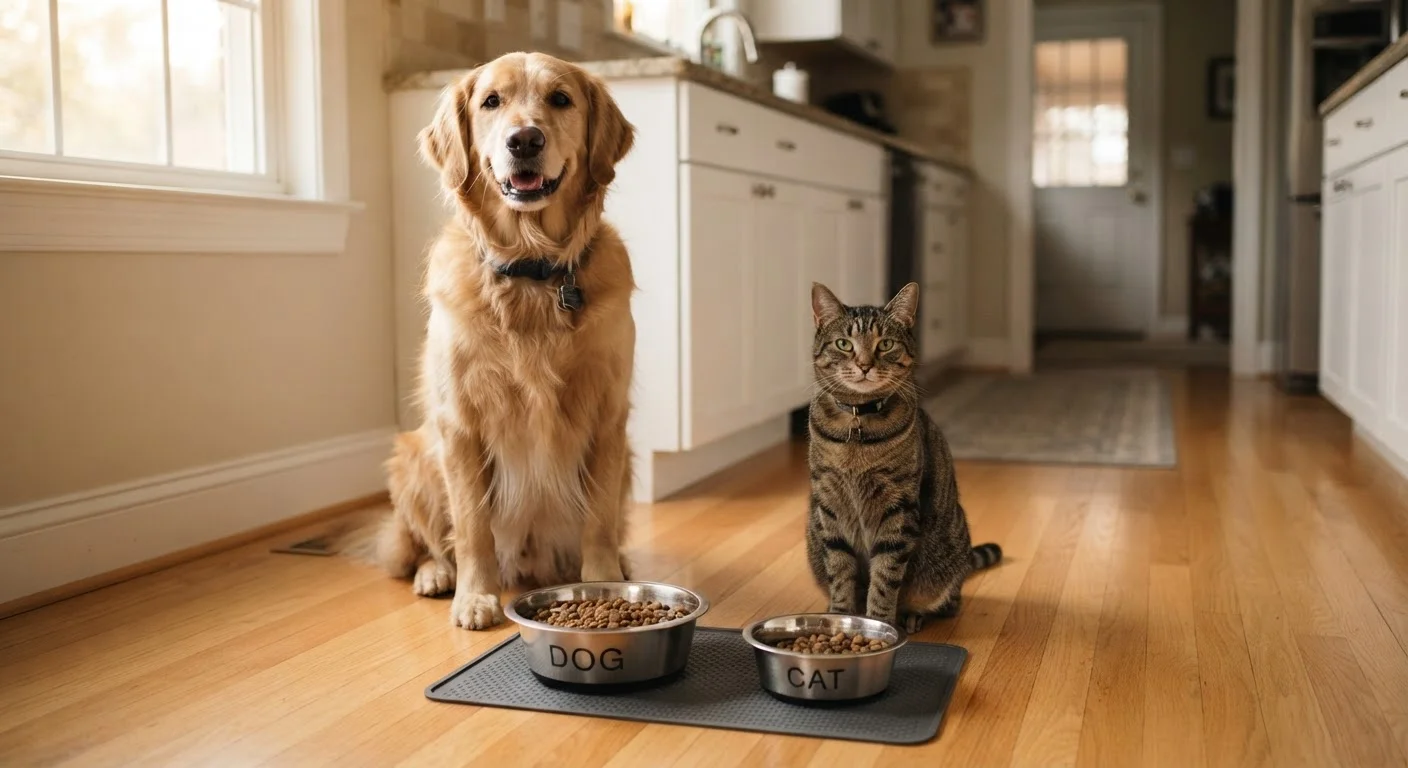
Why Portion Control Matters More Than the Food Itself
Pet obesity is one of the most common and preventable health conditions seen in veterinary practice. Excess body weight is associated with joint stress, metabolic strain, and reduced quality of life - yet many cases trace back not to what a pet is eating, but to how much. For a deeper look at what excess weight does to your pet's body, see our article on the risks of an overweight animal.
Many owners unknowingly overfeed because they rely on bag-label guidelines without adjusting for their pet's actual energy needs. Those guidelines are calculated for an average, intact adult animal at moderate activity - a profile that may not match your spayed, indoor cat or your senior dog who mostly naps. Treating the label as a ceiling rather than a floor, and calibrating down from there with your vet's input, is a more reliable approach.
~60%
Pet dogs and cats estimated to be overweight or obese
According to Association for Pet Obesity Prevention surveys, a majority of U.S. dogs and cats are assessed as overweight or obese by their veterinarians.
10%
Maximum recommended daily calories from treats
Veterinary nutritionists broadly recommend that treats, toppers, and extras should not exceed 10% of a pet's total daily caloric intake.
Reading Body Condition - Not Just the Scale
Weight alone can be misleading. A muscular breed may weigh more than average and still be lean; a small-boned mixed breed may appear trim while carrying excess fat. Veterinarians use a body condition score (BCS) - typically a 9-point scale - to assess fat coverage at the ribs, waist definition when viewed from above, and abdominal tuck. Owners can learn a basic version of this at home between vet visits.
At a healthy weight, you should be able to feel your pet's ribs easily without pressing hard, but not see them prominently. A visible waist from above and a slight abdominal tuck from the side are positive signs in most dogs and cats. If you are uncertain about your pet's condition, ask your veterinarian to walk you through the scoring during your next visit.
Measure every meal with a standard measuring cup or kitchen scale rather than estimating by eye.
Visual estimation is consistently inaccurate - studies in human nutrition show people underestimate portion sizes by 20-50%, and the same bias applies when scooping pet food. A kitchen scale is more precise than volume-based measuring for calorie-dense dry kibble.
Switch from free-feeding to scheduled twice-daily meals.
Free-feeding makes intake invisible and removes natural hunger cues that help regulate appetite. Timed meals allow owners to notice changes in appetite - which can be an early sign of illness - and make portion control straightforward.
Log treats and toppers as part of the daily calorie budget, not in addition to it.
Treats feel small and occasional, but they add up quickly - especially high-calorie training rewards given repeatedly throughout the day. Subtracting treat calories from the meal portion keeps total intake accurate.
Schedule a weight and body condition check with your veterinarian every six months.
Gradual weight gain is easy to miss at home because it happens slowly. Regular professional assessments provide an objective baseline and catch upward trends before they become significant health concerns.
Adjust portions when your pet's activity level or life stage changes.
Caloric needs shift with age, reproductive status, health condition, and seasonal activity patterns. A portion that maintained healthy weight during an active summer may lead to gain during a low-activity winter.
Feeding Structure: Schedules, Measuring, and Treat Accounting
Structure is the single most practical lever most pet owners have. Meal-fed pets - offered food twice daily at set times - are easier to monitor than free-fed pets, where intake is nearly impossible to track accurately. This matters especially in multi-pet households, where one animal may consume another's portion unnoticed.
Use a Scale, Not a Scoop
Dry kibble density varies significantly between formulas - the same measuring cup can hold very different calorie counts depending on the food. Weighing meals in grams using an inexpensive kitchen scale removes that variable and gives you a consistent, repeatable portion every time. Ask your vet for a gram-based daily target rather than relying solely on cup measurements.
Treats are a hidden calorie source that frequently undermines an otherwise sound feeding plan. Most standard training treats are calorie-dense relative to their size. Veterinary nutritionists generally suggest that treats, toppers, and table scraps together should not exceed 10% of daily caloric intake. For more on how these small additions accumulate, our piece on feeding mistakes that quietly add up covers the patterns in detail.
Nutritional needs also change as pets age. A portion size appropriate at two years old may be excessive at eight. Our guide on feeding your pet at every life stage explains how to adjust for those transitions. And if you're just getting started with a new animal, building a health foundation from day one covers the fundamentals of establishing good habits early.
This article is for general informational purposes only and is not a substitute for veterinary advice. Always consult a licensed veterinarian before making significant changes to your pet's diet, especially if your pet has an existing health condition.
The content provided on our blog site traverses numerous categories, offering readers valuable and practical information. Readers can use the editorial team’s research and data to gain more insights into their topics of interest. However, they are requested not to treat the articles as conclusive. The website team cannot be held responsible for differences in data or inaccuracies found across other platforms. Please also note that the site might also miss out on various schemes and offers available that the readers may find more beneficial than the ones we cover.