

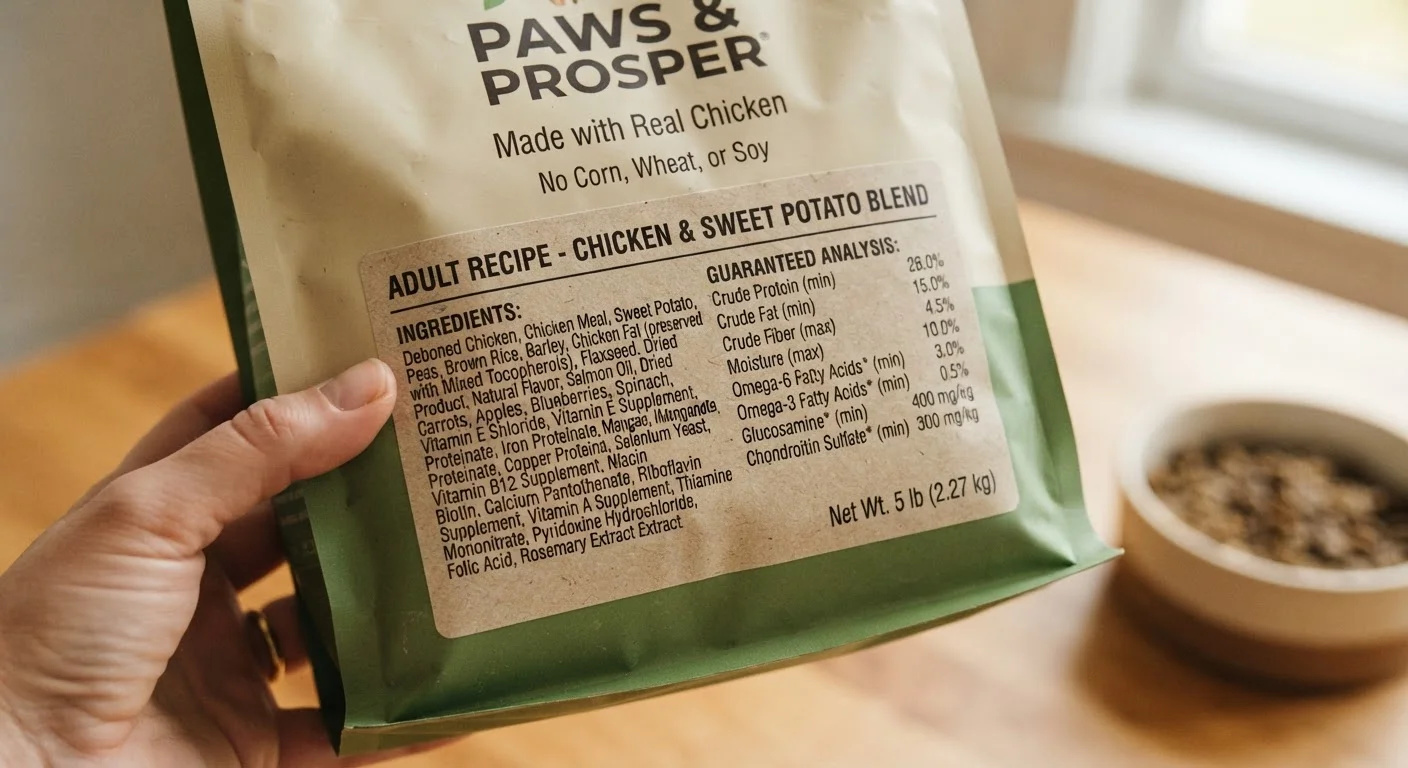
The Four Panels That Actually Matter
Every commercial pet food sold in the U.S. must carry specific information regulated at the state and federal level. Rather than reading the entire package, focus on four key areas: the product name, the AAFCO nutritional adequacy statement, the ingredient list, and the guaranteed analysis. Everything else - the photography, the lifestyle copy, the bold claims on the front - is marketing.
The product name alone carries regulatory weight. AAFCO rules dictate what a manufacturer can call a food based on how much of a named ingredient it actually contains. A food labeled simply 'Salmon Cat Food' must be at least 95% salmon by weight (excluding water for processing). Call it a 'Salmon Entrée' and that threshold drops to 25%. Call it 'With Salmon' and just 3% qualifies. These distinctions matter when you're comparing protein sources across products.
AAFCO Sets Standards - It Doesn't Test Products
AAFCO is a non-governmental organization that publishes model regulations and nutrient profiles used by states to govern pet food labeling. It does not independently test, approve, or certify individual products. Compliance is primarily the manufacturer's responsibility, with oversight by state feed control officials and the FDA.
Decoding the AAFCO Statement
The nutritional adequacy statement is arguably the single most important line on any pet food label. It tells you whether the food is formulated to serve as a complete diet - and for which life stage. Look for language like: 'formulated to meet the nutritional levels established by the AAFCO Dog Food Nutrient Profiles for adult maintenance.'
There are two ways a food can earn this statement. The first is by formulation - the recipe is calculated to hit AAFCO's nutrient minimums on paper. The second, and more rigorous, method is through a feeding trial - the food is actually fed to animals and shown to sustain health over time. Labels that reference feeding trials use specific language such as 'animal feeding tests.' If nutritional completeness matters to you, that distinction is worth finding. For a plain-language breakdown of related terms, see our nutrition terms glossary.
95%
Minimum named ingredient for single-ingredient product names
AAFCO's '95% rule' requires that a product named simply after one ingredient - such as 'Beef Cat Food' - contain at least 95% of that ingredient, excluding water added for processing.
25%
Minimum threshold for 'dinner,' 'entrée,' or 'formula' products
When a descriptor like 'dinner' or 'formula' is added to the product name, AAFCO's rule drops the minimum named-ingredient requirement to 25%, a significant difference that affects ingredient composition.
3%
Minimum required for 'with [ingredient]' claims
The AAFCO 'with' rule means a food marketed as 'with real salmon' needs to contain only 3% salmon - making front-panel callouts far less meaningful than they appear.
What the Ingredient List Is - and Isn't - Telling You
Ingredients are listed in descending order by weight before cooking. This pre-processing weight rule creates a common source of confusion: fresh chicken, which is roughly 70% water, may top the list but contribute less actual protein to the finished food than a chicken meal listed further down. 'Chicken meal' is already rendered and concentrated, so pound for pound it delivers more protein by dry weight.
This doesn't make fresh meat bad - it's a quality ingredient. But it does mean that ingredient position alone is an incomplete guide to nutritional content. Reading the full ingredient list in context - alongside the guaranteed analysis - gives you a more accurate picture. For a structured approach to evaluating any food holistically, see our evaluation checklist.
Use the Guaranteed Analysis to Compare Foods Fairly
When comparing a wet food to a dry food, moisture content makes raw percentages misleading. To compare them accurately, convert both to a dry matter basis: subtract the moisture percentage from 100, then divide the nutrient percentage by that number. This levels the playing field and gives you a truer sense of protein and fat density across formats.
The Guaranteed Analysis: Useful but Limited
The guaranteed analysis panel lists four required values: minimum crude protein, minimum crude fat, maximum crude fiber, and maximum crude moisture. Notice the direction of those guarantees - they're floors and ceilings, not exact figures. The actual protein content may be higher than the stated minimum; fiber content may be lower than the maximum.
The term 'crude' refers to the laboratory measurement method, not ingredient quality. Crude protein, for instance, is estimated by measuring total nitrogen in the food - it doesn't distinguish between highly digestible animal protein and lower-quality protein from plant sources. This is a known limitation of the panel. For a deeper comparison, the guaranteed analysis becomes more useful when you convert values to a dry matter basis - removing moisture from the equation - which allows fair comparison between wet and dry foods. Your veterinarian or a board-certified veterinary nutritionist can help you interpret these numbers for your specific pet's needs.
Marketing Language to Ignore
Terms like 'premium,' 'holistic,' 'gourmet,' and 'ultra' carry no regulatory definition under AAFCO or FDA guidelines. A manufacturer can use them freely regardless of ingredient quality or sourcing standards. Even 'natural,' which AAFCO does define, says nothing about nutritional value - only that ingredients weren't chemically synthesized.
This pattern mirrors what consumers face with human food labels. Marketing claims on human food labels follow similar patterns of using legally vague language to shape perception. The same critical eye applies here. If a claim on a pet food bag isn't backed by the AAFCO statement, the guaranteed analysis, or a verifiable feeding trial, treat it as packaging rather than evidence. For context on one popular trend specifically, grain-free labeling deserves its own scrutiny.
This article is for general informational purposes only and does not constitute veterinary or nutritional advice. Consult a licensed veterinarian or board-certified veterinary nutritionist for guidance specific to your pet's health needs.
Frequently Asked Questions
'Complete and balanced' means the food meets AAFCO nutrient profiles for a specific life stage - such as adult maintenance or growth. It's one of the most meaningful phrases on any label. A food without this statement should not be used as a sole diet.
Ingredients are listed by weight before processing. Fresh meat contains a lot of water, so it weighs more raw but shrinks considerably during cooking. After processing, a grain or meal listed lower may actually make up more of the finished food by dry weight.
The guaranteed analysis lists minimum percentages of crude protein and crude fat, and maximum percentages of crude fiber and moisture. These are regulatory floors and ceilings, not exact nutritional content - actual values in the food may differ.
AAFCO does define 'natural' for pet food - it generally means ingredients derived from plant, animal, or mined sources without chemical synthesis. However, it says nothing about quality, sourcing, or overall nutritional value, so it should not be treated as a health claim.
AAFCO has naming rules based on ingredient percentage. A product simply called 'Beef Dog Food' must contain at least 95% beef (excluding water). Add a qualifier like 'dinner,' 'entrée,' or 'formula' and the threshold drops to just 25%. 'With beef' requires only 3%.
Feeding guidelines are a reasonable starting point but are general estimates based on average activity levels and body weights. Your pet's actual needs depend on age, health status, activity, and metabolism. Your veterinarian can help you dial in the right portion.
The content provided on our blog site traverses numerous categories, offering readers valuable and practical information. Readers can use the editorial team’s research and data to gain more insights into their topics of interest. However, they are requested not to treat the articles as conclusive. The website team cannot be held responsible for differences in data or inaccuracies found across other platforms. Please also note that the site might also miss out on various schemes and offers available that the readers may find more beneficial than the ones we cover.