

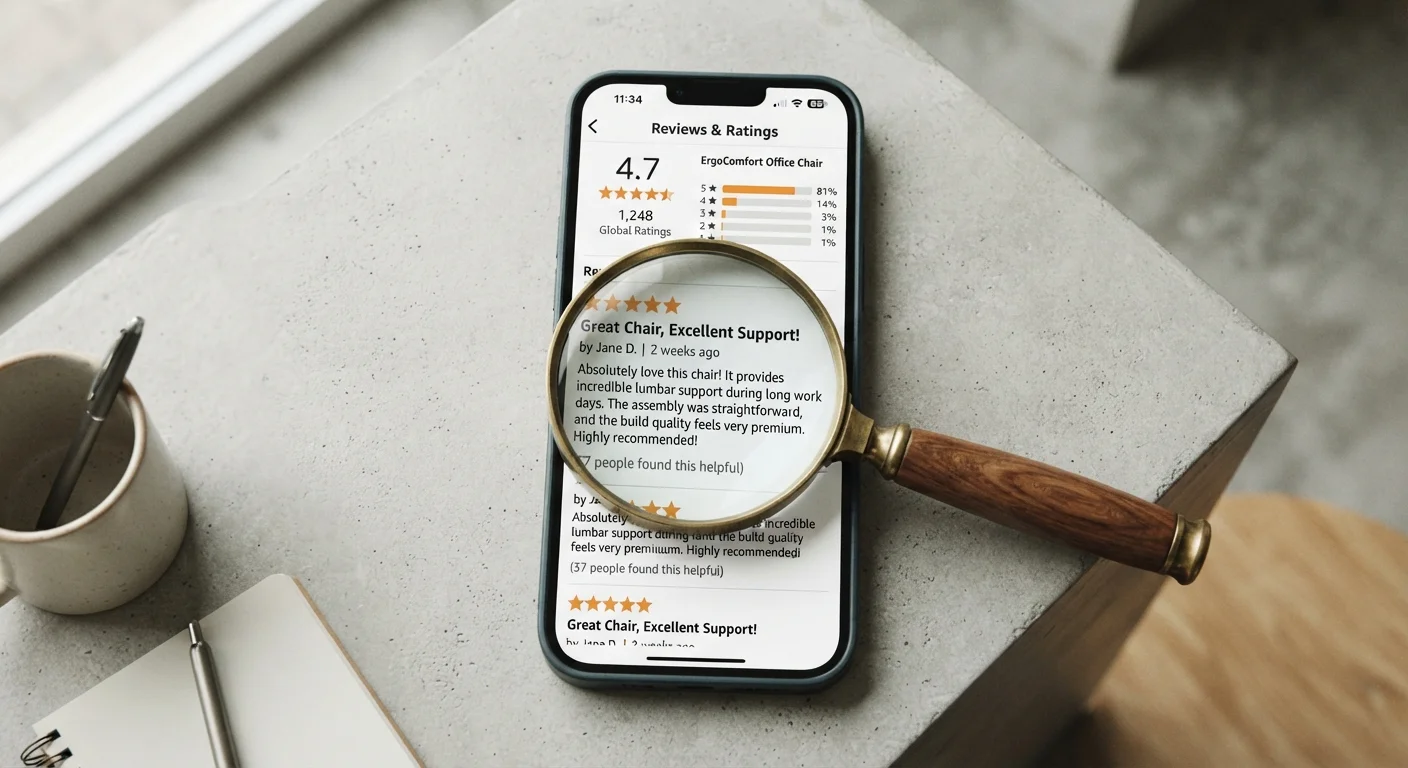
Why Fake Reviews Are Hard to Dismiss
Review manipulation is more common than most shoppers realize. Academic research consistently finds that a meaningful share of online product reviews on major marketplaces show signs of inauthenticity - ranging from seller-incentivized five-star submissions to coordinated campaigns run through third-party review farms. The financial incentive is clear: higher average ratings correlate directly with higher sales conversion rates.
The problem isn't just dishonesty - it's that fake reviews are engineered to pass casual inspection. They mimic the language patterns of genuine feedback closely enough to fool most readers at a glance. What distinguishes them is a set of linguistic, behavioral, and statistical signals that become visible once you know what to look for. This guide walks you through those signals step by step.
For broader context on misleading signals in online shopping, see our guide to online marketplace red flags.
What you will need
Step-by-Step: How to Evaluate Reviews Before You Buy
Work through these checks in order. Each one layers additional signal - no single check is definitive, but together they give you a reliable picture.
Read for Specificity, Not Sentiment
Scan the text of five-star reviews for concrete product detail. Genuine reviewers mention things like dimensions, texture, setup time, or how the item compares to a previous purchase. Fake reviews tend to rely on broad emotional claims: "Amazing product! Highly recommend!" without saying what, exactly, is amazing about it.
If a glowing review could apply to almost any product in that category without changing a single word, treat it as a red flag.
Check the Reviewer's Profile History
Click through to the reviewer's public profile if the platform allows it. Look at the range of products they've reviewed and the dates of those reviews. Warning signs include: reviewing only products from one seller, posting dozens of reviews in a single day, or having a profile with no avatar, no real name, and a review history that started the same week as the product launch.
Conversely, a reviewer with a long, varied history across unrelated product categories - and who occasionally leaves mixed or negative feedback - is exhibiting natural consumer behavior.
Plot the Timeline of Reviews
Sort reviews by most recent and look for clustering. A product that received 300 five-star reviews in one week - especially around a product launch or after a period of silence - is showing a pattern consistent with bulk-purchased reviews. Organic review accumulation is gradual and irregular, reflecting real purchase and usage cycles.
Some platforms display a rating history graph. Use it. A sudden vertical spike followed by a plateau is a meaningful signal worth investigating further.
Use a Third-Party Review Analysis Tool
Several free browser extensions and websites analyze review patterns algorithmically - flagging suspicious volume spikes, grading review authenticity, and estimating what the 'adjusted' rating would look like without suspected fake entries. These tools don't replace your own judgment, but they handle the statistical heavy lifting quickly.
Use these tools as one input among several, not as the final word. Their methodologies vary, and they occasionally produce false positives on legitimate products with unusual review patterns.
Cross-Reference Reviews Across Multiple Platforms
Search for the product on at least one other retail platform or in independent forums and communities. If a product has thousands of glowing reviews in one place but almost no presence - or sharply lower ratings - elsewhere, that asymmetry is informative. Real consumer sentiment tends to be roughly consistent across contexts.
Pay particular attention to community discussions in product-specific forums or subreddits, where incentivized reviews rarely penetrate and critical feedback flows more freely. This pairs well with broader shopping vigilance - see our guide to deceptive pricing tactics for related manipulation patterns to watch for.
Negative Reviews Often Contain the Most Value
A product's three-star and four-star reviews are frequently its most informative. These reviewers usually liked the item enough to use it but had enough reservation to note real limitations. Prioritize reading this middle tier before committing to a purchase.
What Authentic Reviews Actually Look Like
Genuine reviews tend to be uneven in tone. A real buyer might praise the delivery speed, complain that assembly instructions were confusing, and note that the color looked slightly different in person. That mix of satisfaction and minor friction is characteristic of lived experience. Suspiciously polished reviews that read like marketing copy - no drawbacks, no specifics, no personal context - should raise your skepticism.
Also look at the rating distribution itself. A product with 2,000 reviews that are 94% five-star and 5% one-star, with almost nothing in between, is exhibiting a J-curve pattern associated with manipulation. Legitimate products typically attract a fuller bell-curve spread, including honest three- and four-star assessments from buyers who liked but didn't love the item.
Pair your review analysis with other quality signals. Our guide to judging product quality without hands-on testing covers the spec- and materials-based checks that work alongside review scrutiny. And if you want to understand the broader ways ratings can mislead even attentive readers, how customer reviews can mislead even careful shoppers provides useful depth.
Incentivized Reviews Are Not Always Disclosed
Regulatory guidance in the U.S. requires that material connections between reviewers and sellers be disclosed, but enforcement at the individual review level is limited. Assume that some portion of reviews on any high-volume listing may reflect an incentive that was never declared. Treat unusually uniform positive feedback accordingly.
The content provided on our blog site traverses numerous categories, offering readers valuable and practical information. Readers can use the editorial team’s research and data to gain more insights into their topics of interest. However, they are requested not to treat the articles as conclusive. The website team cannot be held responsible for differences in data or inaccuracies found across other platforms. Please also note that the site might also miss out on various schemes and offers available that the readers may find more beneficial than the ones we cover.