

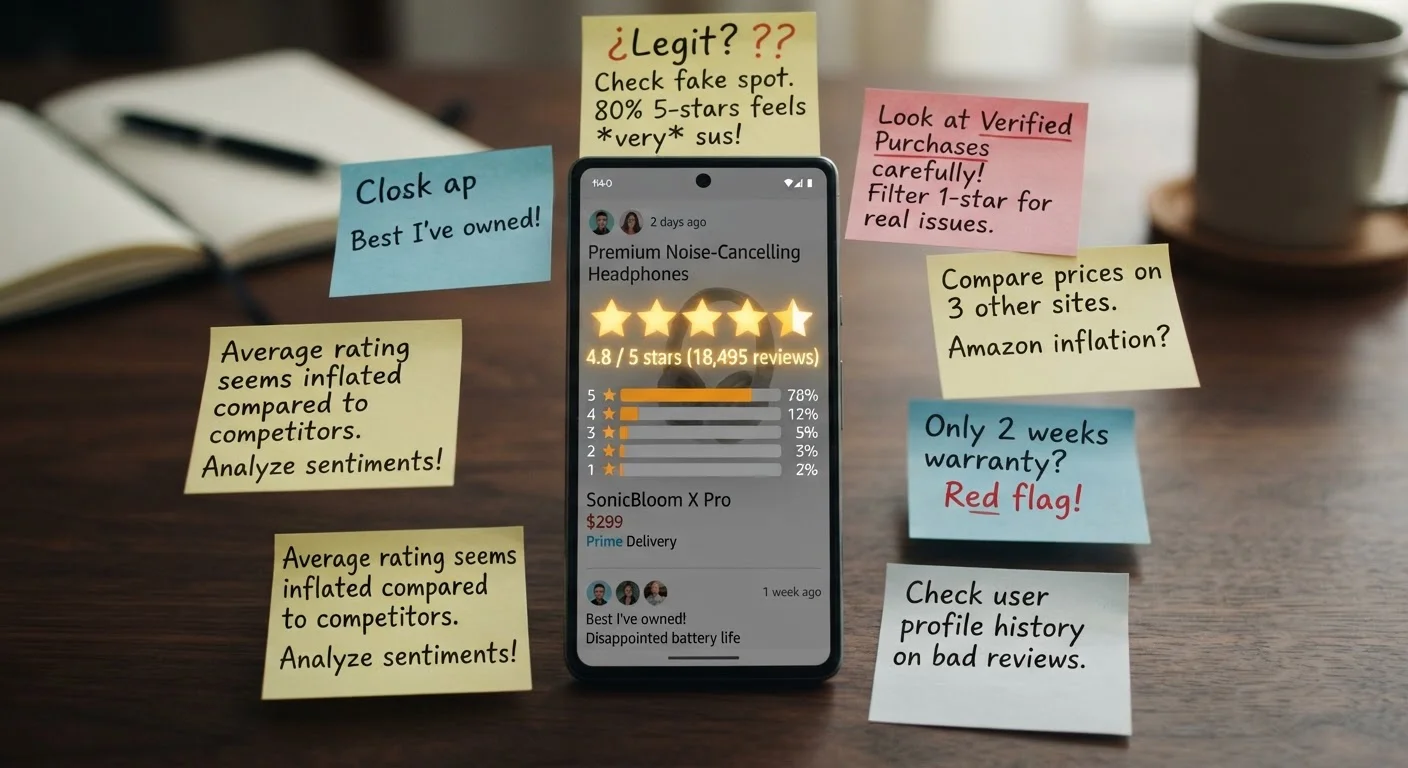
Why Star Ratings Feel More Trustworthy Than They Are
Most shoppers treat star ratings as a shortcut to confidence. A 4.7 out of 5 based on thousands of reviews signals collective wisdom - strangers with nothing to gain, sharing honest experiences. That mental model is intuitive, but it's increasingly out of step with how online reviews actually work.
Review ecosystems on major marketplaces are subject to significant pressure from sellers who depend on ratings for visibility and sales. That pressure has spawned systematic manipulation: incentivized reviews, review gating (soliciting feedback only from satisfied customers), and outright fake accounts. Research from consumer advocacy groups and academic studies on e-commerce consistently shows that a substantial share of reviews across high-competition product categories show signs of inauthenticity. You're not being paranoid to be skeptical - you're being rational.
The mistake most shoppers make isn't trusting reviews at all. It's trusting ratings without reading the underlying text, checking the distribution, or considering the source. Those habits can be built quickly. For a broader look at manipulation patterns on online platforms, see our guide to online marketplace red flags.
Trusting the average star rating without checking the distribution of individual ratings.
Why it happens: Averages are displayed prominently and feel definitive; the full distribution requires an extra click most shoppers skip.
Ignoring reviewer profiles and treating all reviews as equally credible.
Why it happens: Reading individual reviewer histories feels time-consuming, and platforms don't make it obvious that reviewer credibility varies widely.
Discounting negative reviews as outliers or written by unreasonable customers.
Why it happens: Confirmation bias kicks in once a shopper is leaning toward a purchase - critical feedback feels like friction rather than useful data.
Assuming a high review count means a product is well-established and trustworthy.
Why it happens: Volume feels like consensus. Thousands of reviews suggest thousands of buyers, which implies social validation.
Overlooking the absence of negative reviews entirely.
Why it happens: A perfect or near-perfect record seems like good news, so shoppers rarely pause to question it.
How to Read Reviews Like a Skeptic
Switching from passive to active review reading takes only a few extra minutes per purchase, but it changes what you can learn. Start with the rating distribution histogram rather than the average. A product with 3,000 five-star reviews and 900 one-star reviews - and almost nothing in between - is showing you a split audience, not a trustworthy consensus. Genuine products typically accumulate a more gradual spread across all ratings.
~30-40%
Estimated share of online reviews flagged as potentially fake
Multiple independent analyses of major marketplace listings, including work by consumer research organizations, have estimated that a significant portion of reviews in high-competition categories show markers of inauthenticity.
1-2 stars
Where the most actionable product information often lives
Consumer behavior researchers consistently find that low-rated reviews contain more specific, verifiable product detail than high-rated reviews, making them disproportionately valuable for purchase decisions.
Next, sort by lowest ratings and most recent. Sellers cannot easily purge negative reviews once a product has scale, so the one- and two-star section often contains the most candid, specific information about failures. Pay attention to whether critical reviews mention the same recurring flaw - that repetition is signal, not noise.
Language patterns matter too. Authentic negative reviews tend to be specific and situational: the zipper broke after three uses, the battery drained in two hours under light load. Positive reviews that cluster around vague praise - "love it," "great product," "fast shipping" - without describing actual use cases are statistically more likely to be manufactured. Free and paid tools exist that analyze review text and reviewer history to flag suspicious patterns; they're worth bookmarking for significant purchases.
Finally, take the total review count in context of the product's apparent age. A product listed for six months with 8,000 reviews has likely benefited from a review acceleration campaign. Organic accumulation at that pace is uncommon for most product types. Pair review research with what you can learn from evaluating product quality without hands-on testing for a fuller picture.
Review Gating Is a Hidden Distortion
Some sellers only send review request emails to customers who first respond positively to a satisfaction check - a practice known as review gating. This filters out dissatisfied buyers before they can leave public feedback, producing an inflated average that doesn't reflect the full customer experience. Major marketplace platforms prohibit this practice, but enforcement is inconsistent. A product with uniformly glowing reviews and almost no critical feedback warrants extra scrutiny, not automatic confidence.
The goal isn't to distrust every review - it's to weight them appropriately alongside other evidence. Consumer reports from independent testing organizations, editorial coverage from publications that accept no advertising from reviewed brands, and detailed Q&A sections (where sellers cannot easily control responses) all provide signal that complements what review sections offer. See the companion article on spotting fake reviews for deeper pattern-matching techniques.
The content provided on our blog site traverses numerous categories, offering readers valuable and practical information. Readers can use the editorial team’s research and data to gain more insights into their topics of interest. However, they are requested not to treat the articles as conclusive. The website team cannot be held responsible for differences in data or inaccuracies found across other platforms. Please also note that the site might also miss out on various schemes and offers available that the readers may find more beneficial than the ones we cover.