

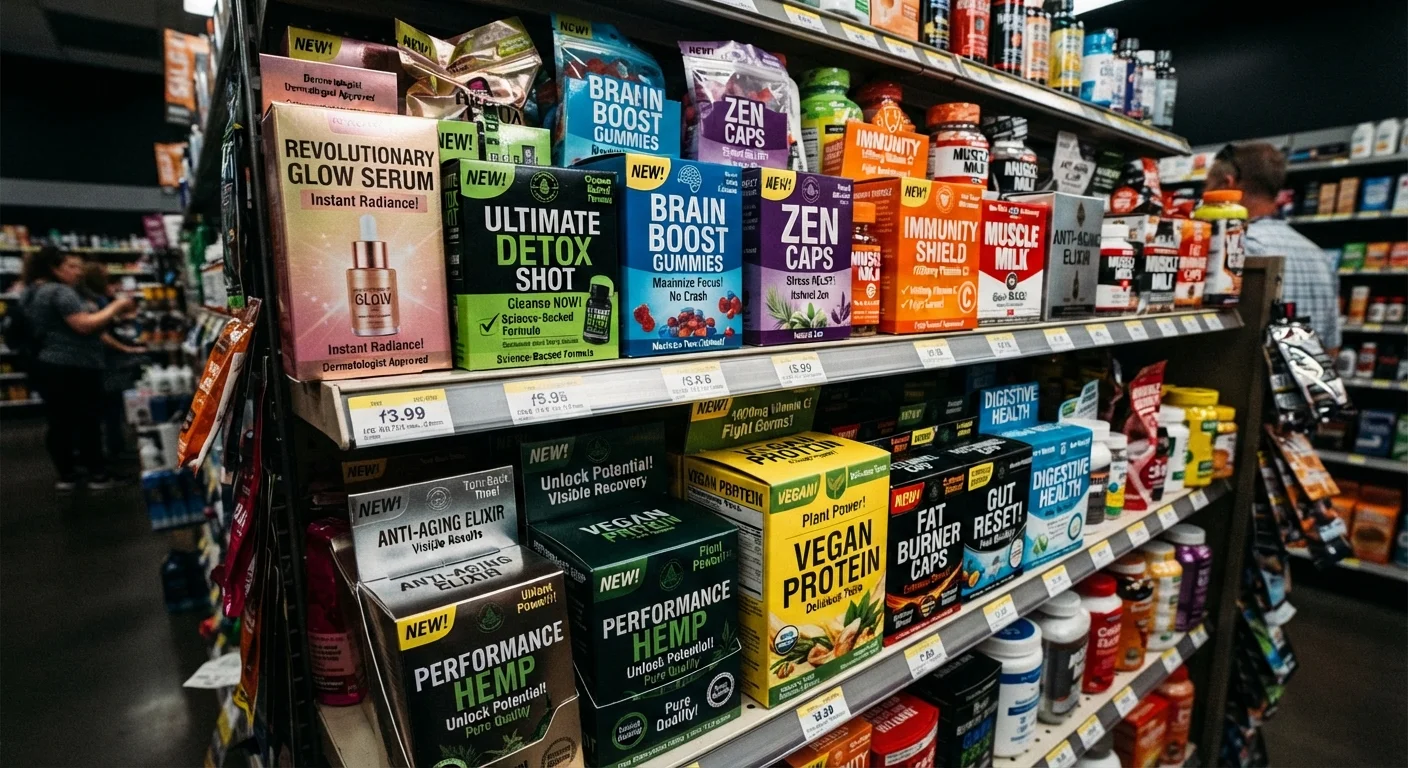
When the Category Itself Is the Warning Sign
Not every disappointing product is the result of a single bad buy. Some product categories are structurally prone to overpromising - the business model depends on selling an aspirational outcome rather than a reliable one. When you understand which categories operate this way, you can calibrate your expectations before you ever read a label.
The pattern usually involves a few common ingredients: outcomes that are difficult to measure objectively, a heavy reliance on before-and-after visuals or testimonials, and terminology that sounds scientific without being regulated. Decoding that kind of product copy is a skill worth developing, because the language is rarely accidental.
Below are the categories where inflated claims appear most consistently - and what to watch for in each.
At-Home Anti-Aging Skincare Devices
Consumer-grade LED masks, microcurrent wands, and ultrasonic scrubbers are marketed using the same terminology as clinical equipment. The problem: professional devices operate at energy levels and treatment durations that at-home versions rarely replicate. Regulatory clearance (where it exists) typically covers safety, not efficacy claims. Independent dermatology research on consumer-grade devices is limited, and what exists often shows modest, temporary effects - far short of the dramatic "clinic results at home" promise.
Red flag language: "clinical-strength," "FDA-cleared" (note: cleared ≠ proven effective), "visibly reduces wrinkles in days."
Regulatory clearance covers safety - it does not validate the marketing claims on the box.
Dietary Supplements for Weight Management
This is one of the most heavily marketed and least regulated consumer categories in the United States. The FDA does not require supplement manufacturers to prove effectiveness before selling. Claims like "supports metabolism" or "burns fat" can be made without clinical trials that meet pharmaceutical standards. Many products lean on single-ingredient studies - often conducted at much higher doses than the supplement contains - to imply broader benefits.
What to look for instead: third-party testing certifications (which verify contents, not claims), and peer-reviewed research on the specific formulation, not isolated ingredients.
Note: This is general consumer education, not medical or dietary advice. Consult a qualified healthcare professional before starting any supplement regimen.
Supplement claims don't require pre-market proof of effectiveness - the burden falls entirely on the buyer.
"Smart" Home Gadgets With Single-Use Functions
A product that does one narrow thing - and requires an app, subscription, or hub to do it - often delivers less value than its price suggests. The "smart" label adds perceived sophistication, but extra features regularly reduce reliability while raising cost. Many single-function smart devices are also discontinued within a few years, leaving buyers with hardware that no longer functions when server support ends.
Ask before buying: Does this device work without an internet connection? What happens if the company stops supporting it?
A "smart" label adds cost and complexity - it doesn't automatically add value.
Hair Growth and Restoration Products
The hair loss category is rife with products that imply clinical outcomes while delivering cosmetic ones - thickening sprays that coat existing strands, for instance, look like growth in photos but don't affect follicles at all. Only a small number of active ingredients have meaningful clinical evidence behind them, and those tend to appear in regulated drug products, not general personal care lines. Marketing in this space aggressively blurs the line between cosmetic enhancement and actual regrowth.
Red flag language: "reactivates follicles," "clinically proven formula" (check who funded the study), "results in 30 days."
Cosmetic thickening and actual follicle regrowth are two entirely different things - packaging rarely clarifies which you're buying.
"As Seen on TV" Kitchen and Cleaning Tools
Infomercial and direct-response products are engineered for a specific purpose: to look transformative in a 90-second demonstration under controlled conditions. The gap between the infomercial and real-world use is rarely accidental. Common patterns include demonstrations using unusually poor versions of the "old way," cherry-picked comparisons, and materials that perform well briefly but degrade quickly with regular use.
What independent testing frequently finds: the product works, but not materially better than existing solutions at a fraction of the price.
Infomercial demonstrations are controlled performances - independent testing consistently tells a different story.
Detox and Cleanse Products
The human body has a well-established detoxification system - the liver and kidneys - that operates continuously without external assistance. The "detox" product category is built on a premise that mainstream physiology doesn't support. Despite this, marketing language in the space often references vague outcomes ("flush toxins," "reset your system") that are impossible to measure and therefore impossible to disprove. Regulatory bodies in the U.S. have periodically acted against specific unsubstantiated claims, but the broader category continues to expand.
This is general consumer information, not medical advice. Consult a healthcare provider with specific questions about your health.
"Detox" is a marketing term - not a physiological process that packaged products are proven to perform.
Applying This Lens Before Every Purchase
Recognizing a high-hype category doesn't mean every product in it is worthless. It means the burden of proof shifts - you should require more credible evidence before spending, not less. Look for independent testing from organizations with no commercial stake in the outcome, and treat manufacturer-cited studies with the same caution you'd give a movie review written by the studio.
Shift the Burden of Proof
For any product in a high-hype category, ask: who conducted the supporting research, and do they have a financial stake in the result? Manufacturer-funded studies and independent peer-reviewed trials are not equivalent forms of evidence. A quick search of the product's core ingredient or mechanism in a neutral database - not the brand's website - will often tell you more than the packaging ever will.
If you're evaluating something that went viral or appeared in an infomercial, the skeptic's pre-purchase checklist is a practical next step. And if the product's listing is heavy on buzzwords and light on specs, understanding how reviews can be manipulated will help you avoid being steered by artificially inflated ratings.
The goal isn't cynicism for its own sake. It's spending your money on things that actually work.
The content provided on our blog site traverses numerous categories, offering readers valuable and practical information. Readers can use the editorial team’s research and data to gain more insights into their topics of interest. However, they are requested not to treat the articles as conclusive. The website team cannot be held responsible for differences in data or inaccuracies found across other platforms. Please also note that the site might also miss out on various schemes and offers available that the readers may find more beneficial than the ones we cover.