

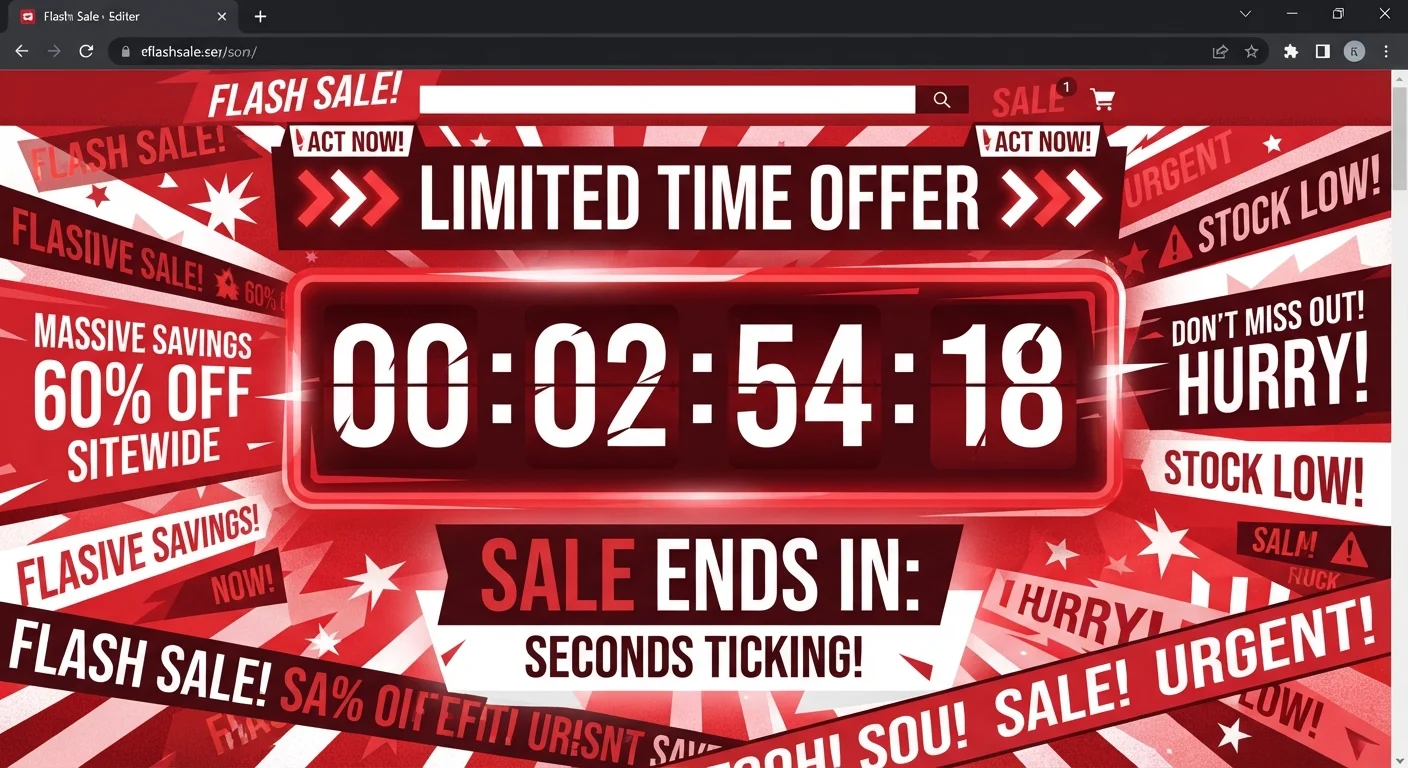
What Artificial Urgency Actually Means
Artificial urgency - sometimes called manufactured scarcity - is a retail tactic that creates a false sense of time pressure or limited availability to accelerate purchasing decisions. It exploits well-documented psychological tendencies: fear of missing out, loss aversion, and the instinct to treat scarce things as more valuable. Understanding why urgency overrides rational judgment is the first step toward resisting it.
These tactics are not limited to shady websites. They appear across mainstream e-commerce platforms, subscription services, and brick-and-mortar promotions. The mechanics vary - countdown timers, "X left in stock" labels, flash sale banners - but the goal is the same: short-circuit deliberation so you act before you think.
Urgency Tactics Work on Savvy Shoppers Too
Research in behavioral economics shows that knowing about a bias does not fully neutralize its effect. Even consumers who recognize urgency tactics report feeling time pressure in the moment. Awareness helps, but it doesn't eliminate the pull - which is why having a concrete pause routine matters more than relying on willpower alone.
Common Myths and the Facts Behind Them
Several deeply held beliefs make urgency tactics effective. Correcting them won't make you immune to the pressure, but it will give you an accurate baseline for evaluating any time-sensitive offer.
Myth
If a countdown timer is ticking, the deal really does expire when it hits zero.
Fact
Many countdown timers are scripted to reset automatically for every visitor or session, with no actual deadline attached.
This is one of the most widely deployed deceptions in e-commerce. A timer creates visceral time pressure, but the underlying code often simply restarts the clock when it reaches zero - or sets a new cookie so the same "24-hour" sale appears fresh on your next visit. The offer isn't expiring; the timer is performing expiration. If you're unsure, close the tab, return in an hour, and observe whether the clock has reset.
Myth
"Only 3 left in stock" means inventory is genuinely running low.
Fact
Low-stock warnings are frequently triggered by automated thresholds, not real-time inventory counts, and may persist indefinitely.
Retailers can configure their platforms to display a low-stock alert whenever stock drops below a set number - say, anything under 10 units - regardless of whether they plan to restock immediately. In some cases, the same warning stays active for months because replenishment keeps the count hovering just below the trigger. The label isn't technically false, but it's designed to alarm rather than inform. Deceptive pricing tactics like this one follow predictable patterns once you know what to look for.
Myth
Flash sales and one-day deals offer prices you genuinely can't find at other times.
Fact
Many flash sale prices match or are barely lower than the item's standard price outside the sale window.
Price history tracking consistently shows that products promoted as flash sale exclusives often carry the same price - or close to it - during non-sale periods. Retailers may inflate the reference "original" price to make the markdown look steeper than it is. This is sometimes called a phantom discount or reference price manipulation. The sale label does real psychological work; the actual savings often don't. See warning signs of a deal that isn't for more on this pattern.
Myth
Feeling urgency about a deal means the deal is probably genuine.
Fact
The urgency you feel is a psychological response to design cues, not reliable evidence that an offer has real value.
Loss aversion - the tendency to feel the pain of a missed opportunity more acutely than the pleasure of a gain - is a well-studied cognitive bias. Retailers deliberately activate it with red text, ticking clocks, and phrases like "selling fast." The emotional response is real; the scarcity it responds to often isn't. Recognizing that your gut reaction is a designed output, not an independent judgment, is the core competency that protects against urgency manipulation.
~60%
Shoppers influenced by scarcity cues
Research in consumer behavior consistently finds that scarcity messaging - low stock labels, limited-time banners - meaningfully increases purchase intent even when buyers suspect the tactic.
90%+
Flash sale prices matched later
Price-tracking analyses of major retail events have found the majority of "flash sale" prices available at similar or identical levels within weeks outside the sale window.
How to Actually Evaluate a Time-Sensitive Offer
The antidote to artificial urgency is structured skepticism. Before acting on any "limited-time" prompt, run through a short mental checklist: Has this item been on sale before? Does the price hold up against comparable products? Can you find any evidence the offer is genuinely expiring?
Tools that track historical pricing data can show whether a product has maintained its "sale" price for weeks or months - a common sign of a phantom discount rather than a real markdown. For more tactics that protect your wallet, see the pre-purchase checklist for viral products, which applies equally well to urgency-driven promotions.
Price History Is Your Best Tool
Before acting on any time-sensitive offer, look up the product's price history using a reputable tracking tool. If the "sale" price has been the standard price for weeks, the countdown timer is theater. Genuine markdowns represent a meaningful departure from the item's typical price - not a label change on a price that never moved.
It's also worth understanding that waiting isn't always the wrong move. The math on waiting for sales is more nuanced than retailers would have you believe - and rarely as urgent as a countdown timer suggests.
The content provided on our blog site traverses numerous categories, offering readers valuable and practical information. Readers can use the editorial team’s research and data to gain more insights into their topics of interest. However, they are requested not to treat the articles as conclusive. The website team cannot be held responsible for differences in data or inaccuracies found across other platforms. Please also note that the site might also miss out on various schemes and offers available that the readers may find more beneficial than the ones we cover.