

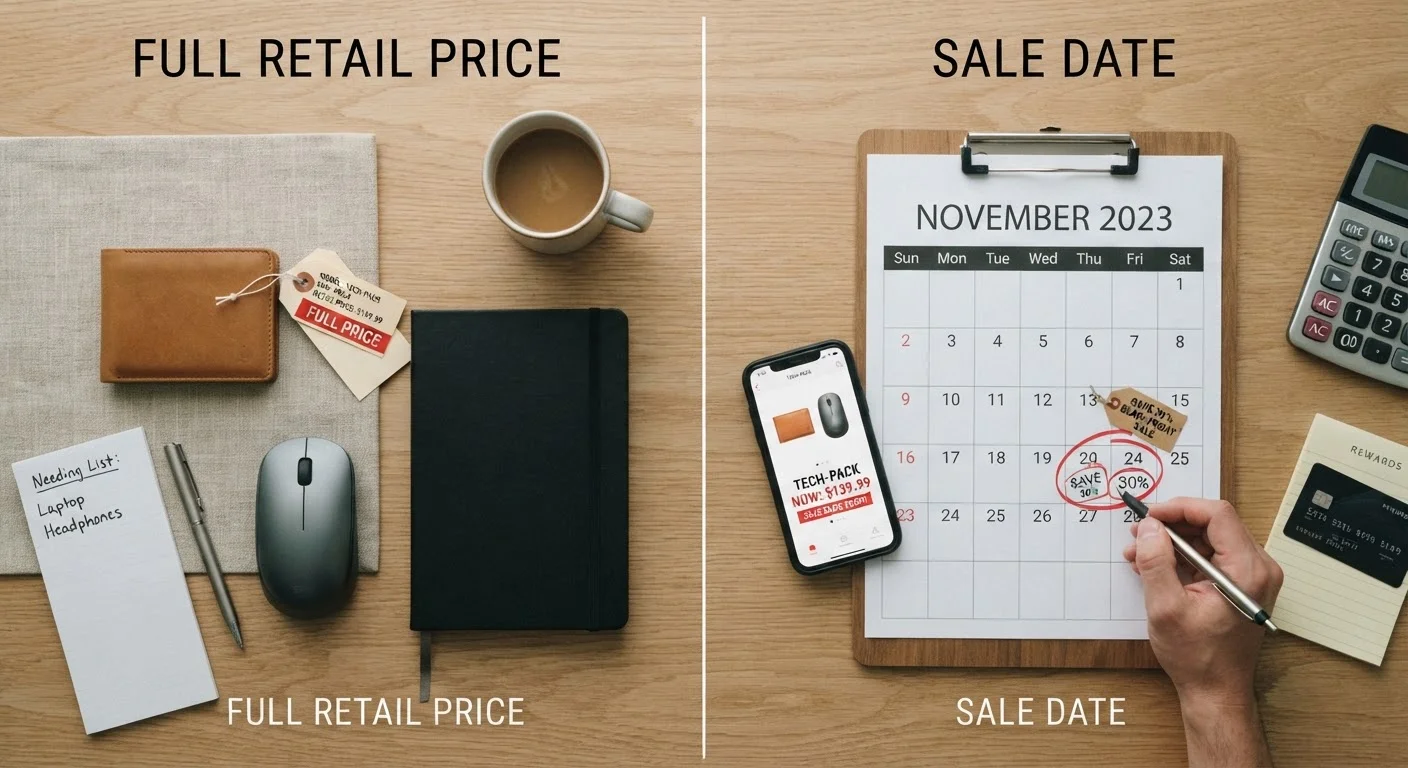
Option A
Paying Full Price
The immediate, certain option.
Best for: Buyers who need an item now, can't risk stockouts, or where the cost of delay outweighs the potential discount.
Option B
Waiting for a Sale
The patient, conditional approach.
Best for: Shoppers with flexible timelines, predictable sale cycles, and no urgent need for the item.
The Real Calculation Behind Sale Savings
Sale prices create a powerful psychological pull. Seeing "40% off" feels like free money - but the math only works out if several conditions are actually true. The item's regular price must be genuine, you must have needed the item anyway, and the act of waiting must not have cost you something else.
Retailers have long known that framing affects perception. A product listed at $80 with a crossed-out "$120" feels like a deal even if it was never sold at $120 for any meaningful period. Price history tools - browser extensions that track historical pricing - exist precisely because reference prices are frequently inflated. Without checking, you're trusting the retailer's math, not doing your own.
The other side of the equation is opportunity cost. Waiting two months to save $30 on a kitchen appliance you use daily means two months of inconvenience. That's a real cost, even if it doesn't show up on a receipt. For time-sensitive needs, the full-price purchase often delivers better value in practice. See our guide to hidden purchase costs for more on costs that don't show up at checkout.
| Criterion | Paying Full Price | Waiting for a Sale |
|---|---|---|
| Price certainty | Known, stable price | Discount may not be genuine |
| Availability risk | Item in hand immediately | May sell out before sale |
| Best for urgent needs | Yes | No |
| Best for planned purchases | Works in any case | Yes, with flexible timeline |
| Impulse risk | Lower - deliberate buy | Higher - sale can trigger unplanned spending |
| Requires price verification | Less critical | Essential to confirm real savings |
| Works best in which categories | Time-sensitive, consumables | Appliances, electronics, seasonal goods |
When Waiting Actually Pays Off
Patience has a real payoff in specific, well-documented scenarios. Certain retail categories follow predictable markdown cycles that are consistent enough to plan around. Major appliances, for example, tend to see significant promotions around holiday weekends and when new model years launch. Electronics often drop in price after initial release windows. Seasonal apparel reliably goes on clearance at the end of each season.
In these cases, waiting isn't gambling - it's scheduling. If you know you'll need a new refrigerator in the next six months and a major sale typically occurs in a predictable window, aligning your purchase with that window is a legitimate strategy, not just wishful thinking.
~23%
Average genuine discount in major sales events
Analysis of major U.S. retail sale events has found that actual price reductions, after accounting for pre-sale price inflation, are often well below headline figures.
64%
Shoppers who made unplanned purchases due to sales
Consumer surveys have consistently found that a majority of shoppers report purchasing something they didn't intend to buy simply because it appeared discounted.
3-4x per year
Typical major appliance sale cycles
Major appliance categories in the U.S. generally see their deepest discounts clustered around a small number of predictable retail windows each year.
The calculation shifts dramatically for consumables or items with short relevance windows. Waiting six weeks for a sale on a birthday gift you need in two weeks isn't a savings strategy - it's a missed purchase. Similarly, fashion and trend-driven goods may be unavailable in your size or color by the time markdowns hit. Bulk buying logic applies a similar lens: timing only helps if the underlying need is stable.
The Psychology Working Against You
Sale framing doesn't just affect how you evaluate a price - it affects whether you buy things you wouldn't have bought otherwise. Research in consumer behavior consistently shows that discount framing increases purchase likelihood even when the absolute price is identical to a competitor's non-sale price. The label does work that the number doesn't.
This creates a specific trap: buying something you didn't need because it was on sale. That purchase isn't a saving - it's a spending event dressed up as financial discipline. If the item sits unused or gets replaced by something better within a year, the "savings" evaporated before they existed. Our article on signs a deal isn't actually a deal covers the mechanics of how this framing works in detail.
Urgency tactics compound the problem. Limited-time countdown timers, "only 3 left" labels, and flash sale structures are designed to compress decision time and suppress your ability to comparison shop. For a closer look at how these mechanics work, see the truth about limited-time offers. A sale that requires you to decide in the next 15 minutes is almost always serving the seller's interests more than yours.
Price History Tools Can Help
Browser extensions that track product price histories are freely available and can show you whether a "sale" price is actually lower than what the item sold for in recent months. Before treating a discount as genuine, checking 90-day price history data takes under a minute and can change the entire calculation. This is especially valuable for online retail where reference prices are harder to verify independently.
A Framework for Making the Call
Rather than defaulting to "wait for a sale" or "never pay full price," a more reliable approach applies a short checklist before any significant purchase.
- Is this a planned purchase? If the item was on your list before you saw the sale, the discount may be meaningful. If the sale created the desire, treat it with suspicion.
- Can you verify the pre-sale price? Use a price history tracker to confirm the item actually sold at the stated original price. If it was marked up immediately before the sale, the discount is manufactured.
- What does waiting actually cost? Factor in the inconvenience, workarounds, or missed utility of not having the item now. For high-use items, that can exceed the discount fast.
- Does this category have a documented sale cycle? If yes, and your timeline is flexible, waiting has a logical basis. If not, you may be waiting indefinitely for a sale that never comes or isn't as deep as expected.
Applying cost-per-use thinking alongside sale timing can also clarify whether a higher-priced item bought at full price outperforms a cheaper sale item in total value. These frameworks work together, not in isolation. For broader spending discipline, building a workable budget is the foundation that makes any purchase timing strategy actually stick.
The content provided on our blog site traverses numerous categories, offering readers valuable and practical information. Readers can use the editorial team’s research and data to gain more insights into their topics of interest. However, they are requested not to treat the articles as conclusive. The website team cannot be held responsible for differences in data or inaccuracies found across other platforms. Please also note that the site might also miss out on various schemes and offers available that the readers may find more beneficial than the ones we cover.