

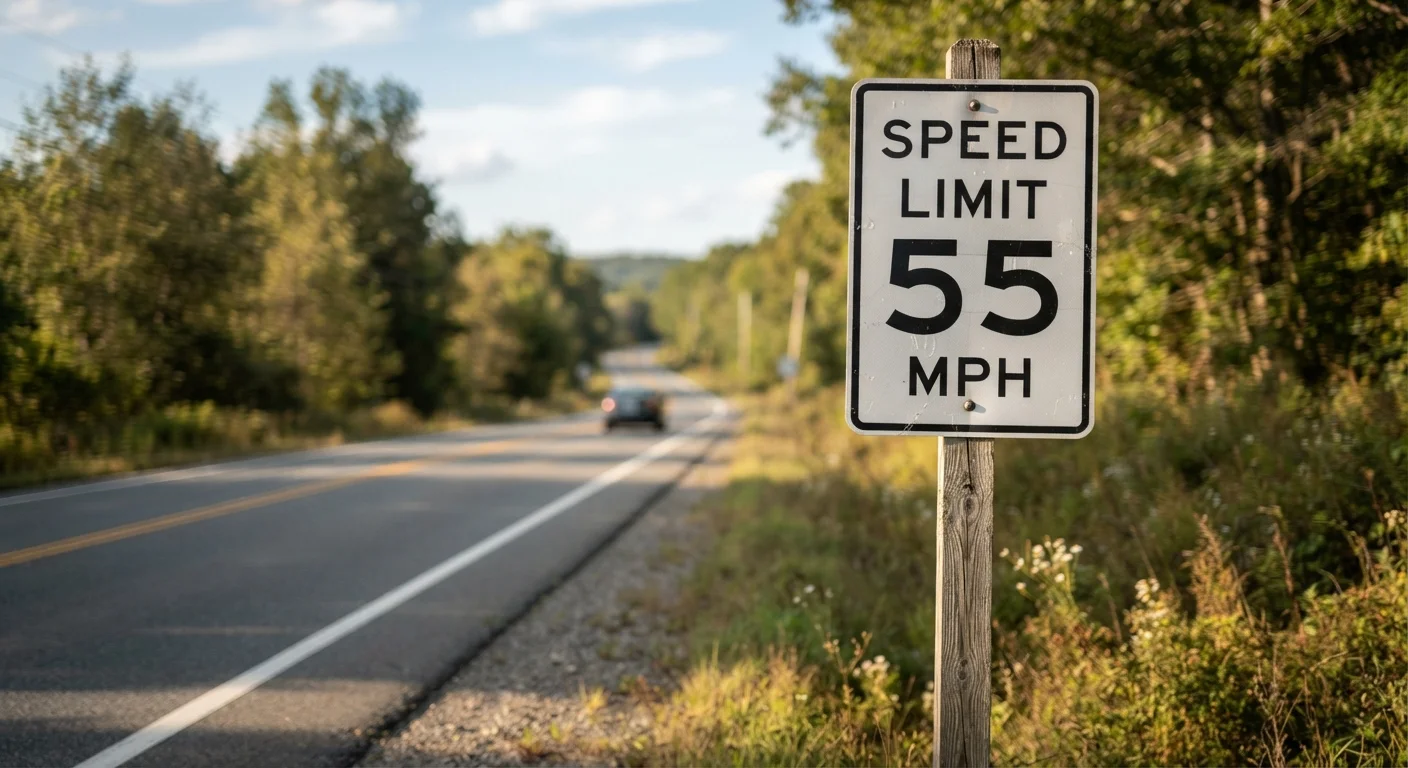
More Than a Number on a Sign
When you pass a speed limit sign, you're not reading a recommendation. You're reading a legal instruction backed by state statute. The number tells you the maximum speed at which you may operate your vehicle on that road under normal, favorable conditions - and law enforcement can cite you for exceeding it.
Speed limits in the U.S. fall into two broad categories. Absolute limits mean any speed above the posted number is a violation, full stop. Prima facie limits - used in many states - establish the posted speed as presumptively lawful, but allow prosecutors to show that a driver was unsafe even within the limit. Both frameworks make clear that the number is a ceiling, not a target.
For a broader look at how regulatory signs communicate legal obligations, see Road Signs Every Licensed Driver Should Still Be Able to Read.
37,000+
Annual U.S. traffic fatalities linked to speed
According to the National Highway Traffic Safety Administration (NHTSA), speeding has been a factor in roughly one-third of all motor vehicle fatalities in the U.S. for over two decades.
85th percentile
Engineering benchmark for setting speed limits
Traffic engineers commonly use the speed at which 85 percent of drivers naturally travel on a given road as a reference point when establishing or reviewing posted limits.
1995
Year federal speed limit mandate ended
Congress repealed the National Maximum Speed Law in 1995, returning full authority over speed limits to individual states, which now set their own maximums - some as high as 85 mph.
How Speed Limits Are Established
Speed limits are not arbitrary. Traffic engineers typically use a method called the 85th percentile rule as a starting point: they study the speed at which 85 percent of drivers naturally travel on an unposted road, then set the limit at or near that figure. The idea is that the limit reflects a speed most drivers find reasonable and safe under normal conditions.
State legislatures set maximum limits for road categories - interstates, rural highways, urban arterials - while cities and counties often have authority to adjust limits on local roads. School zones, hospital zones, and construction zones carry separate statutory or posted limits that override the standard number.
Speed Limits Vary Significantly by State
There is no single national speed limit. Maximums on rural interstates range from 65 mph in some states to 85 mph in parts of Texas. Urban freeways, local roads, and school zones all carry different statutory maximums depending on jurisdiction. Always be aware of the limits applicable to the state and road type you're driving on - especially when crossing state lines.
Statutory speed limits - defaults written into state law - apply even on stretches of road where no sign is posted. In most states, for example, 25 mph is the default in residential areas and 55 mph on undivided rural highways unless a different speed is signed.
When Conditions Change What's Lawful
Here's where many drivers misunderstand speed law: the posted limit applies under normal, ideal conditions. Once conditions deteriorate, your legal obligation changes even if the sign doesn't.
Rain reduces tire grip and lengthens stopping distances significantly. Fog shrinks your effective sight distance. Ice can multiply stopping distance several times over. In each of these scenarios, traveling at the posted limit may constitute reckless or negligent driving under most state laws - even without technically speeding.
This is directly relevant to following distance, too. Tailgating becomes far more dangerous as speed increases, because stopping distance grows with velocity. And for how to adapt your driving in specific adverse conditions, Driving in Rain, Fog, and Ice: How Conditions Change the Rules breaks down practical adjustments by weather type.
Adjust Speed Before You Have To
Experienced drivers slow down proactively when entering areas of reduced visibility, wet pavement, or heavy pedestrian activity - before conditions force a reaction. This habit gives you more stopping distance, more reaction time, and a stronger legal standing if an incident occurs. Your speedometer isn't the only thing law enforcement and courts will look at; context matters.
Variable and Temporary Speed Limits
Not all speed limit signs are static. A growing number of highways - particularly in high-traffic metro corridors - use dynamic message signs that display reduced speeds during congestion, accidents, or severe weather. These variable limits carry the same legal weight as a fixed sign. Ignoring them can result in a citation.
Construction zones present a similar scenario. When workers are present, posted construction zone limits typically come with significantly higher fines and, in some states, mandatory license points. The reduced limit applies whether or not you personally see any workers - the sign controls.
Understanding your vehicle's condition matters in speed management too. Worn tires, for example, dramatically reduce stopping ability. See our guide to tire pressure, tread depth, and load rating for what to watch for.
Frequently Asked Questions
Not necessarily. In most states, the speed limit is a maximum under ideal conditions. If weather, traffic, or road conditions make that speed dangerous, you can still be cited - or held liable in a crash - even if you never exceeded the posted number.
Speed limits are set primarily by individual states, with local governments sometimes authorized to adjust limits on roads under their jurisdiction. The federal government no longer mandates a national maximum speed limit, though it did so from 1974 to 1995.
An absolute speed limit means any speed over the posted number is automatically a violation, with no room for a driver to argue that the speed was reasonable given conditions. States like California use this approach.
Yes. Variable speed limit signs - used on some highways - can display lower speeds during congestion, bad weather, or incidents. Temporary construction zone limits are also legally posted and typically carry doubled fines.
The posted number doesn't change, but your legal obligation does. Drivers are expected to adjust speed for conditions. Traveling at the posted limit on ice or in heavy rain may still be considered reckless or negligent driving.
A statutory speed limit is a default maximum set by state law for a category of road - such as 25 mph in a school zone or 55 mph on an undivided highway - that applies even without a sign explicitly posted.
The content provided on our blog site traverses numerous categories, offering readers valuable and practical information. Readers can use the editorial team’s research and data to gain more insights into their topics of interest. However, they are requested not to treat the articles as conclusive. The website team cannot be held responsible for differences in data or inaccuracies found across other platforms. Please also note that the site might also miss out on various schemes and offers available that the readers may find more beneficial than the ones we cover.