

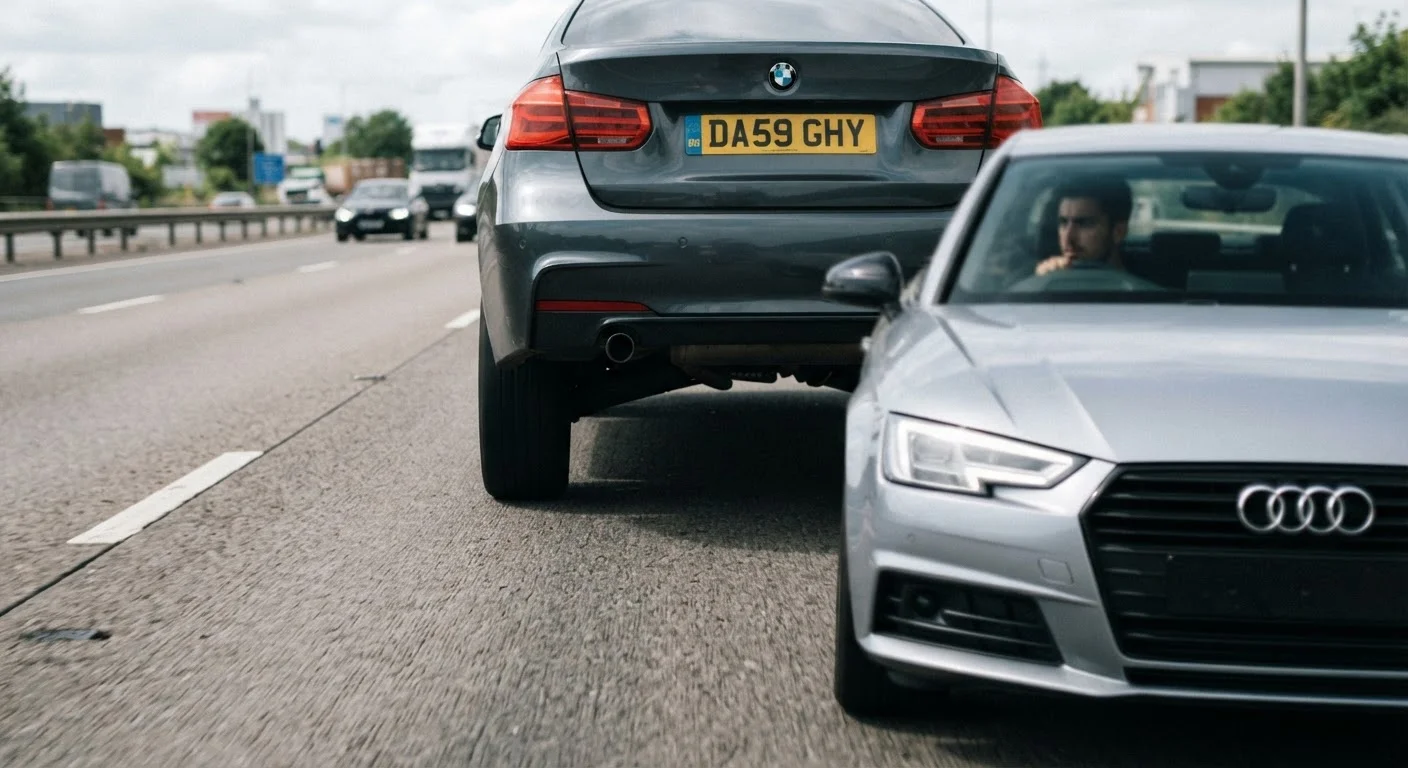
The Physics Behind Why Gaps Disappear
Most drivers underestimate how fast a safe cushion of space can vanish. At 60 mph, your vehicle is covering 88 feet every second. A standard reaction time for an alert driver is roughly 1.5 seconds - meaning your car travels approximately 132 feet before your foot even reaches the brake pedal. Add the braking distance on top of that, and the total stopping distance under good conditions regularly exceeds 240 feet.
The problem is that most people gauge gaps visually, and visual estimates at speed are notoriously unreliable. A gap that feels comfortable at 40 mph feels the same at 65 mph - but the physics are dramatically different. This mismatch between perception and reality is precisely why rear-end collisions happen so frequently even when drivers feel attentive.
~240 ft
Minimum stopping distance at 60 mph
Estimated total stopping distance under ideal dry-road conditions, combining average reaction distance and braking distance for a typical passenger vehicle.
2×
Braking distance increase on wet pavement
Wet roads can roughly double the distance required to stop compared to dry conditions, according to general road safety guidance from traffic safety organizations.
~29%
Of all U.S. crashes are rear-end collisions
Rear-end crashes consistently rank among the most common crash types nationally, based on data reported by the National Highway Traffic Safety Administration (NHTSA).
Conditions compound the risk. Wet pavement can double braking distance. Ice can increase it by four to ten times. Drivers who maintain the three-second rule in dry summer conditions and never adjust for winter roads are operating with an incomplete safety margin for a large portion of the year.
How the Three-Second Rule Works in Practice
The three-second rule is simple: watch for the vehicle ahead to pass a fixed reference point - a sign, a crack in the road, a bridge pillar - then count. If you reach that same point before you reach three seconds, you are following too closely. No calculation required, no speedometer check needed.
This method scales naturally with speed. At 30 mph, three seconds translates to roughly 132 feet. At 70 mph, it becomes about 308 feet. The rule adapts to your actual conditions rather than locking you into a fixed car-length estimate that fails at higher speeds.
Adjust Your Gap for Conditions, Not Just Speed
The three-second rule is a minimum for ideal conditions - clear skies, dry pavement, alert driving. Add at least one extra second for rain, two or more for fog or ice. If you are driving at night or fatigued, extend your gap further still, since reaction times lengthen when visibility or alertness decreases. Night driving particularly rewards a larger cushion.
For rain, fog, or heavy traffic, a four-to-six-second gap is more appropriate. Large commercial trucks also deserve extra following distance - their braking distance is significantly longer than a passenger vehicle's, and their size can obstruct your view of road hazards ahead. Understanding how to read the full road environment is a core part of defensive driving.
Why Tailgating Persists - and What It Costs
Tailgating is rarely calculated aggression. More often, it is a product of routine complacency - the same overconfidence that leads drivers to misjudge familiar stretches of road. Experienced drivers are actually more susceptible to this pattern, not less, because familiarity reduces perceived risk. This is explored in depth in the context of overconfidence behind the wheel.
The costs are measurable. According to the National Highway Traffic Safety Administration (NHTSA), rear-end crashes are consistently among the most frequent collision types on U.S. roads, representing hundreds of thousands of incidents annually. Many result in whiplash injuries, property damage, and insurance claims that could have been entirely avoided with a larger gap.
There is also a time-cost myth worth addressing: drivers often tailgate because they feel it will get them where they are going faster. In practice, maintaining a proper following distance adds only seconds to a typical commute while eliminating the risk of being the at-fault driver in a crash that could cost hours, thousands of dollars, or much worse.
Building safer gap habits is not about driving slowly - it is about driving with accuracy. Combined with attention to distracted driving risks and lane-change awareness, consistent following distance is one of the simplest and highest-impact habits any driver can develop.
Frequently Asked Questions
The three-second rule is the standard recommendation for dry conditions: pick a fixed object and ensure at least three seconds pass between when the car ahead passes it and when you do. In rain, fog, or on ice, increase that gap to four to six seconds or more. Speed alone doesn't determine a safe gap - road and weather conditions matter just as much.
Yes. Every U.S. state has laws requiring drivers to maintain a reasonable and prudent following distance. While exact language varies by state, following too closely is a ticketable offense. In a collision, a driver who was tailgating is typically found at fault under the principle that the trailing vehicle had a duty to maintain a safe gap.
Familiarity with a route or confidence in one's reflexes can create a false sense of control. Research into driver behavior consistently shows that overconfidence - not malice - is the most common reason experienced drivers underestimate gap requirements. The brain adapts to familiar situations and can downplay risk that feels routine.
It still matters significantly. At 30 mph, a driver with an average reaction time of 1.5 seconds will travel roughly 66 feet before braking even begins. Add braking distance and the total stopping distance can exceed 100 feet. Urban and suburban tailgating is common and genuinely dangerous.
Avoid braking suddenly or engaging with the driver. Where safe and legal, move to a different lane to allow them to pass. If you cannot change lanes, gradually reduce your speed to create more space between you and the vehicle ahead - this gives you more time to slow down gently and reduces the chance of a chain-reaction collision.
The content provided on our blog site traverses numerous categories, offering readers valuable and practical information. Readers can use the editorial team’s research and data to gain more insights into their topics of interest. However, they are requested not to treat the articles as conclusive. The website team cannot be held responsible for differences in data or inaccuracies found across other platforms. Please also note that the site might also miss out on various schemes and offers available that the readers may find more beneficial than the ones we cover.