

Our Verdict
No single transmission type wins outright - the right choice depends entirely on how and where you drive. Automatics remain the practical default for most American drivers, while manuals reward enthusiasts, CVTs suit fuel-conscious commuters, and dual-clutch units appeal to those who want performance without a clutch pedal.
| Best for | Recommended |
|---|---|
| Drivers who want maximum control and lowest upfront cost | Manual |
| Everyday commuters and families who want simplicity and reliability | Automatic |
| High-mileage commuters prioritising fuel economy | CVT |
| Performance-minded drivers who prefer paddle-shift convenience | Dual-Clutch |
Why Your Transmission Type Actually Matters
The transmission is the mechanical bridge between your engine and your wheels. It manages gear ratios so your engine stays in an efficient power range whether you're merging onto a highway or creeping through a school zone. The type of transmission in your car shapes how it feels to drive, how much it costs to maintain, and how much you'll spend if something goes wrong.
Most American drivers don't choose a transmission so much as inherit one - it comes with the vehicle they buy. But understanding what you have (or are shopping for) removes a significant source of automotive confusion. Here's what sets each type apart.
| Manual | Automatic | CVT | Dual-Clutch | |
|---|---|---|---|---|
| Driver input required | High (clutch + gear selection) | None | None | Optional (paddle shifters) |
| Fuel efficiency | Good | Good to very good | Very good | Very good |
| City driving comfort | Tiring in heavy traffic | Very comfortable | Comfortable | Can feel jerky |
| Typical repair cost | Lower | Moderate to high | High | Moderate to high |
| Availability in new vehicles | Declining rapidly | Very common | Common | Less common |
| Performance feel | Engaging, driver-led | Smooth, refined | Disconnected at times | Fast, responsive |
Manual Transmission: The Driver's Original Interface
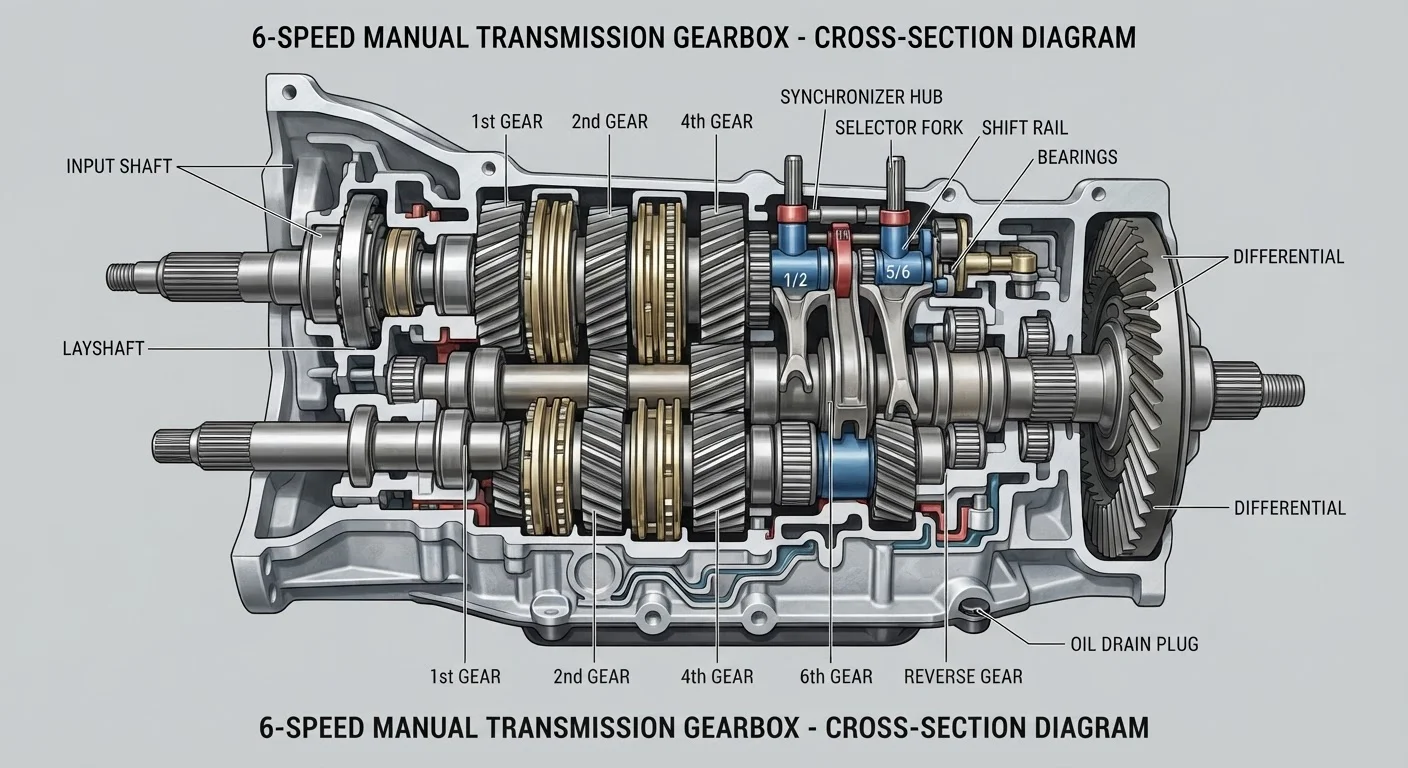
A manual transmission (also called a stick shift or standard) requires the driver to operate a clutch pedal and physically select gears via a shift lever. This gives the driver complete control over when gear changes happen - a feature many enthusiasts value highly. Mechanically, manuals are relatively simple compared to their automatic counterparts, which can translate to lower repair costs when issues do arise.
The tradeoffs are real, though. Learning to drive a manual takes time and practice, and stop-and-go city traffic can be fatiguing. Manual transmissions have also become increasingly rare in the US market - most new vehicles don't offer them, which limits your options. If you drive one, check your owner's manual for the correct clutch fluid and gear oil specifications, since using the wrong fluid can quietly cause damage.
Match Your Transmission to Your Driving Habits
Before deciding which transmission suits you, think honestly about where you spend most of your driving time. Frequent stop-and-go commuters will find an automatic or CVT far less tiring than a manual. Highway drivers who rarely sit in traffic may barely notice the difference between types. Your daily route matters more than manufacturer marketing claims.
Automatic Transmission: The American Default
The traditional automatic transmission uses a torque converter and a set of planetary gear sets to shift gears without any input from the driver. Modern automatics typically have six to ten speeds, making them far more efficient than earlier four-speed designs. They're smooth, intuitive, and well-suited to the wide variety of road conditions American drivers face daily.
Maintenance is the key responsibility with automatics. Transmission fluid degrades over time and, if neglected, can accelerate wear inside the unit dramatically. Our guide to car fluids and what happens when they run low explains what ignoring transmission fluid actually does to your drivetrain. Repair costs for automatic transmissions are higher than for manuals, but reliability has improved substantially in modern vehicles when properly serviced.
CVT: Efficiency Over Everything
A continuously variable transmission (CVT) uses a belt and pulley system to provide a theoretically infinite range of gear ratios - rather than fixed steps. This keeps the engine operating in its most efficient range almost constantly, which is why CVT-equipped vehicles frequently post strong fuel economy numbers.
The driving experience is polarising. CVTs can produce a sensation called "rubber-band effect" during hard acceleration - the engine revs rise quickly while vehicle speed catches up more gradually. This disconnect bothers some drivers considerably. CVTs also have a reputation for higher repair costs than traditional automatics, and replacement units can be expensive. They perform best in vehicles driven primarily in city and suburban conditions at moderate speeds.
~96%
New US cars sold with automatic transmissions
Industry sales data consistently shows that the vast majority of new vehicles sold in the United States have some form of automatic transmission, including CVTs and DCTs.
3-5 years
Typical CVT warranty period from manufacturers
Many automakers offer extended powertrain warranties specifically for CVT-equipped vehicles, reflecting higher consumer concerns about long-term reliability.
Dual-Clutch Transmission: Performance Logic, Real-World Quirks
A dual-clutch transmission (DCT) uses two separate clutch packs - one for odd-numbered gears, one for even - allowing it to pre-select the next gear before you've finished the current shift. The result is extremely fast, seamless gear changes with minimal power interruption. DCTs are common in performance-oriented vehicles and some fuel-efficient small cars.
The engineering trade-off shows up in low-speed driving. DCTs can feel jerky or hesitant in parking lots and bumper-to-bumper traffic because their clutch logic wasn't optimised for those conditions. Early DCT designs also had reliability concerns in some models, though more recent engineering has addressed many of these issues. Like all transmissions, they require specific fluid service intervals - checking the manufacturer's schedule matters. For context on how your vehicle's systems interconnect, understanding your drivetrain setup alongside your transmission type helps you build a complete picture of how power reaches your wheels.
Don't Skip Transmission Fluid Service
All four transmission types rely on clean, properly specified fluid to function correctly. Skipping fluid changes - or using the wrong fluid - is one of the most common causes of premature transmission failure. Repair or replacement costs for any modern transmission can run into the thousands of dollars. Always follow the interval and fluid specification listed in your owner's manual, not a generic rule of thumb.
The content provided on our blog site traverses numerous categories, offering readers valuable and practical information. Readers can use the editorial team’s research and data to gain more insights into their topics of interest. However, they are requested not to treat the articles as conclusive. The website team cannot be held responsible for differences in data or inaccuracies found across other platforms. Please also note that the site might also miss out on various schemes and offers available that the readers may find more beneficial than the ones we cover.